
How Is CGT on Investment Property Calculated in Australia?

When you sell an investment property in Australia for more than you paid for it, the Australian Taxation Office (ATO) requires you to pay tax on the profit. This is known as Capital Gains Tax (CGT).
Understanding how CGT works is crucial for any property investor. It’s a common misconception that CGT is a separate tax; it is not. Instead, the net capital gain you make is added to your assessable income for the financial year, and you are taxed at your marginal tax rate.
Failing to calculate your CGT correctly or maintain proper records can lead to significant compliance risks. The ATO has sophisticated data-matching systems that track property sales, and errors can result in:
Unexpected Tax Bills: A miscalculation can leave you with a much larger tax debt than you budgeted for.
ATO Audits: Discrepancies between your reported figures and official records can trigger a formal audit.
Significant Penalties: Incorrectly reporting a capital gain can attract administrative penalties and interest charges from the ATO.
The Essentials of CGT for Investment Properties
Think of Capital Gains Tax as the tax on the profit you make from disposing of a capital asset, such as a rental property. A firm grip on the rules is your first line of defence against a surprise tax bill and compliance issues with the ATO.
The Key Date in Australian CGT History
One of the most fundamental concepts in Australian CGT is the acquisition date of your property. The rules changed entirely on 20 September 1985, when the current capital gains tax system was introduced.
This date divides properties into two categories:
Pre-CGT Assets: Any property acquired before 20 September 1985 is generally exempt from CGT.
Post-CGT Assets: Any property acquired on or after 20 September 1985 is subject to CGT when a CGT event occurs.
While this seems straightforward, be cautious. A pre-CGT property is not always exempt. If you make major capital improvements to it after the 1985 cut-off, a portion of your profit may become taxable. You can find more information on the history of capital gains tax in Australia on Wikipedia, which must be read with reference to official ATO guidance.
What Triggers a CGT Event?
A "CGT event" is the specific action that triggers a potential tax liability. For property investors, this most commonly occurs when you sell the property.
However, a sale is not the only trigger. A CGT event can also happen if you gift the property, if it is destroyed (e.g., in a fire and you receive an insurance payout), or if it is compulsorily acquired by a government authority.
For tax purposes, the most important date is the contract date—the day you sign the contract of sale—not the settlement date. This is critical as it determines the financial year in which your capital gain or loss must be reported.
Calculating Your Capital Gain or Loss: A Step-by-Step Guide
Working out the capital gain on your investment property is more complex than simply subtracting the purchase price from the sale price. The Australian Taxation Office (ATO) requires a specific calculation method based on two key figures: your capital proceeds and the property's cost base.
Getting this calculation right is non-negotiable for accurate CGT reporting and ATO compliance. It requires meticulous record-keeping of every eligible expense, from the moment of acquisition until the day of disposal. Every dollar you correctly include in the cost base is a dollar of profit you do not have to pay tax on.
Step 1: Determine Your Capital Proceeds
First, you must identify your capital proceeds. This is the total amount of money or the value of any other assets you receive from the CGT event.
In a typical property sale, this is the sale price stipulated in the contract. However, it can also include other payments or assets received as part of the transaction, so ensure you account for everything.
Step 2: Calculate the Cost Base
The cost base is the cornerstone of your CGT calculation. It represents the total cost of acquiring, holding, and disposing of your investment property. The ATO defines the cost base in five distinct elements, and it is in your financial interest to capture every eligible expense.
For a comprehensive breakdown, refer to our detailed guide on capital gains tax calculation in Australia.
The image below provides a simple visual of how a property sale triggers a CGT event and a tax obligation.
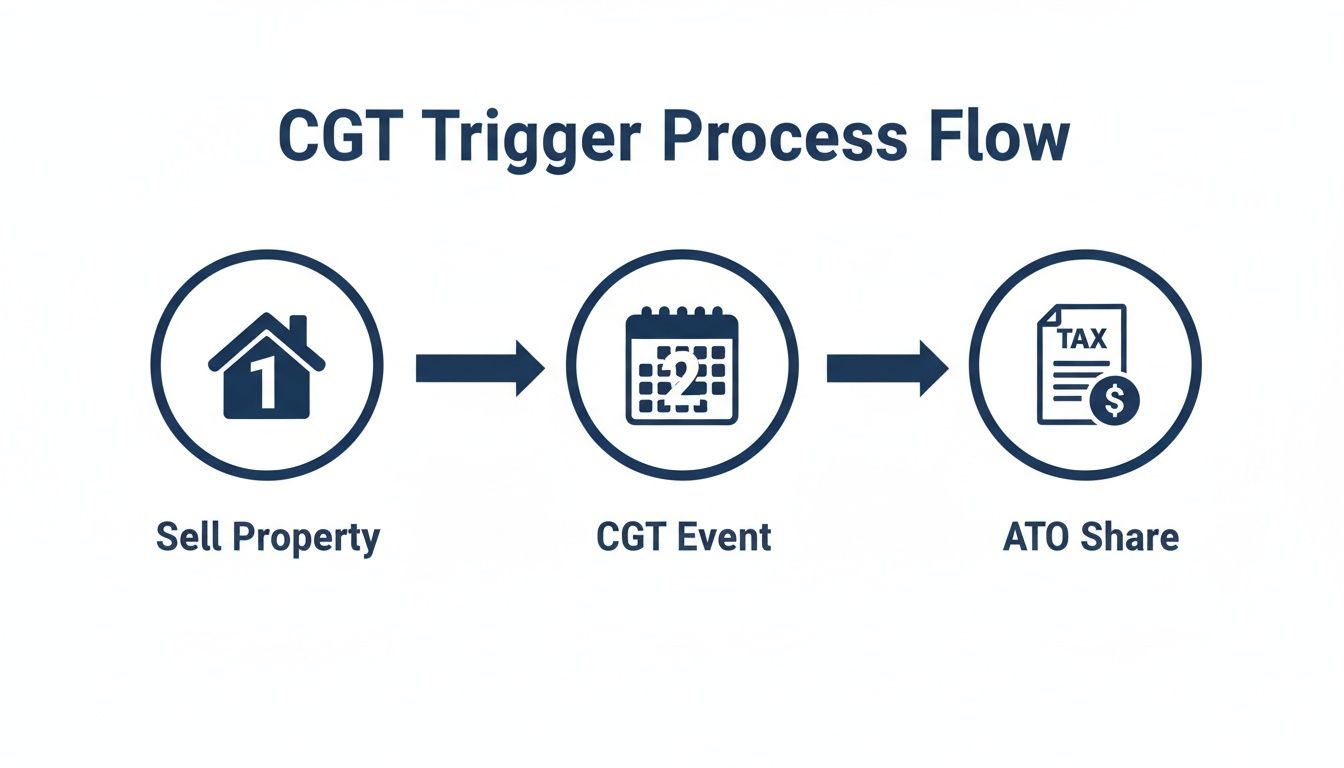
As shown, the sale is the trigger. Once that CGT event occurs, the ATO is entitled to a share of the profit.
The cost base is broken down into five key elements.
The 5 Elements of an Investment Property's Cost Base
The ATO defines five specific elements that constitute a property's cost base. Understanding and tracking each is crucial to accurately calculating your capital gain and ensuring you do not overpay tax.
Cost Base Element | Description | Examples |
|---|---|---|
Element 1: Acquisition Costs | The money paid or property given to acquire the asset. | Purchase price, valuation fees related to the purchase. |
Element 2: Incidental Costs | Direct costs associated with buying and selling the property. | Stamp duty, legal fees, agent commissions, advertising costs. |
Element 3: Costs of Owning | Non-deductible costs of holding the property over time. | Council rates, land tax, insurance (only if not claimed as a deduction against rental income). |
Element 4: Capital Improvements | Costs incurred to increase the property's value or add to its structure. | Kitchen/bathroom renovations, extensions, adding a deck. |
Element 5: Title Costs | Expenses incurred to establish, preserve, or defend your ownership rights. | Legal fees to resolve a boundary dispute. |
Tracking these costs diligently is essential. While you may consider strategies for rental renovations that can impact your property's value, ensure they meet the ATO’s definition of a capital improvement to be included in the cost base.
A critical ATO rule: You generally cannot include any cost in the cost base if you have already claimed it as a tax deduction. This prevents "double-dipping." For example, if you deducted council rates against your rental income each year, you cannot also add them to your cost base when you sell.
Step 3: Calculate the Capital Gain or Loss
With your capital proceeds and total cost base determined, the final calculation is straightforward.
Capital Gain = Capital Proceeds - Cost Base
If your capital proceeds are greater than your cost base, you have a capital gain. If your cost base exceeds your capital proceeds, you have a capital loss.
A capital loss cannot be used to offset other income (like your salary). However, it can be carried forward indefinitely to reduce capital gains you make in future financial years.
This three-step process provides your gross capital gain or loss. The next step is to determine if you are eligible for any discounts or concessions that can reduce the final amount included in your assessable income.
How to Legally Reduce Your CGT Liability
Paying tax on the profit from your investment property is a legal requirement, but you should not pay more than necessary. The Australian Taxation Office (ATO) provides several legitimate concessions and exemptions. With careful planning, you can significantly reduce your final tax bill.
Most major savings come from strategic timing of your sale and correctly applying exemptions available for properties that were once your home.

The 50% CGT Discount
For most investors, the most powerful tool for reducing CGT is the 50% CGT discount.
The rule is simple: if you are an Australian resident (individual or trust) and have owned the investment property for at least 12 months before the CGT event, you can reduce your taxable capital gain by half. This means only 50% of the gain is added to your assessable income. Companies are not eligible for this discount.
The financial impact of this discount is substantial. According to the Parliamentary Budget Office, the CGT discount on residential investment properties cost the government $5.4 billion in forgone revenue in the 2021-22 financial year. When combined with negative gearing, this figure rose to over $8.6 billion.
Important Condition: The 12-month ownership period starts from the contract date for the purchase and ends on the contract date for the sale. Using settlement dates is a common error that can disqualify you from the discount.
The Main Residence Exemption
Your own home—your main residence—is generally exempt from CGT. Any profit made from selling the property you live in is usually tax-free.
However, the situation becomes more complex when a property has served as both your home and an investment. If you lived in the property before renting it out, you may be eligible for a partial exemption. The ATO requires you to apportion the capital gain based on the periods it was your main residence versus the periods it was used to produce income.
The Six-Year Absence Rule
A valuable provision often overlooked is the "six-year absence rule." This allows you to move out of your main residence, rent it out, and continue to treat it as your main residence for CGT purposes for up to six years.
This is particularly useful if you need to relocate for work or personal reasons but intend to move back. You can earn rental income for up to six years without forfeiting the full main residence exemption upon sale.
The critical condition is:
You cannot treat any other property as your main residence during that same period (the ATO allows a brief overlap when moving between homes, but this is limited).
Other Concessions and Considerations
While the 50% discount and main residence rules are the most common, other strategies can help reduce your CGT on investment property:
Small Business CGT Concessions: If your property was an "active asset" used in your small business, a suite of four generous concessions may apply to reduce, defer, or even eliminate your capital gain.
Affordable Housing Discount: You may be eligible for an additional CGT discount of up to 10% if you have provided affordable rental housing to people on low to moderate incomes.
Negative Gearing: While not a CGT concession, negative gearing allows you to deduct net rental losses against your other income. For more information, see our guide on mastering negative gearing tax benefits in Australia.
Tax laws differ globally, but the principle of leveraging deductions is universal. For comparison, you can explore other systems, like these U.S. Short Term Rental Tax Deductions, to broaden your understanding of property tax principles. Navigating these rules requires careful planning and a solid grasp of the ATO's strict criteria to maintain compliance.
Practical Example: A Step-by-Step CGT Calculation
Theory is useful, but a practical example demonstrates how the numbers work. Let's walk through a real-world CGT calculation for a typical Australian investment property to show how the different components fit together.
This scenario illustrates how to correctly calculate the cost base, apply relevant discounts, and determine the final taxable amount for your CGT on investment property.
The Scenario: An Investor's Journey
Olivia, an Australian resident for tax purposes, bought an investment property in Sydney 15 years ago and has decided to sell. She has kept meticulous records of every expense.
Let's break down her journey and calculate her CGT liability.
Purchase Date: 1 July 2009
Sale Contract Date: 30 August 2024
Ownership Period: Over 15 years, which makes her eligible for the 50% CGT discount.
Step 1: Calculating the Cost Base
The first and most critical step is to construct Olivia’s cost base. This includes not just the purchase price but all eligible capital costs she incurred to buy, hold, improve, and sell the property. These costs must be distinguished from the day-to-day running expenses she would have claimed as tax deductions each year.
Here is a breakdown of her costs:
Expense Category | Description | Amount |
|---|---|---|
Purchase Price | The amount paid to acquire the property. | $500,000 |
Stamp Duty | State government tax on the property transfer. | $18,000 |
Legal Fees (Purchase) | Conveyancing costs for the initial purchase. | $2,500 |
Kitchen Renovation | A major capital improvement to increase value. | $25,000 |
Deck Addition | A structural addition to the property. | $15,000 |
Agent's Commission (Sale) | Fee paid to the real estate agent upon selling. | $22,000 |
Legal Fees (Sale) | Conveyancing costs for the sale process. | $2,500 |
Total Cost Base | $585,000 |
Olivia correctly excluded items like council rates, insurance, and loan interest from her cost base because she claimed these as annual deductions against her rental income. For more on annual claims, see our guide to rental property tax deductions.
Step 2: Determining the Capital Proceeds
Next, we identify Olivia's capital proceeds. This is the selling price listed on the contract of sale, before any selling costs are deducted.
Sale Price: $950,000
Step 3: Calculating the Capital Gain
Now, we calculate Olivia's total capital gain by subtracting her cost base from her capital proceeds.
Total Capital Gain = Capital Proceeds - Cost Base $950,000 - $585,000 = $365,000
This $365,000 is Olivia's gross capital gain. Because she owned the property for more than 12 months, she is eligible for a significant tax reduction.
Step 4: Applying the 50% CGT Discount
As an Australian resident who held the asset for over a year, Olivia can apply the 50% CGT discount. This step halves her taxable gain.
Discounted Capital Gain: $365,000 x 50% = $182,500
This final figure of $182,500 is her net capital gain. This is the amount Olivia must add to her other assessable income (e.g., her salary) for the 2024-2025 financial year. The total amount will then be taxed at her individual marginal tax rate.
This example highlights how diligent record-keeping and a clear understanding of the rules lead to an accurate and optimised tax outcome.
Special CGT Rules and Circumstances
Capital Gains Tax is not always a straightforward calculation. Life events like being a foreign resident, inheriting a property, or experiencing a relationship breakdown introduce unique tax rules. All property investors must be familiar with these scenarios to remain compliant with the Australian Taxation Office (ATO).
These circumstances can fundamentally change how CGT is calculated and which exemptions are available. Errors can lead to significant tax bills and ATO penalties.
Rules for Foreign Residents
For foreign residents owning Australian property, the CGT landscape has changed significantly, particularly regarding the main residence exemption.
For properties sold after 30 June 2020, foreign residents are generally no longer eligible to claim the main residence exemption. This is a major change, as it could make the entire capital gain taxable, even if the property was your home for many years.
Very limited exceptions apply, usually linked to specific life events. If you were a foreign resident for a continuous period of six years or less and experienced a specific event (such as a terminal medical diagnosis or the death of a spouse), you may still be able to claim the exemption.
Foreign Resident Capital Gains Withholding
Another critical component is the Foreign Resident Capital Gains Withholding (FRCGW). This is not a tax but a prepayment mechanism to ensure foreign residents meet their tax obligations.
If a foreign resident sells Australian real estate with a market value of $750,000 or more, the buyer is legally required to withhold 12.5% of the purchase price and remit it to the ATO. The seller can then claim this amount as a credit when they lodge their Australian income tax return.
FRCGW is applied automatically unless the seller obtains a clearance certificate from the ATO before settlement, proving they are an Australian resident for tax purposes. It is the vendor's responsibility to manage this; otherwise, a significant portion of their sale proceeds will be withheld.
Inherited Properties and CGT
Inheriting a property also involves specific CGT rules. The tax outcome depends on several factors:
Date of Death: Whether the deceased passed away before or after 20 September 1985 (when CGT was introduced).
Property Use: Whether it was the deceased's main residence and how the beneficiary uses it.
Acquisition Date: When the deceased originally acquired the property.
As a general rule, if the inherited property was the deceased's main residence just before their death and you sell it within two years, you may be fully exempt from CGT. For more details, see our guide on how to use the main residence exemption and the 6-year rule.
CGT and Relationship Breakdowns
When a marriage or de facto relationship ends, the transfer of assets like property between spouses may be eligible for "rollover relief." This allows a property to be transferred from one partner to another without triggering an immediate CGT event.
Instead of being taxed at the time of transfer, the CGT liability is deferred until the receiving partner eventually sells the property. The original cost base also transfers to the new owner, ensuring the full capital gain is accounted for at the final sale.
Your Essential Guide to Record Keeping and ATO Compliance
Flawless record-keeping is your best defence. For Capital Gains Tax, organised documentation is the foundation for an accurate calculation and for staying compliant with the Australian Taxation Office (ATO). This is not just about organisation; it is a legal requirement that directly impacts your tax liability.
Without adequate records, you could overpay CGT or be unable to substantiate your claims during an ATO audit. The ATO uses powerful data-matching technology to monitor property sales, cross-referencing information from state revenue offices and financial institutions to identify inconsistencies. This makes meticulous record-keeping more important than ever.

Your Non-Negotiable Record Keeping Checklist
To correctly calculate your CGT and satisfy the ATO, you must keep detailed records for at least five years after the financial year in which you lodge the tax return for the sale.
Here is a practical checklist of essential documents:
Acquisition & Sale Documents: The original purchase and sale contracts are non-negotiable for establishing CGT event dates.
Incidental Costs: Keep all receipts for expenses like stamp duty, legal fees, and real estate agent commissions. These are added to your cost base.
Capital Improvements: Retain invoices for any new kitchens, extensions, or other structural upgrades. These are key components of your cost base.
Proof of Ownership: Keep any documents related to defending your title to the property.
Main Residence Evidence: If the property was ever your home, documents like utility bills or electoral roll details are needed to prove the specific periods it was your main residence.
A simple ATO rule: you must be able to substantiate every figure used in your CGT calculation. If you cannot produce a record for an expense, you generally cannot include it in your cost base, which could result in a higher tax bill. For a deeper dive, check our insights on tax record keeping.
FAQ: Common Questions on CGT for Investment Property
When does the CGT event happen for a property sale?
The CGT event occurs on the date you sign the contract of sale, not the settlement date. According to the ATO, this determines the financial year your capital gain or loss must be reported in. For example, a contract signed in June with a settlement in August belongs to the financial year ending 30 June.
Can I use losses from other investments to reduce my property capital gain?
Yes. The ATO allows you to offset capital gains with capital losses from the same financial year. If your total losses exceed your total gains, you have a net capital loss. This loss cannot be deducted from other income (like a salary) but can be carried forward indefinitely to offset capital gains in future years.
How is CGT calculated if I lived in the property before renting it out?
If your investment property was previously your main residence, you will generally be eligible for a partial main residence exemption. The capital gain is usually apportioned based on the periods the property was your home versus the periods it was used to produce income. You may also be able to apply the 'six-year rule' to extend the exemption period.
Can I add the cost of a property valuation to my cost base?
Only in specific circumstances. The ATO permits including valuation costs in your property's cost base if the valuation was required to calculate the cost base itself. Common examples include a valuation for an inherited property or a valuation when a main residence is first used to produce income. Valuations for insurance or refinancing are generally not included.
Summary: Key Takeaways
CGT is Not a Separate Tax: Your net capital gain is added to your assessable income and taxed at your marginal rate.
Calculation is Key: Capital Gain = Capital Proceeds - Cost Base. A negative result is a capital loss.
The 12-Month Rule: Holding an asset for over 12 months makes you eligible for the 50% CGT discount (for individuals and trusts).
Record Keeping is Non-Negotiable: You must keep detailed records of all costs for at least five years after the sale to substantiate your cost base and comply with ATO requirements.
Special Rules Apply: Situations like being a foreign resident, inheriting property, or relationship breakdowns have unique CGT implications that require careful consideration.
Get Professional Tax Advice
Navigating Capital Gains Tax on investment properties requires careful planning and expert advice. To ensure compliance and maximise any available concessions, it is wise to consult a professional.
Contact Baron Tax and Accounting today for expert guidance tailored to your specific situation.
Baron Tax and Accounting
Website: https://www.baronaccounting.com
Email: info@baronaccounting.com
Phone: +61 1300 087 213
Whatsapp: 0450468318
Line: Barontax
Comments