
How to Use the Main Residence Exemption 6-Year Rule to Reduce Tax

The Australian Taxation Office (ATO) main residence exemption 6-year rule is a significant tax provision allowing you to treat a former home as your main residence for up to six years after moving out. Correctly applying this rule can mean you pay zero Capital Gains Tax (CGT) when you sell the property.
Understanding this rule is critical for any homeowner who needs to relocate temporarily for work, family, or travel. Misinterpreting the conditions can lead to significant tax liabilities and ATO penalties, while failing to use it when eligible means unnecessarily overpaying tax. This guide provides clear, step-by-step instructions based on current ATO regulations.
Understanding the 6-Year Rule and Why It Matters
Life is unpredictable. A new job interstate, an overseas travel opportunity, or the need to care for a family member might require you to move out of your home. If you decide to rent it out, the prospect of a large CGT bill upon selling can be a major concern.
The ATO's 6-year rule was designed for these exact situations. It allows your former home to retain its tax-free status for up to six years, even while it generates rental income. This provides valuable flexibility without an immediate financial penalty.
The Core Concept Explained
The rule acknowledges that a person's primary home may temporarily change without them intending to relinquish it as their main residence. However, the ATO enforces strict conditions:
Initial Occupancy: The property must have been your genuine main residence before you started renting it out.
One Residence Only: You cannot claim another property as your main residence during the same period of absence.
The six-year period begins on the first day the property is made available for rent. If you meet these criteria and sell within the six years, the capital gain can be fully exempt from CGT.
Why Is This Rule So Important?
Correctly applying this rule is essential for sound financial planning and tax compliance. An incorrect claim can trigger an ATO audit, resulting in back-dated tax, interest, and penalties. Conversely, not claiming the exemption when you qualify is a missed opportunity to save thousands of dollars in tax. The financial stakes are high, making a thorough understanding of the rules crucial.
For a deeper dive into the broader topic, our comprehensive guide to the CGT exemption for a main residence covers all the essential details you need to know.
How to Qualify for the 6 Year Rule Exemption
The 6-year rule is one of the most generous tax concessions available to property owners, but eligibility is not automatic. To benefit, you must adhere strictly to the ATO's specific requirements. Meeting these criteria can be the difference between a tax-free sale and a substantial CGT liability.
The foundational principle is that the property must have been your genuine home before it was used to produce income. You cannot purchase a property, rent it out immediately, and then retroactively apply the main residence exemption to avoid tax.
The Initial Main Residence Test
First, you must establish with the ATO that the property was your genuine home. This requires more than just holding the title; it involves proving the property was the centre of your domestic life.
To satisfy this test, you will need to provide evidence, such as:
Proof that you and your family physically lived there.
Confirmation that your personal belongings were kept at the property.
Mail addressed to you at that address, including your listing on the electoral roll.
Utility accounts (e.g., electricity, gas, internet) connected in your name.
The more comprehensive your evidence, the stronger your position will be in the event of an ATO review.
This flowchart breaks down the decision-making process when you’re figuring out if the 6-year rule applies to your situation.Essentially, the moment you rent out your former home, a six-year countdown begins. If you sell within that window, you have a clear path to a potential tax-free gain.
The Critical "No Other Main Residence" Rule
This is the most common point of failure. While using the 6-year absence rule for one property, you cannot treat any other property you own as your main residence. This applies to properties anywhere in Australia or overseas.
For tax purposes, an individual can only have one main residence at a time. Attempting to claim the exemption on two properties simultaneously is a direct violation of ATO rules and will disqualify your claim on the first property.
If you purchase and move into a new home, you must choose which property will receive the main residence exemption for the overlapping period.
Eligibility Checklist for the 6 Year Rule
Use this checklist to see if you meet the ATO's criteria for applying the 6-year main residence exemption.
Requirement | Met (Yes/No) | Key ATO Consideration |
|---|---|---|
Initial Residence | Was the property genuinely your main residence before it produced income? | |
No Other Main Residence | Have you nominated another property as your main residence during the absence period? | |
Foreign Residency | Were you an Australian resident for tax purposes at the time of signing the sale contract? | |
Income-Producing | Did the absence period during which you earned income exceed 6 years in total? |
This table helps you quickly spot any potential issues with your eligibility before you make a decision.
Income-Producing vs. Non-Income-Producing Absences
A crucial distinction exists between absences where the property is rented out versus when it is left vacant.
Income-Producing Absence: The 6-year clock starts on the day the property is first available for rent. The clock resets each time you move back in and re-establish the property as your main residence. This feature is highly beneficial for individuals who undertake multiple temporary relocations.
Non-Income-Producing Absence: If you move out but do not rent the property, the six-year limit does not apply. You can continue treating it as your main residence indefinitely, provided you do not nominate another property as your main residence.
This means leaving your home vacant for an extended period will not exhaust your six-year allowance. Understanding this rule is vital for effective long-term tax planning.
Real World Examples of the 6 Year Rule in Action
Applying tax law to practical scenarios clarifies its impact. The following examples demonstrate how the main residence exemption 6-year rule functions for individuals and families in common situations, including the tax consequences of exceeding the six-year limit.
These scenarios illustrate potential Capital Gains Tax (CGT) savings and the calculation methodology when a full exemption is not available.

Example 1: The Interstate Work Assignment
Sarah, an IT consultant, purchased her Melbourne apartment for $500,000 on 1 July 2017 and lived in it as her main residence.
On 1 July 2021, she accepted a four-year contract in Sydney. She rented out her Melbourne apartment and moved into a rental property in Sydney, ensuring she did not purchase or nominate another property as her main residence.
Upon completing her contract on 30 June 2025, Sarah sold her Melbourne apartment for $750,000, realising a capital gain of $250,000.
Timeline: Lived in the property from 2017–2021 (4 years); rented it out from 2021–2025 (4 years).
6-Year Rule Application: Her absence of four years is within the six-year limit.
Tax Outcome: Sarah is eligible to apply the main residence exemption for the entire ownership period. The $250,000 capital gain is completely tax-free.
Example 2: The Family Moving for Schooling
The Miller family purchased their Brisbane home on 1 January 2016 for $600,000. They lived there until 1 January 2020, when they relocated to a regional town for their children's schooling.
They rented out their Brisbane house for five years while renting in the new town. On 1 January 2025, they sold the Brisbane home for $1,000,000, resulting in a $400,000 capital gain.
Timeline: Lived in from 2016–2020 (4 years); rented out from 2020–2025 (5 years).
6-Year Rule Application: The five-year absence falls within the six-year window.
Tax Outcome: The Millers can treat the house as their main residence for the entire nine-year ownership period. The $400,000 gain is fully exempt from CGT.
Example 3: Exceeding the Six-Year Limit
Liam purchased his house on 1 February 2013 for $400,000 and lived in it for two years. On 1 February 2015, he accepted a job overseas and rented out the property. He returned to Australia and sold the house on 1 February 2024 for $900,000, making a $500,000 capital gain.
Total Ownership Period: 11 years (Feb 2013 to Feb 2024).
Rental Period: 9 years (Feb 2015 to Feb 2024).
6-Year Rule Application: His rental period of nine years exceeds the six-year limit by three years.
Because Liam exceeded the six-year limit, he cannot claim a full exemption. A partial exemption applies. The capital gain must be apportioned between exempt and non-exempt days.
The ATO formula is:Taxable Gain = Total Gain x (Non-Exempt Days / Total Ownership Days)
The non-exempt period is the 3 years he rented the property after the initial 6-year absence period expired.
Total Ownership: 11 years.
Non-Exempt Period: 3 years.
Taxable Portion: (3 years / 11 years) = 27.27%
Assessable Capital Gain: $500,000 x 27.27% = $136,350.
Liam must declare a capital gain of $136,350. As he owned the property for more than 12 months and is an Australian resident for tax purposes, he is eligible for the 50% CGT discount, reducing his taxable gain to $68,175.
For a deeper dive into these calculations, check out our complete guide on Capital Gains Tax calculation in Australia.
How to Reset the 6-Year Rule for Multiple Absences
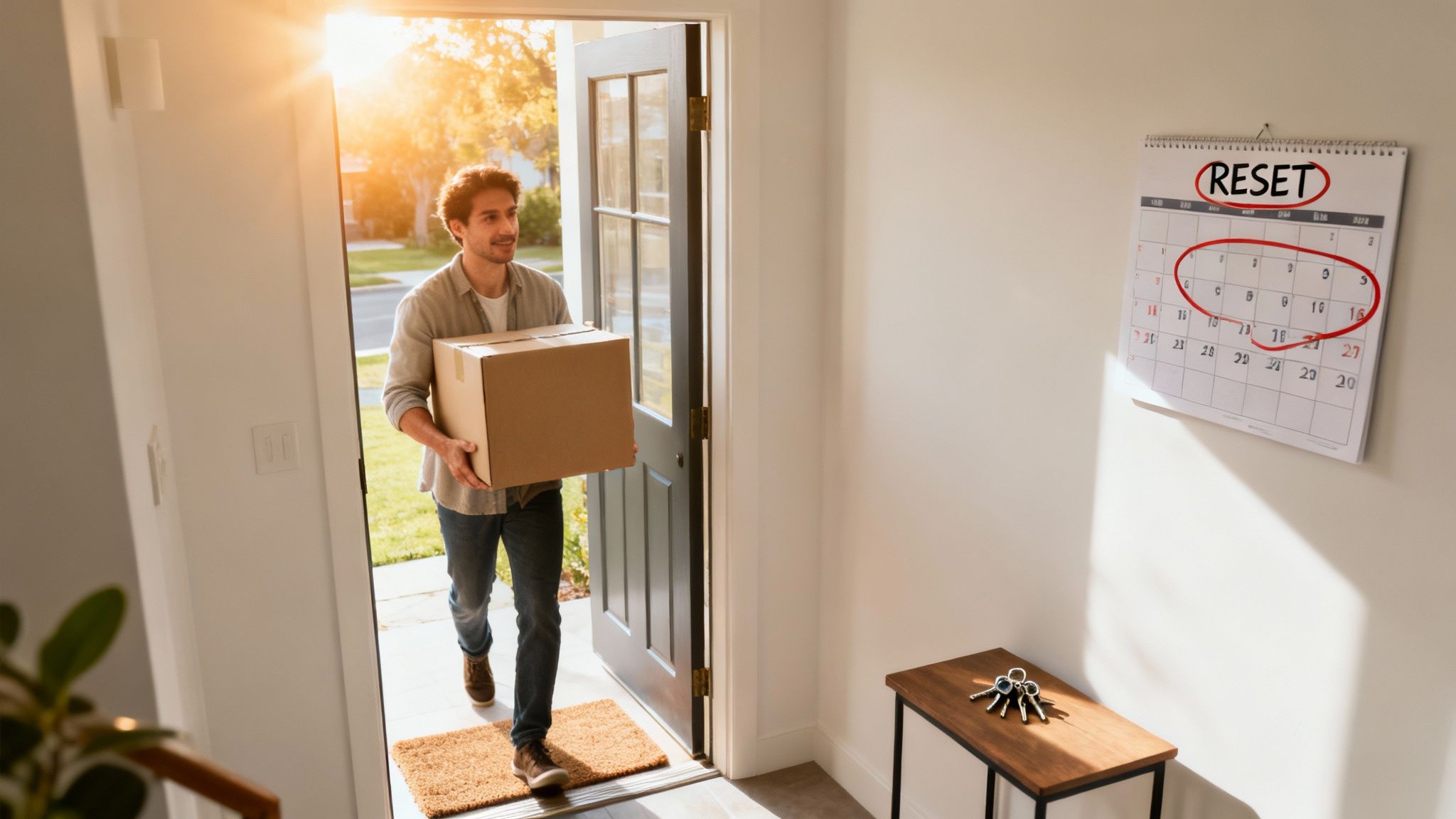
A powerful and often overlooked feature of the main residence exemption 6-year rule is its reset provision. It is not a single-use exemption. By moving back into the property and re-establishing it as your genuine main residence, you can reset the six-year clock for future absences.
This strategy offers significant flexibility for long-term property owners, particularly those whose careers involve periodic relocations. It allows for multiple tax-free absences over the life of the property, protecting substantial capital gains from CGT.
Proving You Have Genuinely Moved Back In
The ATO requires clear evidence that you have "re-established" the property as your main residence. A brief stay for a holiday is insufficient. You must demonstrate that the property has again become the centre of your domestic life.
To substantiate your claim, you need documented proof of your actions and intent. The ATO will look for evidence that you have:
Moved your personal belongings and furniture back into the home.
Updated your address on the Australian Electoral Roll.
Changed your address for your driver's licence and car registration.
Arranged for your mail to be delivered to the property.
Connected utilities (electricity, gas, internet) in your name.
Key Takeaway: The ATO assesses your genuine intention. Your actions must clearly demonstrate that the property has ceased being a rental and has become your home again, even if for a short but meaningful period.
Strategic Application of the Reset Rule
Understanding the reset rule enables powerful long-term tax planning.
Consider a professional who accepts a three-year interstate contract. They rent out their home, using three years of their six-year allowance. Upon returning, they live in the home for one year, re-establishing it as their main residence. If another contract opportunity arises, they can move out again, and a new six-year period begins. This allows for multiple tax-free absences, shielding significant capital growth from CGT.
Common Mistakes That Can Cost You Thousands
The main residence exemption 6-year rule is a valuable tax concession, but it is easy to misapply. A single error can invalidate your claim and result in a significant, unexpected tax assessment from the ATO. By understanding common pitfalls, you can apply the rule correctly and protect your assets.
Nominating Another Main Residence
This is the most critical error. While your original home is being rented out under the 6-year rule, you cannot treat another property you own as your main residence. The ATO is unequivocal: you are entitled to only one main residence for tax purposes at any given time.
If you purchase and move into a new property, you must make a choice. Claiming the new property as your main residence immediately breaks the 6-year rule for the old one. From that point, a portion of the capital gain on the first property becomes taxable.
Becoming a Foreign Resident for Tax Purposes
Recent changes to tax law have significantly impacted the main residence exemption for non-residents. If you are a foreign resident for tax purposes when you sign the contract of sale, you will generally lose your entitlement to the main residence exemption.
This means that even if you lived in the property for decades before moving overseas, the entire capital gain could be taxable. The 6-year rule will not apply. While very limited exceptions exist for certain life events occurring within six years of becoming a foreign resident, these are extremely narrow. Selling a property from overseas makes professional tax advice essential.
Misunderstanding How Partial Exemptions Work
The 6-year rule is not always an all-or-nothing exemption. If the property was used for mixed purposes—for example, renting out a room or running a business from a home office—you will likely only qualify for a partial exemption. The ATO requires you to apportion the capital gain based on the floor area used to produce income.
For instance, if 20% of your home's floor area was used exclusively for business purposes, then 20% of the capital gain will be subject to CGT. You cannot apply a full exemption to the entire property in this case.
Correctly calculating this apportionment is crucial for tax compliance. An incorrect calculation can lead to penalties. Our guide on how to avoid capital gains on property dives deeper into essential tips on this topic.
Making Major Renovations While Renting
Undertaking major renovations while the property is rented can complicate your CGT calculation. Minor repairs are generally tax-deductible against rental income. However, major renovations that add capital value become part of the property's "cost base."
If you are only entitled to a partial exemption (e.g., you exceed the six-year limit), these renovation costs are factored into the CGT calculation to reduce the taxable gain. However, if you successfully claim a full exemption, you receive no tax benefit for these capital expenditures. Meticulous record-keeping of all expenses is therefore mandatory.
FAQ Section
What records do I need to prove a property was my main residence?
To prove a property was your main residence, the ATO requires evidence showing it was the centre of your domestic life. Key documents include utility bills (electricity, gas), your address on the Australian Electoral Roll, driver's licence, car registration, bank statements, and other official correspondence sent to that address. The more varied and consistent the evidence, the stronger your claim. Refer to ATO guidelines on 'main residence' for detailed criteria.
Does the 6-year rule apply if I leave my property vacant?
Yes, and the rules are more generous. The six-year limit only applies when the property is used to produce income (i.e., rented out). If you move out and leave the property vacant, you can continue to treat it as your main residence indefinitely under the 'continuing main residence' rule, as long as you do not nominate another property as your main residence.
What happens if I move overseas permanently?
Becoming a foreign resident for Australian tax purposes has severe consequences for the main residence exemption. Under current legislation, you generally lose the entitlement to the main residence exemption if you are a foreign resident at the time you sign the sale contract. The 6-year rule becomes irrelevant, and the entire capital gain may be taxable. Professional tax advice is critical in this scenario.
Can I claim both the 6-year rule exemption and the 50% CGT discount?
Yes, they can be used together on the same property sale, but they apply to different portions of the capital gain. The 6-year rule makes a portion of the gain tax-free. The 50% CGT discount can then be applied to the remaining taxable portion of the gain, provided you are an Australian resident for tax purposes and have owned the asset for more than 12 months.
Summary
The main residence exemption and its 6-year rule are powerful tools for Australian property owners to minimise Capital Gains Tax. Correct application provides flexibility for temporary relocations without immediate tax consequences. However, strict adherence to ATO regulations is mandatory to avoid significant penalties.
Key Takeaways
Eligibility is Not Automatic: The property must be your genuine main residence before it is used to produce income.
One Main Residence Rule: You cannot claim another property as your main residence while applying the 6-year rule to a former home.
The 6-Year Clock: The six-year period only runs while the property is available for rent. If vacant, the exemption can continue indefinitely.
The Reset Provision: Moving back into the property and re-establishing it as your main residence resets the 6-year clock for future absences.
Foreign Residency: Becoming a foreign resident for tax purposes generally disqualifies you from claiming the main residence exemption.
Given the complexity of tax law and the high financial stakes, seeking personalised advice from a qualified tax professional is strongly recommended to ensure compliance and optimise your financial outcome.
Navigating the complexities of property tax and the main residence exemption 6-year rule requires a steady hand. The team at Baron Tax and Accounting is here to provide clear, accurate advice tailored to your specific circumstances. Ensure you are compliant and maximising your financial position by speaking with one of our specialists.
Website: https://www.baronaccounting.com
Email: info@baronaccounting.com
Phone: +61 1300 087 213
Comments