
What Should I Give My Staff This Holiday Season? 10 ATO-Compliant Ideas

The holiday season presents a perfect opportunity for employers to show appreciation, but navigating the complexities of Australian tax law can turn a thoughtful gesture into a compliance headache. Many business owners ask, 'what should I give my staff this holiday season?' without fully considering the implications for Fringe Benefits Tax (FBT), income tax deductions, and Goods and Services Tax (GST). A poorly chosen gift can create unintended tax liabilities for your business and, in some cases, even your employees. This is not merely about generosity; it's a matter of financial compliance governed by the Australian Taxation Office (ATO) and Fair Work Ombudsman. Key compliance risks include incorrectly claiming GST credits, failing to report FBT on entertainment gifts, and treating cash-convertible items as minor benefits, all of which can lead to penalties and audits.
This guide provides a comprehensive roundup of 10 thoughtful and popular gift ideas, meticulously analysed through the lens of Australian Taxation Office (ATO) regulations. We move beyond generic suggestions to provide actionable, tax-effective strategies for rewarding your team. You will find step-by-step guidance on how to select gifts that are not only meaningful but also structured to minimise FBT exposure and maximise potential tax deductions in line with current financial year rules. Understanding these rules is critical for managing your business's financial health, meeting your compliance obligations, and ensuring your holiday gestures foster genuine goodwill without incurring penalties.
1. Gift Cards (Retail, Dining, or Coffee)
Gift cards remain a popular choice, offering flexibility and simplicity. They empower employees to select something they truly want, respecting individual tastes while allowing the business to maintain strict budget control.
How It Works and Tax Implications
This approach involves purchasing prepaid cards from various retailers or dining establishments. The value can be tailored to your budget. From a tax perspective, non-entertainment gift cards are treated favourably under ATO rules.
Pros: High perceived value due to choice; easy to budget and distribute.
Cons: Can feel impersonal if not presented thoughtfully; some cards have restrictive terms.
ATO Rules: Non-entertainment gift cards (e.g., for a department store or supermarket) costing less than $300 (including GST) per employee are generally considered a 'minor benefit'. This makes them exempt from Fringe Benefits Tax (FBT), and the business can typically claim a tax deduction and the GST credit.
Compliance Risk: Gift cards that can be easily converted to cash (e.g., a universal Visa debit card) may be treated as cash by the ATO, making them subject to PAYG withholding and superannuation. Stick to cards for specific retailers.
Practical Examples
Sole Trader: Giving a $150 Myer gift card to a part-time assistant. This is an FBT-exempt minor benefit.
SME: Distributing $250 JB Hi-Fi gift cards to a team of 15. The total cost is deductible, and no FBT applies.
For more detailed guidance on the tax implications of staff gifts, you can explore the specifics of FBT and deductions for Christmas gifts.
2. Premium Wellness Products (Skincare, Aromatherapy, Bath Sets)
Gifting wellness products shows you care about your team's wellbeing beyond the workplace. This approach acknowledges the importance of rest and self-care, providing a tangible tool for relaxation.
How It Works and Tax Implications
This involves curating high-quality self-care items like luxury skincare sets or essential oil diffusers. The message is one of genuine care for employee health.
Pros: Promotes a positive company culture; high perceived value and thoughtfulness.
Cons: Can be difficult to choose items that suit everyone's preferences or skin types.
ATO Rules: As a non-entertainment gift, a wellness product valued under $300 (including GST) per employee typically qualifies as an FBT-exempt minor benefit. The cost is tax-deductible for the business.
Compliance Risk: Ensure the total value per employee remains under the $300 threshold to maintain FBT-exempt status.
Practical Examples
Individual: A manager gifts a $120 Aesop gift set to each direct report. This is a tax-deductible, FBT-free minor benefit.
Corporation: A company provides all 100 employees with a $200 wellness pack from a local supplier. The expense is fully deductible and FBT-free.
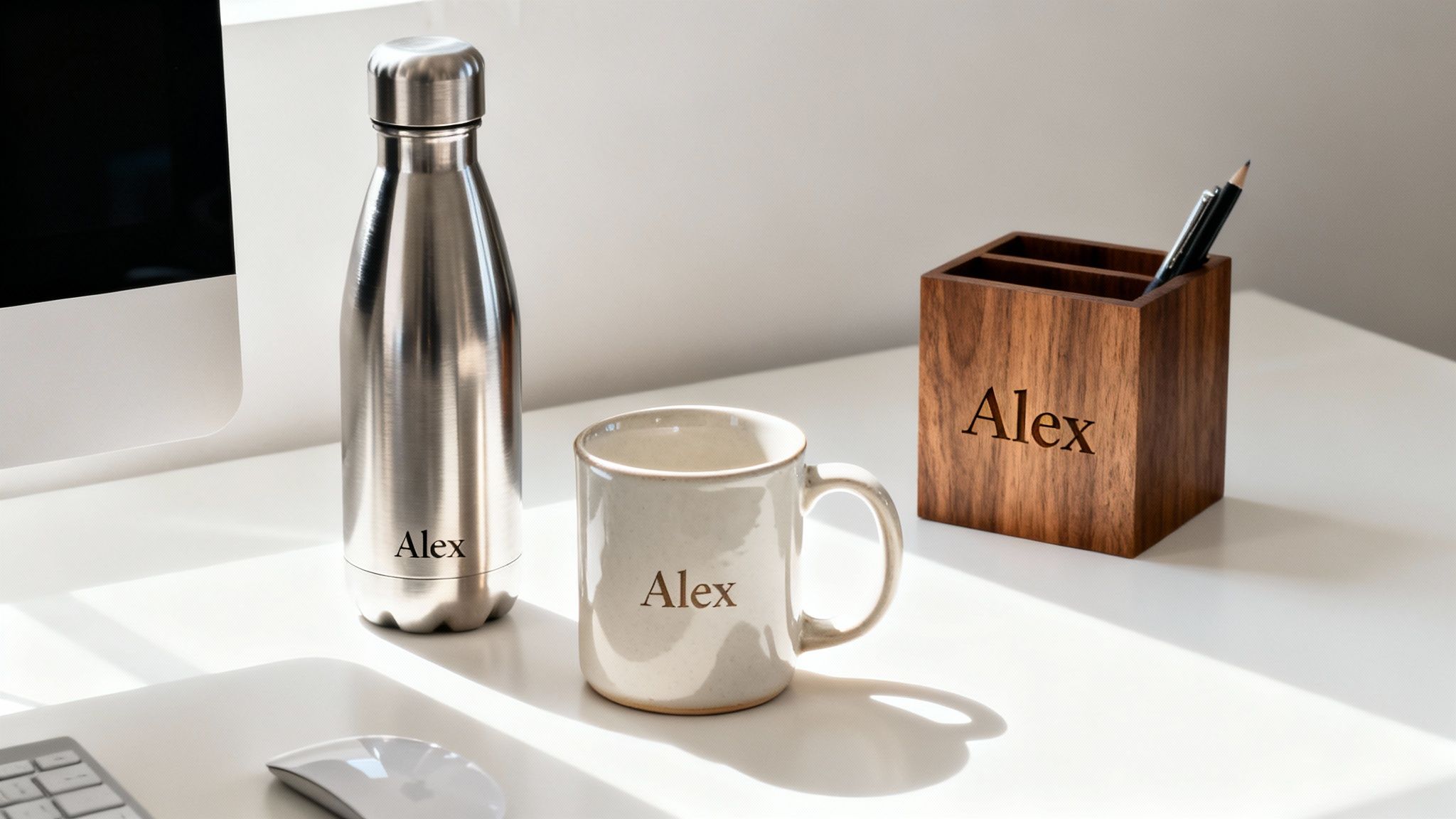
3. Personalized Items (Engraved Water Bottles, Mugs, or Desk Accessories)
Personalised items move beyond generic gifts to acknowledge each team member individually. Custom gifts like engraved water bottles or monogrammed portfolios demonstrate thoughtfulness and create a lasting sense of value.
How It Works and Tax Implications
This involves selecting practical items and customising them with an employee's name or initials. This signals that they are seen as a vital individual within the organisation.
Pros: High emotional impact; reinforces a sense of belonging; serves as a lasting keepsake.
Cons: Requires longer lead times for customisation; potential for errors (e.g., spelling mistakes).
ATO Rules: A non-entertainment personalised gift valued under $300 (including GST) per employee generally qualifies as a 'minor benefit' and is exempt from Fringe Benefits Tax (FBT). The business can claim a tax deduction.
Compliance Risk: The key to FBT exemption is that the gift must be infrequent and not easily convertible to cash. An engraved desk set clearly meets this criterion.
Practical Examples
SME: An accounting firm gifts each of its 20 employees a high-quality leather compendium with their initials embossed, costing $180 each. This is a tax-deductible and FBT-exempt expense.
Partnership: A law firm provides its partners and staff with engraved pens costing $250 each. The gift qualifies as a minor benefit.
4. Experience Gifts (Concert Tickets, Event Passes, or Subscription Services)
Shifting focus from material items to memorable moments, experience gifts are an excellent choice. This offers a unique reward that supports work-life balance.
How It Works and Tax Implications
This strategy involves gifting non-physical experiences. The power of this gift lies in its emotional impact and the creation of positive memories.
Pros: Creates lasting memories; can be highly personalised to an employee's interests.
Cons: Tax treatment can be complex; scheduling can be difficult for the employee.
ATO Rules: The tax treatment depends on the type of experience. * Entertainment: Tickets to concerts, movies, or sporting events are considered 'entertainment' by the ATO. Providing these will attract FBT, even if the value is under $300. The business cannot claim a GST credit but can claim an income tax deduction for the FBT paid. * Non-Entertainment: A subscription to a streaming service (e.g., Netflix) or a wellness app for personal use at home is generally not considered entertainment. If under $300, it can be an FBT-exempt minor benefit.
Compliance Risk: Misclassifying an entertainment gift as a minor benefit is a common error that can lead to an FBT liability.
Practical Examples
SME: A tech company gives each employee a $150 Ticketek voucher. This is an entertainment gift. The company must pay FBT on the value of the vouchers.
Corporation: A company provides a 12-month Spotify Premium subscription (value approx. $155) to each staff member. This is a non-entertainment gift and qualifies as an FBT-exempt minor benefit.
For a deeper understanding of how these gifts are treated for tax, you can find more information about how to manage Fringe Benefits Tax (FBT) in Australia.
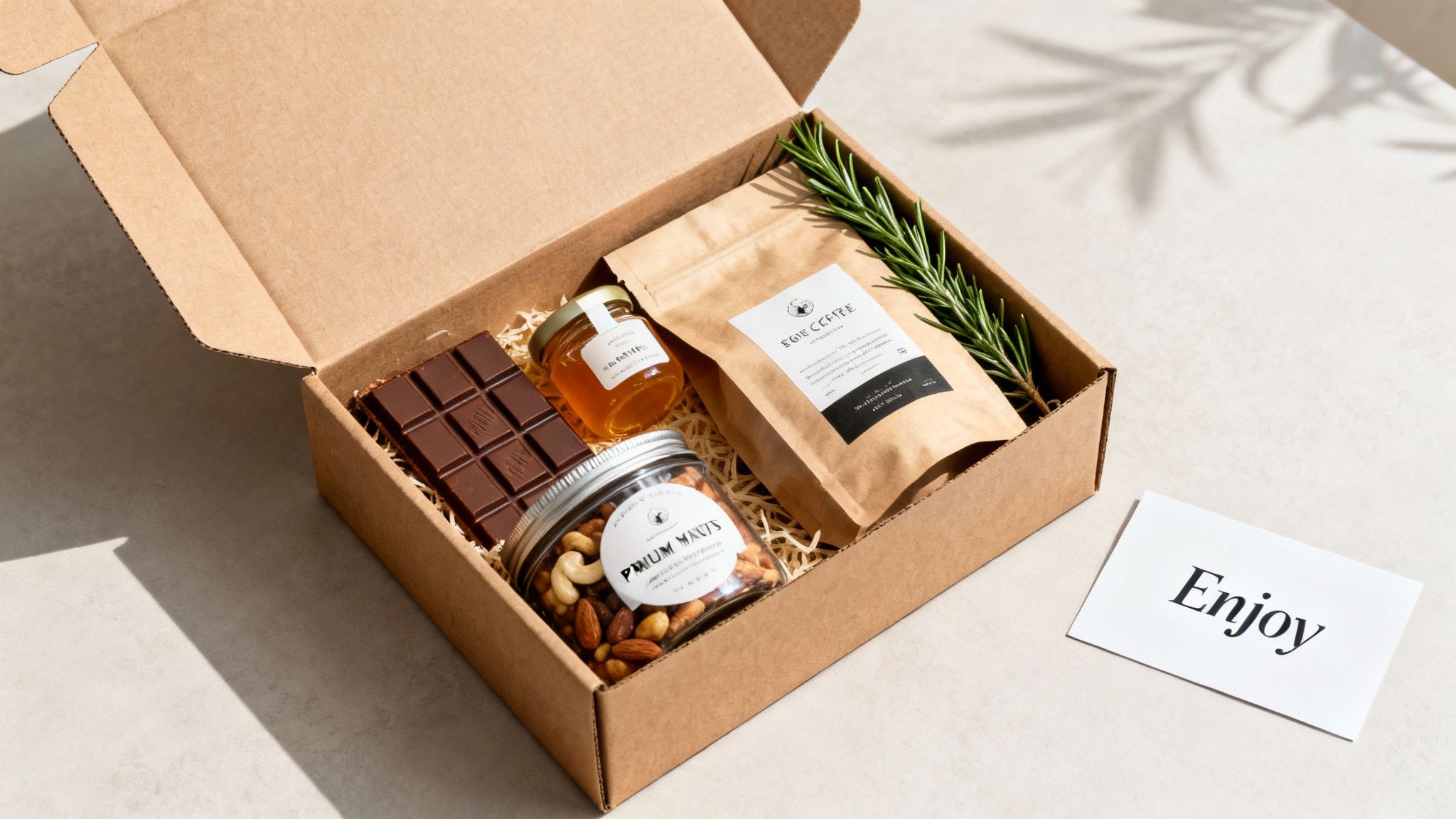
5. Gourmet Food Hampers or Premium Snack Boxes
Curated food hampers are a sophisticated and widely appreciated gift. This provides a tangible, shareable experience that appeals to a broad audience.
How It Works and Tax Implications
This approach involves sourcing packaged collections of high-quality food and non-alcoholic drink items. A well-curated hamper feels like a special indulgence.
Pros: Luxurious feel; appeals to a wide range of people; can be shared with family.
Cons: Must manage dietary restrictions; perishable items require careful logistics.
ATO Rules: Gourmet food and non-alcoholic beverages are classified as non-entertainment. A hamper costing less than $300 (including GST) per employee is an FBT-exempt minor benefit. The cost is tax-deductible, and GST credits can be claimed.
Compliance Risk: Including alcohol (wine, beer, spirits) in the hamper reclassifies it as entertainment, which will attract FBT. To maintain the FBT exemption, stick to non-alcoholic contents.
Practical Examples
Sole Trader: Gifting a $200 gourmet hamper with cheeses, crackers, and specialty tea to a subcontractor. This is a deductible, FBT-free expense.
SME: A real estate agency provides all 30 employees with a premium food hamper (no alcohol) valued at $250 each. The full cost is deductible and FBT-free.
For more information on how such expenses are treated, explore our guide on tax deductions for your small business.
6. Professional Development or Learning Opportunities (Online Courses, Certifications)
Investing in your team's growth is a powerful gift that extends well beyond the holiday season. It demonstrates a genuine commitment to their career progression and offers long-term value.
How It Works and Tax Implications
This involves providing subscriptions or access to online learning platforms like LinkedIn Learning, Coursera, or industry-specific training. The key benefit is empowerment.
Pros: Strategic investment in employee skills; high long-term value for both employee and company; promotes loyalty.
Cons: Value is only realised if the employee uses the resource; requires time allocation for learning.
ATO & Fair Work Rules: Work-related training and self-education provided to employees are generally exempt from FBT under the 'work-related benefit' exemption. The cost is tax-deductible for the business. This is considered a highly compliant and strategic form of employee reward.
Compliance Risk: The training must have a sufficient connection to the employee's current employment duties to be FBT-exempt. A personal hobby course (e.g., photography for an accountant) may not qualify.
Practical Examples
SME: An IT firm provides its developers with a $299/year subscription to a coding tutorial platform. This is FBT-exempt and tax-deductible.
Corporation: A marketing agency gifts each team member access to various courses for professional development related to digital marketing. The cost is a deductible business expense with no FBT implications.
For those exploring other long-term employee incentive structures, you might also be interested in understanding how an Employee Share Scheme builds wealth.
7. Eco-Friendly and Sustainable Gifts (Bamboo Products, Reusable Items)
Aligning corporate gifting with sustainability values is a modern and responsible way to show appreciation. Eco-friendly gifts reflect a business ethos that resonates with environmentally conscious employees.
How It Works and Tax Implications
This involves sourcing gifts that minimise environmental impact, like high-quality reusable water bottles or bamboo desk organisers. The core benefit is gifting with purpose.
Pros: Reinforces positive corporate values; appeals to younger, eco-conscious demographics; often practical and durable.
Cons: Can sometimes have a higher unit cost; requires vetting suppliers for genuine sustainability claims.
ATO Rules: As tangible, non-entertainment items, sustainable gifts fall under the standard minor benefit rules. If the cost is under $300 (including GST) per employee, the gift is FBT-exempt and tax-deductible.
Compliance Risk: No specific tax risks beyond ensuring the value remains under the $300 minor benefit threshold.
Practical Examples
Startup: A tech startup gifts its 15 employees a set of high-quality reusable coffee cups and lunch containers from a B Corp certified brand, costing $90 per person. The gift is a deductible, FBT-free minor benefit.
Professional Services Firm: A consulting firm provides staff with sustainably sourced bamboo desk accessories valued at $150 each, reinforcing its CSR policy.
8. Technology Gadgets and Accessories (Portable Chargers, Wireless Earbuds, Smart Speakers)
Gifting technology is a modern and practical way to show appreciation. Items like portable chargers or wireless earbuds are highly functional for both professional and personal use.
How It Works and Tax Implications
This approach involves selecting consumer electronics that offer genuine utility. A quality pair of noise-cancelling earbuds can improve focus, while a reliable portable charger is invaluable.
Pros: High perceived value and desirability; practical for daily use in hybrid work environments.
Cons: Can be expensive; compatibility issues (e.g., iOS vs. Android) may arise.
ATO Rules: A technology gadget is a non-entertainment gift. Provided the value is less than $300 (including GST) per employee, it qualifies as an FBT-exempt minor benefit.
Compliance Risk: Be cautious with high-value items. A gift exceeding the $300 threshold will attract FBT on its full value, not just the excess amount.
Practical Examples
SME: Gifting Anker portable chargers valued at $120 to all travelling sales staff. This is an FBT-exempt minor benefit.
Corporation: Providing employees with a choice of wireless earbuds valued at $280. This remains under the FBT threshold and is a deductible expense.
Alternative for High-Value Tech: For items like laptops or phones, consider a formal salary sacrifice arrangement for electronic devices, which has its own specific FBT rules.
9. Wellness and Fitness Gifts (Fitness Trackers, Yoga Mats, Gym Memberships)
Investing in your team's health is a gift that offers returns far beyond the holiday season. It shows a commitment to employee well-being and promotes a healthy work-life balance.
How It Works and Tax Implications
This involves providing tools or access to services that support physical and mental health, such as fitness trackers, yoga mats, or subsidised gym memberships.
Pros: Promotes a healthy and productive workforce; demonstrates a strong culture of care.
Cons: Health is personal, so one size does not fit all; may require an opt-in approach.
ATO Rules: Providing an employee with an in-house gym or subsidising a membership at an external gym is an exempt benefit under specific FBT rules, separate from the minor benefit exemption. Recreational facilities located on business premises are generally FBT-exempt. For external memberships under $300 provided as an infrequent holiday gift, the minor benefit exemption may apply.
Compliance Risk: An ongoing, regular gym membership subsidy would not qualify as a 'minor benefit' and would be subject to FBT. A one-off holiday gift is safer for exemption.
Practical Examples
SME: Gifting each employee a premium yoga mat and a 3-month subscription to a meditation app, with a total value of $180. This is an FBT-exempt minor benefit.
Corporation: Offering a one-time $299 contribution towards a gym membership of the employee's choice as a Christmas gift. This would qualify as an FBT-exempt minor benefit.
10. Charitable Donations or Volunteer Opportunities (Donations in Employee's Name)
Facilitating charitable giving offers a meaningful alternative to traditional gifts. This involves making a donation to a registered charity in an employee's name or providing paid time off for volunteering.
How It Works and Tax Implications
This method allows you to allocate a set budget towards a cause the employee cares about. It transforms a corporate gift into a gesture that reflects personal values.
Pros: High social and emotional impact; aligns with corporate social responsibility (CSR) goals; tax-efficient for the business.
Cons: Lacks the tangible feel of a physical gift; impact depends on employee's personal values.
ATO Rules: Donations made by the business directly to a Deductible Gift Recipient (DGR) are generally tax-deductible for the company. Because the gift is to the charity, not the employee, FBT does not apply to the donation itself.
Fair Work Rules: Providing paid time off for volunteering is treated as normal salary and wages. The business claims a deduction for the wages paid, and the employee is taxed as usual.
Practical Examples
Company: A business makes a $100 donation to a DGR-endorsed charity in each employee's name. The company claims a $100 tax deduction for each donation, and no FBT is payable.
SME: An SME organises a paid volunteer day. The wages paid to employees for that day are deductible as a normal business expense.
For further information on claiming deductions, review the ATO guidance on gifts and donations.
FAQs: ATO Rules for Staff Gifts
1. What is the ATO's 'minor benefit' rule for staff gifts?A minor benefit is a gift provided to an employee that is valued at less than $300 (including GST) and is given on an infrequent or irregular basis. If a gift meets these criteria and is not classified as entertainment, it is generally exempt from Fringe Benefits Tax (FBT). The business can also claim an income tax deduction and GST credits.
2. Is a cash bonus or a Visa gift card a good holiday gift?From a tax perspective, no. The ATO treats cash and cash-convertible items (like a universal Visa debit card) as salary and wages, not as a gift. This means you must withhold PAYG tax and pay superannuation on the amount, which adds complexity and cost. It is not eligible for the minor benefit exemption.
3. What is the difference between an 'entertainment' and 'non-entertainment' gift?A non-entertainment gift is typically an item like a hamper (without alcohol), a book, or a tech gadget. An entertainment gift involves providing recreation, such as tickets to a concert, movie, or sporting event, or a holiday. Entertainment gifts are subject to FBT regardless of their value, whereas non-entertainment gifts under $300 are generally FBT-exempt.
4. Can I claim a tax deduction for all staff gifts?You can generally claim a tax deduction for the cost of staff gifts. However, the treatment of GST and FBT depends on the gift's classification. For FBT-exempt minor benefits (non-entertainment, under $300), you can claim a deduction and the GST credit. For entertainment gifts, you can claim a deduction for the cost plus any FBT paid, but you cannot claim a GST credit.
5. Do I need to keep records of the gifts I give my staff?Yes. According to ATO requirements, you must keep detailed records of all benefits provided to staff. This includes receipts, the date the gift was given, its value, and who received it. These records are essential to substantiate your claims for tax deductions and FBT exemptions during an audit.
Summary
Choosing the right holiday gift requires balancing generosity with strict compliance with Australian tax law. A well-executed gifting strategy can boost morale and reinforce a positive workplace culture, while a poorly planned one can create unintended FBT liabilities and compliance issues.
Key Takeaways:
The $300 Minor Benefit Rule is Key: For non-entertainment gifts, keeping the cost below $300 (including GST) per employee is the most effective way to ensure the gift is FBT-exempt and tax-deductible.
Avoid Cash and Cash Equivalents: Cash bonuses and universal gift cards are treated as salary, attracting PAYG withholding and superannuation obligations.
Distinguish Entertainment from Gifts: Tickets to events are entertainment and attract FBT. Hampers without alcohol are non-entertainment gifts and can be FBT-free.
Documentation is Mandatory: Always maintain clear records of what was gifted, its value, and to whom it was given to meet ATO and ASIC requirements.
By applying these principles, you can confidently answer "what should I give my staff this holiday season?" with a choice that is both meaningful for your team and financially sound for your business.
Call to Action
Navigating the complexities of FBT, PAYG, and superannuation for staff gifts can be challenging. To ensure your holiday gifting strategy is both generous and fully compliant with ATO regulations, seek professional guidance.
Contact Baron Tax and Accounting for specialised advice tailored to your business needs.
Website: https://www.baronaccounting.com
Email: info@baronaccounting.com
Phone: +61 1300 087 213

Comments