
A Guide to the Business Travel Deduction in Australia

A business travel deduction lets you claim expenses for work-related travel, but only when the trip requires you to be away from home overnight. The golden rule here is that the cost must be directly tied to earning your income. This is a crucial difference from your daily drive to the office, which the Australian Taxation Office (ATO) always considers a private, non-deductible expense.
This article is based on the Current Financial Year (2025-26 FY) at the time of writing.
At Baron Tax & Accounting, a common point of confusion we observe with Brisbane-based clients is correctly distinguishing between private holiday costs and legitimate business travel expenses. It's not unusual to see a sole trader append a personal holiday to a work trip without properly apportioning the shared costs, which can lead to compliance issues with the ATO.
Step-by-Step Guide to Claiming Your Deduction
Step 1: Determine if Your Travel Qualifies
First, confirm the travel is for genuine business purposes and requires you to be away from your home overnight. Travel to your regular workplace is a non-deductible daily commute.
Step 2: Pay for the Expense Yourself
You can only claim an expense you paid for and were not reimbursed for. If your employer covers a cost, you cannot claim it.
Step 3: Keep Meticulous Records
Retain all receipts, invoices, and bank statements as proof of purchase. For trips of six or more consecutive nights, a travel diary is mandatory.
Step 4: Apportion Costs for Mixed-Purpose Trips
If your trip includes both business and private elements, you must separate the costs. Only claim the portion of expenses that relates directly to your income-earning activities.
Step 5: Claim the Deduction in Your Tax Return
Lodge your tax return, including the calculated travel expenses at the relevant section. Ensure you have all substantiating documents ready in case the ATO requests them.
Understanding Your Business Travel Deduction Entitlements
Getting to grips with the basics of a business travel deduction is the first step. At its core, the ATO lets you claim costs for your transport, accommodation, and meals, but only when your work sends you away from home overnight.
The key idea is that this isn't your regular commute. It’s about journeys to alternative work locations that aren't your usual place of business.
Distinguishing Business Travel from Daily Commutes
The line between a deductible business trip and your daily commute is a firm one, and the ATO is very clear on this.
Daily Commute (Non-Deductible): This is the trip between your home and your regular place of work. It’s considered a private expense, full stop. Even if you make a few work calls on the way, it doesn't change a thing.
Business Travel (Deductible): This is when you travel from your home or normal workplace to an alternative location to do your job. Think of a client's office on the other side of town, an interstate conference, or a meeting with an overseas supplier.
Core Eligibility for a Business Travel Deduction
To successfully claim travel deductions, you need to tick a few key boxes set by the ATO. These rules apply to everyone—sole traders, employees, and company directors alike.
The trip’s primary purpose must be for business. If a trip is mainly for personal reasons with some incidental work activity, the travel costs (like airfares) are generally not deductible.
The intention behind the trip is everything. A family holiday to Cairns where you happen to squeeze in a one-hour client meeting won't pass the "primary purpose" test. On the other hand, a trip planned specifically for a three-day conference in Sydney clearly meets the requirement.
For a deeper dive into general work-related claims, you can learn more about what you can claim on tax in Australia in our comprehensive guide.
Key Categories of Travel Expenses
When you're on the road for work, your deductible costs generally fall into three buckets:
Transport: This covers everything from airfares, train tickets, and bus fares to taxis, ride-sharing costs, and car hire fees.
Accommodation: The cost of your hotel, motel, or serviced apartment is deductible for the business portion of your stay.
Food and Drink: You can claim the cost of your meals while you're away overnight for work.
It’s crucial to remember that you can only claim what you actually paid for out of your own pocket. If your employer reimbursed you for an expense, you can’t claim it again on your tax return.
The Core Rules for Claiming Travel Expenses
Before you even start tallying up receipts, it’s crucial to get your head around the core Australian Taxation Office (ATO) rules for business travel. Think of these principles as a filter—they’ll help you figure out if an expense is genuinely work-related and has a chance of being claimable.
The absolute number one rule is that the travel must be directly linked to earning your income. Your trip has to be for doing your job, not for personal reasons with a bit of work sprinkled in.
The Overnight Stay Requirement
One of the biggest hurdles is the overnight stay rule. This is a real cornerstone of business travel deductions. If your work genuinely requires you to be away from home overnight, you can start looking at claiming costs like accommodation and meals.
Without that overnight stay, the ATO generally won't let you claim food, drinks, or a place to sleep. This is what stops people from trying to claim their lunch every time they work away from their usual office for the day.
Business as the Primary Purpose
The ATO will always look at the primary purpose of your trip. To claim your major transport costs, like flights, the whole journey needs to be overwhelmingly for business. Sticking a quick two-hour meeting onto a week-long family holiday just won’t cut it.
For instance, a Brisbane architect flying to Sydney for a three-day industry conference can almost certainly claim their airfare. But what if they flew to Sydney for a one-week holiday and only had a single client meeting? In that case, the primary purpose is personal, and the airfare isn't deductible.
Key Takeaway: The ATO looks at the dominant reason for the trip. If your business activities are just an add-on to a personal holiday, you can’t claim the cost of getting there and back.
Your Normal Workplace and Travel Claims
Understanding what the ATO considers your normal workplace is vital, because business travel deductions are for trips away from this spot. For most employees, it’s simple—it’s your office, workshop, or shopfront.
But with modern work arrangements, things can get a bit blurry.
Home Office: If your home is your main place of work, then travelling from there to a client’s office is usually deductible.
Multiple Sites: If you’re a contractor or a tradie working at different client sites, travel between those sites is deductible. But your first trip from home to the first site, and your last trip from the final site back home, are generally seen as a private commute.
You can dive deeper into vehicle-specific claims in our guide on the cents per km method for car expenses.
The Reimbursement Rule
This one’s simple but catches a lot of people out: you cannot claim an expense that someone else has already paid for or reimbursed you for. It’s a strict "no double-dipping" policy.
If your employer pays the hotel bill directly or gives you back the exact amount you spent, you haven't actually incurred an expense yourself. So, there's nothing for you to claim on your tax return.
This gets a bit different if you receive a travel allowance. An allowance is a set amount of money your employer gives you to cover estimated costs. You have to declare this allowance as income, but then you can claim your actual expenses against it.
Apportionment for Mixed-Purpose Trips
When a trip is a genuine mix of business and pleasure, you need to apportion your expenses. This just means you can only claim the portion of the cost that directly relates to your work activities.
For shared costs like a hotel room, you have to split the business days from the personal days. If you stay for five nights but only two were for a conference, you can only claim the accommodation for those two business nights. Any cost that is 100% private—like a museum ticket or dinner with a friend—is never deductible.
What You Can (and Can't) Claim on Your Business Trip
Once you've ticked the box and confirmed your trip is genuinely for business, the next step is getting granular. You need to know exactly which expenses the Australian Taxation Office (ATO) will accept and which ones they'll reject.
Think of it this way: your expenses fall into two buckets. The first contains everything directly and necessarily linked to your work. The second is for anything personal. The golden rule is simple: if you only spent the money because of your work travel, it’s probably deductible. This covers the big-ticket items like getting there, having a roof over your head, and eating while you’re on the job.
Allowable Business Travel Expenses
When you're away from home overnight for work, a whole range of costs come into play. Keeping meticulous records of these is the key to making a successful claim later on.
Here are the most common expenses you can generally claim:
Transportation: This covers your flights, train tickets, or bus fares to get where you're going. It also includes the costs of getting around while you're there, like taxis, Ubers, or a hire car for work-related meetings.
Vehicle Costs: If you're using your own car, you can claim expenses like fuel and oil. You'll need to use either the cents per kilometre method or the logbook method to work out your claim. A proper mileage calculation is essential to maximise what you can claim correctly.
Accommodation: The cost of your hotel, motel, or serviced apartment is deductible for the business portion of your stay.
Meals: The cost of food and drinks you have while you're away overnight for work is claimable. Just remember, the ATO expects these costs to be reasonable—lavish, extravagant meals are likely to raise a red flag.
Incidental Expenses: Don't forget the small but necessary costs. Things like work-related phone calls, paying for internet access, or laundry and dry cleaning for your work attire are also claimable.
Common Non-Deductible Expenses
Knowing what you can't claim is just as important. Trying to sneak in personal expenses is one of the fastest ways to get the ATO’s attention, and not in a good way. These costs are always considered private and have no place in your business travel claim.
Steer clear of these common pitfalls:
Sightseeing and Entertainment: Tickets to see the sights, go to a show, or catch a footy game are personal expenses, even if they happen during your trip.
Family and Friends' Costs: You can't claim any costs for a spouse, partner, or family member travelling with you. The only exception is if they are a genuine employee of the business and their travel is essential for a business purpose. This means you can't claim their share of a meal or the extra cost of a larger hotel room.
Souvenirs and Personal Shopping: Any gifts you buy for people back home or personal items for yourself are not deductible.
Personal Holiday Components: If you decide to add a few extra days to your trip for a mini-holiday, any costs from that personal portion—like extra nights' accommodation or meals on your days off—are non-deductible.
Deductible vs Non-Deductible Business Travel Expenses
Expense Category | Generally Deductible | Generally Non-Deductible |
|---|---|---|
Airfares/Transport | Flights, trains, or car hire to get to your work destination. | Flights for a spouse or family member joining you for a holiday. |
Local Travel | Taxis, Ubers, or public transport to and from meetings or the airport. | A rental car used for a weekend sightseeing trip. |
Accommodation | Hotel or serviced apartment for the nights required for business. | Extra nights booked to extend the trip for personal leisure. |
Meals & Drinks | Reasonable costs for your own food and drink while away on business. | Expensive dinners with friends who live in the city you're visiting. |
Entertainment | N/A - Generally considered a separate FBT issue, not a travel deduction. | Tickets to a concert, sporting event, or a round of golf. |
Conference Fees | Registration fees for work-related seminars or conferences. | Costs for optional, non-work-related tours or events at the conference. |
Family Costs | N/A | Any cost related to a non-employee family member travelling with you. |
Incidentals | Work-related phone calls, internet, or laundry for work clothes. | Souvenirs, personal shopping, or magazines. |
Remember, the core principle is whether the expense has a direct connection to your income-earning activities. If it’s private, leave it out.
Mastering Your Record-Keeping Requirements
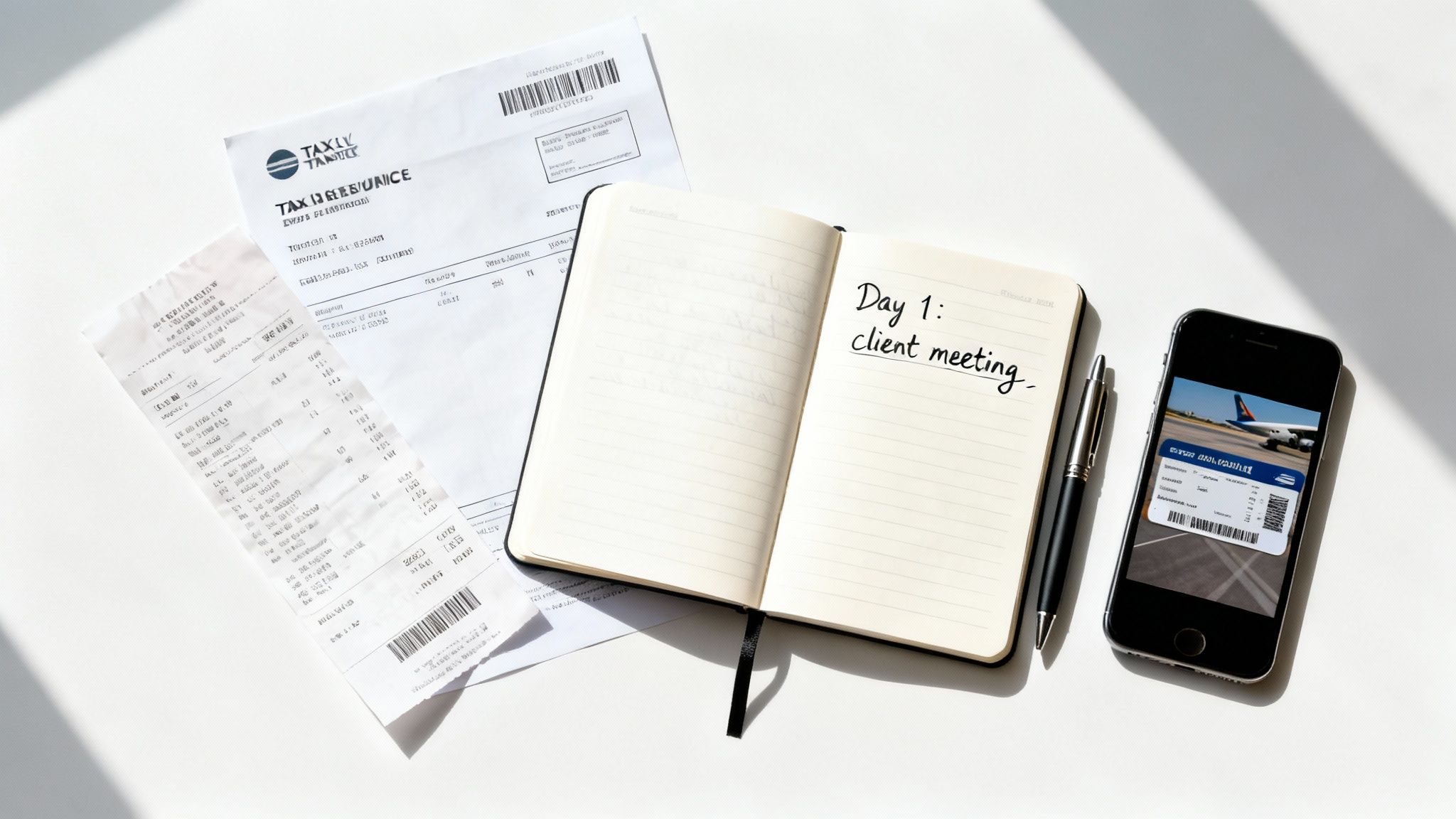
When it comes to claiming business travel deductions, proof is everything. The Australian Taxation Office (ATO) has strict substantiation rules, and the principle is simple: if you can't prove you spent the money for a legitimate business purpose, you can't claim it.
This means you need a rock-solid paper trail. We're talking about holding onto tax invoices, receipts, and bank statements for every single expense you want to claim. Diligent record-keeping isn't just good practice—it's a non-negotiable part of staying compliant. You absolutely must be able to produce this evidence if the ATO ever comes knocking.
The Essential Travel Diary
If your business trip lasts for six or more consecutive nights, keeping a travel diary is mandatory. This isn't just a suggestion; it's a hard-and-fast ATO requirement that serves as your primary evidence to justify the business purpose of the entire trip.
Don't worry, this diary doesn't need to be a fancy leather-bound journal. A simple notebook, a spreadsheet, or even a digital document will do the trick, as long as it contains the right information.
For each business activity, your travel diary must detail:
What: The nature of the activity (e.g., client meeting, site inspection, conference).
When: The date and approximate time the activity started.
Where: The location of the activity.
How long: The duration of the activity.
Think of it as the story of your trip. It’s what connects your expenses—like flights and accommodation—to your income-earning activities, proving they were necessary for your business.
+-------------------------------------------------------------+
|               Example Business Travel Diary Entry           |
+-------------------------------------------------------------+
| Date:          15 August, Current FY                        |
| Location:      Melbourne, VIC                               |
|-------------------------------------------------------------|
| 9:00 AM - 1:00 PM: Attended "Future of Construction Summit" |
|                  at Melbourne Convention Centre.            |
| 2:30 PM - 4:00 PM: Met with John Smith, Director of ABC     |
|                  Developments, at their Collins St office.  |
+-------------------------------------------------------------+
Digital Records and Storage
Let’s be honest, paper receipts are a hassle. Thankfully, the ATO fully accepts electronic copies of receipts and invoices, which is fantastic news for anyone wanting to cut down on clutter.
There’s a catch, though. Any digital copy must be a true and clear reproduction of the original document. A blurry, unreadable photo won’t cut it. It’s worth making sure your initial scans or photos are crystal clear.
Crucial Compliance Point: You are legally required to keep all your tax records, including everything related to business travel, for a minimum of five years from the date you lodge your tax return.
This five-year rule is critical. If you lose your records before this period is up and you face an audit, the ATO could disallow your deductions and hit you with penalties.
The Exception: Reasonable Allowances
The ATO gets it—collecting a receipt for every single coffee or sandwich can be impractical while you're on the road. This is why they provide "reasonable amounts" for daily travel expenses covering accommodation, food, drink, and incidentals.
If your claim for these specific costs is below the relevant ATO daily limit, you might not need to keep every single receipt. However, this is an exception to the substantiation rule, not a free pass. You must still be able to prove that you actually spent the money and that the travel was for work. For specific rates, you must refer to the relevant Taxation Determination for the Current Financial Year on the ATO website.
And if you're using your own car for travel, maintaining a detailed logbook is usually the best way to back up your expense claims. We cover this in depth in our guide on how to keep a compliant car logbook for the ATO.
How to Apportion Mixed Business and Private Travel
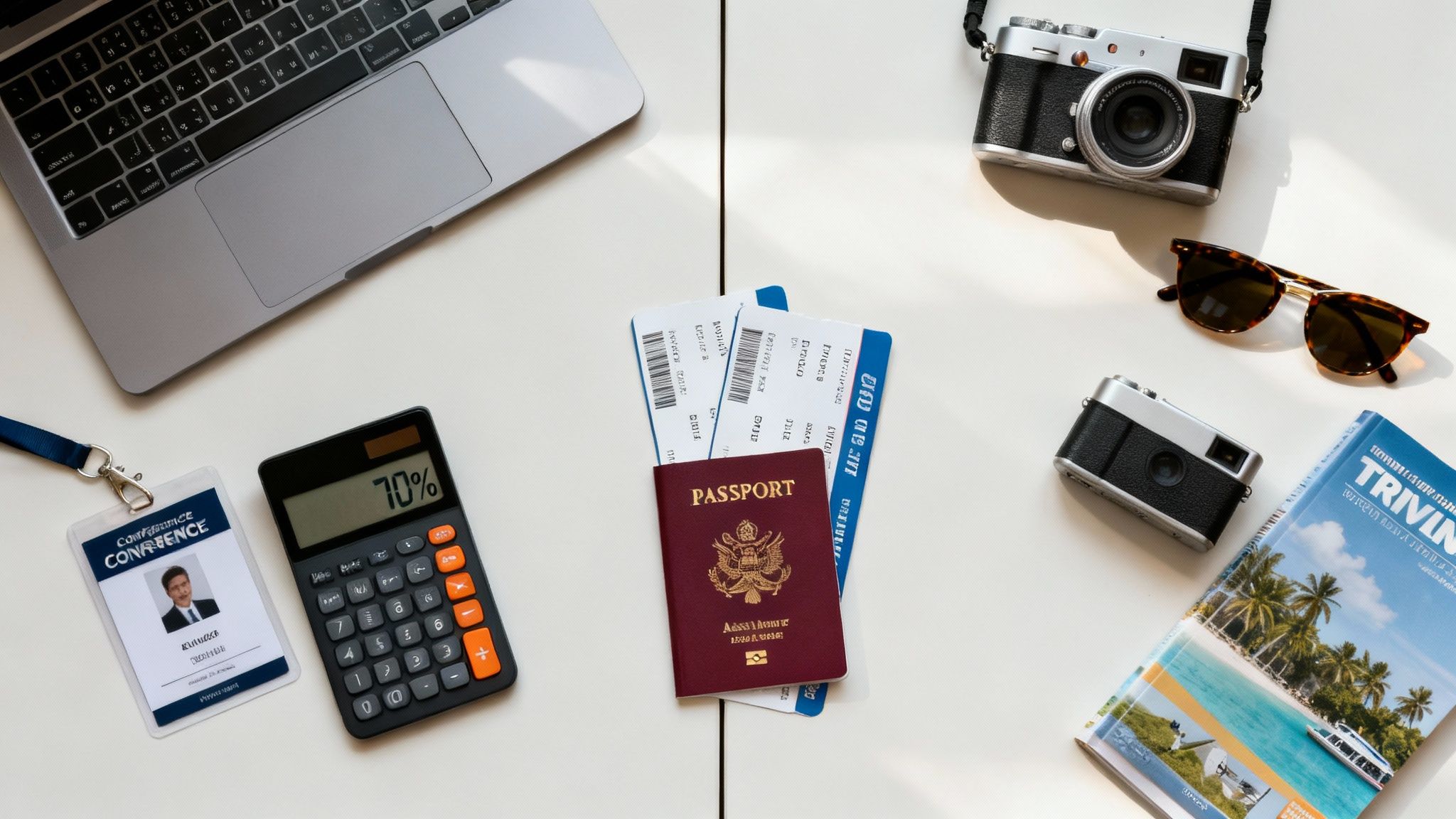
It’s pretty common to tack a few personal days onto a business trip. Who wouldn't? But this is exactly where so many people get tripped up with their tax claims. The Australian Taxation Office (ATO) is very clear: you must apportion your expenses, which is just their way of saying you need to fairly split the costs between the business and private parts of your trip.
The rule of thumb is straightforward: you can only claim a business travel deduction for expenses that directly help you earn your income. Any costs from the holiday portion of your trip? Those are strictly off-limits. Get this wrong, and you risk the ATO adjusting or even disallowing your entire claim.
Determining the Primary Purpose of the Trip
Before you even think about splitting costs, you have to figure out the trip's primary purpose. The ATO looks at the main reason you travelled in the first place to decide if big-ticket items like your flights are deductible at all.
If the trip is mainly for business, you can usually claim the full cost of getting there and back. But if it's mostly a holiday with a bit of work sprinkled in, those travel costs are not deductible.
Think about it this way. A five-day trip where you spend three full days at a mandatory conference and two days sightseeing is clearly for business. On the flip side, if you take a two-week family holiday and just pop into one two-hour meeting, the primary purpose is personal. The flights wouldn't be claimable in that case.
How to Calculate Apportionment
Once you've established the trip is primarily for business, it's time to apportion the costs. The easiest way is to sort every expense into one of three buckets.
100% Business Expenses: These are costs exclusively for your work. Easy ones include conference registration fees, a taxi to a client meeting, or a meal where you’re discussing business.
100% Private Expenses: These are purely for fun. Think tickets to a footy game, a sightseeing tour, or dinners out on your days off.
Shared Expenses: These are costs that cover both the work and play parts of your trip, like flights and accommodation. These are the ones that need to be divided on a fair and reasonable basis.
The most common and accepted method for splitting these shared costs is to use a simple day-by-day calculation.
Practical Example: A Brisbane Business Owner in Melbourne
Let's walk through a real-world example of a sole trader from Brisbane.
Who: David, a graphic designer based in Sunnybank.
Trip: Flies from Brisbane to Melbourne for a 5-day trip.
Purpose: 3 days at a design conference (business) and 2 days visiting friends (private).
Costs: * Return Airfare: $400 * Accommodation: $200 per night ($1,000 total) * Conference Ticket: $800 * AFL Game Ticket: $60
Here’s how David would break down his business travel deduction:
Expense | Total Cost | Business vs Private Days | Calculation | Deductible Amount |
|---|---|---|---|---|
Airfare | $400 | 3 Business / 2 Private | $400 x (3/5) | $240 |
Accommodation | $1,000 | 3 Business / 2 Private | $1,000 x (3/5) | $600 |
Conference Fee | $800 | 100% Business | $800 x 100% | $800 |
AFL Ticket | $60 | 100% Private | $60 x 0% | $0 |
Total Claim | $1,640 |
This method gives you a clear, logical calculation that stands up to ATO scrutiny. Just keep in mind that Fringe Benefits Tax (FBT) rules can also come into play, especially when employees are involved in the travel.
Navigating Domestic vs International Travel Claims
While the core rules for claiming business travel are the same whether you’re flying from Brisbane to Perth or Brisbane to Singapore, international trips definitely add a few extra layers of complexity. The Australian Taxation Office (ATO) uses the same fundamental principles, but you can bet they’ll expect more rigorous proof and specific calculations for any overseas travel.
The most immediate headache is dealing with foreign currency. Every single expense you pay for in another currency—from a cab in Tokyo to a hotel in London—has to be converted back to Australian dollars (AUD) for your tax return. The ATO lets you use the exchange rate on the day you paid for the expense, or you can use an average rate over a specific period if that’s more practical.
Foreign Currency and International Allowances
Getting the currency conversion right is non-negotiable. The best habit to get into is noting the exchange rate on the day of the transaction. Even better, just keep your bank or credit card statements, as they’ll show the final AUD amount you were charged. For more complex situations involving overseas work, it's crucial to understand all your obligations. You can find out more in our detailed guide on navigating foreign income tax in Australia.
On top of this, the ATO’s "reasonable amounts" for travel allowances are completely different for international destinations. The tax office groups countries into various cost categories based on how expensive it is to travel and live there. This means the reasonable daily allowance for meals and incidentals in a high-cost country will be much higher than for a cheaper one. You’ll need to look up the correct ATO determination for that financial year to find the specific rate for the country you visited.
Key Consideration: For international travel, the ATO looks much more closely at your itinerary to confirm the trip was genuinely for business. Make sure your travel diary clearly spells out why your presence was needed overseas and how each activity directly helped your business.
Is Travel Insurance Deductible?
This is a really common question, and the answer is yes—but only for the business portion of your trip. If your entire trip is 100% for work, you can claim the full cost of your travel insurance policy. Simple.
However, if you’re mixing business with a bit of a holiday, you have to apportion the insurance cost fairly. For example, if you spend seven days on business activities and three days on personal sightseeing, you can only claim 70% of the insurance premium as a deduction.
These rules are becoming more important than ever. The latest global business travel report indicates a significant rise in business travel, highlighting the need for businesses to get their expense tracking and paperwork right to claim these costs correctly.
Summary
Primary Purpose is Key: The main reason for the trip must be business to claim major transport costs like airfares.
Overnight Stay Required: To claim accommodation and meals, the travel must require you to be away from home overnight.
Apportion Everything: You must separate business and private expenses on a mixed-purpose trip. Only the business portion is deductible.
Record-Keeping is Non-Negotiable: Keep all receipts and invoices for five years. A travel diary is mandatory for trips of six or more consecutive nights.
No Double-Dipping: You cannot claim an expense that your employer has already reimbursed you for.
Frequently Asked Questions (FAQ)
Can I claim my daily commute to and from the office?
No. The Australian Taxation Office (ATO) considers the trip between your home and your regular place of work to be a private expense, so it is not deductible.
What’s a travel diary, and do I really need one?
A travel diary is a log of your business activities during a trip. The ATO mandates a travel diary for any trip that lasts for six or more consecutive nights. It's your primary evidence to prove the journey's business purpose. Even for shorter trips, keeping a diary is best practice for solid record-keeping.
My employer gave me a travel allowance. Can I still claim my expenses?
Yes. You must first declare the travel allowance as income in your tax return. You can then claim deductions for the actual business travel expenses you paid for out of pocket. If your claim is below the ATO's reasonable allowance amount, you may not need to provide written evidence for every expense, but you must still be able to show you incurred the expense.
Are meals and drinks deductible when I’m on a work trip?
Yes, provided the travel required you to stay away from home overnight. The cost of reasonable meals and drinks can be claimed as part of your overall travel expenses. You cannot claim meals on a day trip where no overnight stay occurs.
Need clarity on your situation?
This information is general in nature and serves as a guide. The specific rules for business travel deductions can be complex and depend heavily on your individual circumstances, employment type, and the nature of your travel. The ATO regularly updates its guidance, making it essential to apply the correct rules for the relevant financial year.
To ensure you are claiming correctly and maximising your entitlements without risking non-compliance, seeking personalised advice is recommended. A qualified professional can review your specific travel itinerary and expense records to provide tailored guidance.
Baron Tax & Accounting
Website: https://www.baronaccounting.com
Email: info@baronaccounting.com
Phone: +61 1300 087 213
Whatsapp: 0450 468 318

Navigating the rules around the business travel deduction in Australia can feel like an absolute headache, especially when you are trying to separate work commitments from personal downtime. Whether you are flying interstate for client meetings or expanding your operations globally, understanding what the Australian Taxation Office (ATO) actually allows you to claim is crucial for avoiding an audit. When planning a trip, the core principle the ATO looks at is the "dominant purpose". If your primary reason for packing your bags is to generate assessable income—such as attending an industry conference, inspecting commercial properties, or meeting suppliers—then major expenses like flights, accommodation, and vehicle hire are generally deductible. However, if you decide to tack on a cheeky holiday at the end,…
This guide on Australian business travel deductions is super helpful for keeping expenses straight. Tax time can get pretty messy when mixing work trips with personal downtime. Speaking of travel, if anyone ever wraps up a work conference and decides to head abroad for leisure, checking out yacht charter prices istanbul is a fun way to look at options on the Bosphorus. Naturally, personal holiday excursions like that definitely won't fly as a legitimate write-off down under! Sticking strictly to the rules outlined here keeps things safe with the ATO.
Great overview! Navigating tax rules can be tricky, especially when mixing personal activities with work trips. This guide makes understanding the Australian Taxation Office guidelines much easier. Whether someone is traveling interstate or planning New Zealand travel for client meetings, keeping accurate records and a detailed travel diary is essential. Splitting mixed-purpose trips properly ensures you only claim legitimate business expenses without risking an audit. Thanks for breaking down these complex rules into clear, actionable steps that every business owner and employee can easily follow!