
What Can I Claim on Tax in Australia? An ATO Guide to Deductions

In Australia, a tax deduction is an expense you incur to help you earn your income. Understanding what you can legitimately claim on tax is one of the most critical steps at tax time, as it directly reduces your taxable income, which can lead to a significant tax refund.
Why does this matter? Claiming deductions correctly not only maximises your potential refund but also ensures you remain compliant with Australian Taxation Office (ATO) regulations. The key compliance risk is making incorrect or unsubstantiated claims, which can lead to ATO audits, adjustments to your tax return, and financial penalties. Every claim must be legitimate and supported by proper records.
This guide provides a clear overview of the types of expenses you can claim, whether you are an employee, a business owner, or an investor, based on the latest ATO rules.
The Three Golden Rules of Claiming a Deduction
Before looking at what you can claim, it is essential to understand the foundational framework the Australian Taxation Office (ATO) uses to assess every deduction. If an expense does not meet all three of these non-negotiable rules, you cannot claim it. Mastering these rules is the most effective way to lodge an accurate tax return and avoid ATO scrutiny.
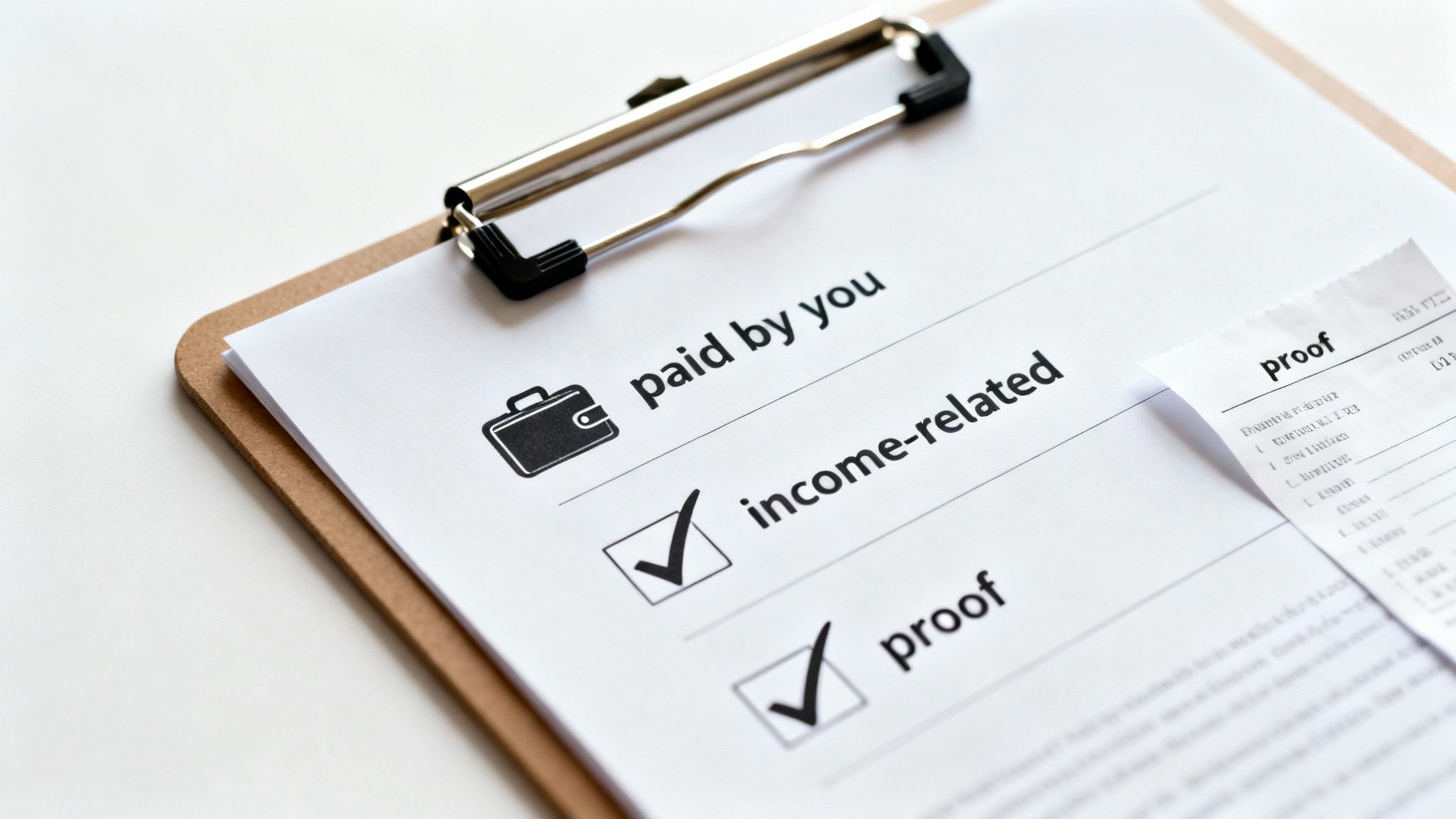
The ATO outlines three core conditions for any claim:
1. You Must Have Spent the Money Yourself (and Not Been Reimbursed)
The expense must have been paid from your own pocket. If your employer, a client, or anyone else pays you back for the cost, it is no longer your expense, and you cannot claim a deduction for it.
Example: You buy a $1,500 work laptop. If your employer reimburses you the full amount, you cannot claim a deduction. If they only reimburse you $1,000, you may be able to claim the remaining $500 you are out of pocket.
2. The Expense Must Be Directly Related to Earning Your Income
There must be a clear and direct connection between the cost and your income-earning activities. The expense cannot be private, domestic, or capital in nature (unless specific capital allowance rules apply).
Example: A graphic designer pays a $30 monthly subscription for design software essential for their work. This is directly related and therefore deductible. However, the cost of a standard business suit for an office worker is considered a private expense for conventional clothing and is not deductible.
3. You Must Have a Record to Prove It
You must have evidence to substantiate your claim. Without proof, the ATO can disallow your deduction. Valid records include:
Tax invoices or receipts
Bank or credit card statements
Logbooks (for car expenses) or travel diaries
Keeping organised records is crucial. A practical guide on how to organize receipts for taxes can simplify this process significantly. The ATO generally requires you to keep records for five years from the date you lodge your tax return.
Common Work-Related Expenses for Employees
For most Australian employees, the primary way to reduce taxable income is by claiming work-related expenses. These are costs you cover yourself to perform your job. Before claiming, always check your expense against the three golden rules.
Vehicle and Travel Expenses
While your daily commute from home to your primary workplace is considered private travel and is not deductible, you can claim costs for work-related travel, such as:
Driving between different work sites during the day.
Travelling to an alternative workplace for the same employer.
Transporting bulky tools or equipment required for your job if there is no secure storage available at the workplace.
You can claim these costs using either the cents per kilometre method (for up to 5,000 business kilometres) or the logbook method, which requires detailed records but may yield a larger claim.
Uniforms and Protective Clothing
You can claim the cost of purchasing, renting, or repairing clothing that is occupation-specific, protective, or a compulsory uniform registered with AusIndustry. This does not include conventional clothing like a standard suit or dress.
Example: A construction worker can claim steel-capped boots and a high-vis vest as protective gear. A nurse can claim their scrubs as an occupation-specific uniform.
Self-Education Expenses
If you undertake a course or study that has a direct connection to your current employment and helps maintain or improve your skills, you can claim related expenses. This includes course fees, textbooks, and stationery. The study must relate to your current job, not a future or different role.
Working from Home Expenses
With many Australians now working from home, these claims are common but also heavily scrutinised by the ATO. You can claim the additional running costs you incur.
The ATO provides two methods:
Fixed-Rate Method: A simplified rate of 67 cents per hour worked from home. This covers internet, phone, electricity, gas, and stationery.
Actual Cost Method: This requires calculating the specific work-related percentage of all your home office running expenses, supported by detailed records and receipts.
Choosing the right method is important. Our detailed article on work from home tax deductions breaks down both options.
Other Common Deductions
Depending on your profession, other deductible expenses may include:
Tools and Equipment: The cost or depreciation of items required for your job.
Professional Fees: Union fees, professional association memberships, or subscriptions to industry journals.
Stationery and Supplies: Minor items like pens and notebooks used for work.
For a deeper analysis of employee claims, see our guide to individual tax deductions.
Deductions for Your Investment and Rental Property
If you own an investment property that was available for rent or genuinely rented out during the financial year, you can claim a range of related expenses. The ATO closely monitors rental property claims, so meticulous record-keeping is non-negotiable.

Immediately Deductible Expenses
These are ongoing costs associated with managing your rental property, which can be claimed in the same financial year they are paid. Common examples include:
Loan Interest: Interest charged on the mortgage for the investment property.
Management Fees: Costs paid to a real estate agent to manage the property.
Council and Water Rates: Regular service charges from local authorities.
Insurance: Premiums for landlord, building, and contents insurance.
Repairs and Maintenance: Costs to fix wear and tear, such as repairing a leaking tap or replacing a broken window.
For short-term rentals, specific rules may apply. Researching strategies for short-term rental tax deductions can help ensure compliance.
Capital Works and Depreciation
A common point of confusion is the difference between a repair and a capital improvement.
A repair restores something to its original state (e.g., fixing a broken fence panel) and is immediately deductible.
An improvement enhances the property beyond its original state (e.g., building a new deck). This is a capital expense.
Capital expenses, including improvements (capital works) and the decline in value of assets like ovens or air conditioners (depreciation), must be claimed over several years. A quantity surveyor’s report is highly recommended to create a depreciation schedule, which can unlock significant deductions. Our guide to rental property tax deductions explains this in more detail.
Key Business Deductions for Sole Traders and SMEs
For sole traders and small to medium-sized enterprises (SMEs), deductions are crucial for managing cash flow and tax liabilities. Any expense directly related to running the business and generating income is generally deductible. The ATO expects stringent record-keeping for all business claims.
Day-to-Day Operating Expenses
These are the ongoing costs of running your business and can be claimed in the financial year they are incurred. They include:
Wages and Superannuation: Payments to employees, including their super contributions.
Rent and Utilities: Lease costs for your premises and bills for electricity, internet, etc.
Cost of Goods Sold (COGS): The direct cost of purchasing or manufacturing the goods you sell.
Marketing and Advertising: Expenses for promoting your business.
Insurance and Professional Fees: Premiums for business insurance and fees paid to accountants or lawyers.
Our small business tax deductions guide provides a comprehensive list.
Capital Expenses and Asset Depreciation
Larger purchases that provide a long-term benefit to the business are known as capital expenses. You generally cannot claim the full cost upfront. Instead, you claim their decline in value over time through depreciation.
Example: A photographer who buys a $5,000 camera for their business would claim a portion of its cost each year over its 'effective life,' as determined by the ATO.
However, government initiatives like the instant asset write-off or temporary full expensing may allow eligible businesses to immediately deduct the full cost of certain assets. These rules change, so it is vital to check the latest information on the ATO website.
FAQ: Your Top Tax Deduction Questions
Here are answers to some of the most frequently asked questions about Australian tax deductions.
1. How long do I need to keep my receipts for tax purposes?
According to the ATO, you must keep records, including receipts, invoices, and logbooks, for five years from the date you lodge your tax return. Digital copies are acceptable as long as they are clear and legible. This applies to individuals, investors, and businesses.
2. Can I claim my daily commute to work?
No, in most cases. The ATO classifies travel between your home and your main place of work as a private expense. Limited exceptions exist, such as if you are required to transport bulky tools essential for your job and have no secure storage at the workplace, or if your role is itinerant (i.e., you have shifting places of work).
3. What is the difference between a tax deduction and a tax offset?
These two terms are often confused but have different impacts:
A tax deduction reduces your taxable income. The financial benefit depends on your marginal tax rate.
A tax offset (or rebate) directly reduces the amount of tax you must pay, dollar for dollar. A deduction lowers the income on which you are taxed, while an offset is a direct credit against your final tax bill.
4. Can I claim a deduction without a receipt?
It is very limited. The ATO allows individuals to make a total claim of up to $300 for work-related expenses without receipts. However, you must have actually spent the money and be able to explain the claim if asked. For all claims over this amount, and for all business and investment property expenses, you must have proof of purchase. Using our tax return checklist can help ensure you have the necessary documentation.
Summary of Key Takeaways
To ensure your tax return is both compliant and optimised, remember these core principles:
The Three Golden Rules: Every claim must meet the ATO's three criteria: you paid for it, it's work-related, and you have proof.
Record-Keeping is Non-Negotiable: Maintain organised records for at least five years. This is your best defence in case of an ATO review.
Know Your Category: The rules for employees, investors, and businesses differ. Claim only what is permissible for your specific situation.
Repairs vs. Improvements: Understand the difference. Repairs are claimed immediately, while improvements are claimed over time.
Seek Professional Advice: Tax law is complex and subject to change. Generic advice is a starting point, but personalised guidance ensures you get the best outcome.
Need Personalised Tax Advice?
While this guide provides a solid overview, Australian tax law has many nuances. Your specific circumstances can significantly impact what you can claim. An investment in professional advice can save you money, ensure compliance, and provide peace of mind.
For expert guidance tailored to your individual or business needs, contact the team at Baron Tax and Accounting.
Website: https://www.baronaccounting.com
Email: info@baronaccounting.com
Phone: +61 1300 087 213
Comments