
Your Guide to the ATO's Cents Per Kilometre Rate in 2026

When claiming work-related car expenses, the Australian Taxation Office (ATO) provides two main options. The cents per kilometre method is often the simpler choice, designed to reduce administrative burdens for taxpayers. This article is based on the Current Financial Year at the time of writing.
This flat rate is designed to cover all your car's running costs—fuel, insurance, servicing, and even depreciation. The key rule to remember is that you can claim up to a maximum of 5,000 business kilometres per car, each financial year. Staying informed about the cents/km rate for 2026 and beyond is crucial for accurate tax planning.
At Baron Tax & Accounting, we observe that many sole traders and employees in Brisbane find the cents per kilometre method particularly useful for its simplicity. It effectively removes the need to track every individual vehicle expense, which is a common challenge for those managing a busy schedule. This straightforward approach allows them to focus on their core work while still claiming a fair deduction for their vehicle usage.
Understanding The Cents Per Kilometre Method
Think of the cents per kilometre method as the ATO’s straightforward, no-fuss way to claim deductions for your work-related driving. It's essentially a flat-rate allowance for every business kilometre you travel, saving you from keeping a shoebox full of receipts for every little thing.
Who Is This Method For?
This approach is perfect for people who use their personal car for work but don't accumulate a very high number of kilometres throughout the year. It’s an ideal option for:
Sole traders travelling between client meetings or picking up supplies.
Employees who need to drive between different job sites or attend off-site training.
Landlords who drive to inspect their rental properties.
The main advantage is its simplicity. You can sidestep the tedious task of collecting receipts for fuel, registration, insurance, and servicing. The ATO’s rate is designed to be an average that wraps all those costs into one easy number.
What Does the Rate Cover?
The cents per kilometre rate is an all-in-one figure. This is important: when you use this method, you can’t claim any other car expenses separately. The rate is built to cover every running cost associated with using your car for work, including:
Fuel and oil
Servicing and repairs
Registration and insurance premiums
Depreciation (the natural decline in your car's value)
This all-inclusive design is what makes it so simple. For a more detailed look at travel claims, you can learn more about the business travel deduction in Australia. The golden rule to remember, though, is the 5,000-kilometre cap. This limit applies to each vehicle, for each financial year.
How The ATO Sets The Cents Per Kilometre Rate
The cents per kilometre rate isn't an arbitrary number. Each year, the Australian Taxation Office (ATO) carefully calculates this figure to reflect the average costs of owning and running a standard vehicle in Australia.
It bundles together all typical expenses, from obvious ones like petrol and oil to less frequent costs like servicing, tyres, registration, and insurance. It also accounts for depreciation—the gradual decline in your car's value over time, which is a significant but often overlooked expense.
The Factors Driving Rate Changes
The ATO reviews this rate annually to ensure it aligns with the economy. The key drivers behind any changes include:
Inflation: As the general cost of living rises, so does the cost of keeping a car on the road.
Fuel Prices: Significant fluctuations in fuel costs are a major factor in the ATO's calculation.
Vehicle Market Data: The ATO analyses national data on everything from average maintenance costs to insurance premiums.
This thorough approach ensures the rate remains fair and realistic, providing a genuine reflection of what it costs to use a personal car for work.
Historical Rate Progression
Looking back at how the rate has changed over the years provides a good indication of how the ATO responds to economic shifts. For Australian sole traders and small businesses, this method is a refreshingly simple way to claim car expenses.
The ATO announces the rate for each financial year, and it's important to use the correct figure when lodging your tax return. The rate has seen a notable increase in recent years, reflecting rising vehicle running costs. For example, the rate was 66 cents in the 2017–18 income year and has climbed significantly since then. This upward trend is good news, offering some predictability for business owners in Brisbane planning their tax deductions. You can find more official details on the ATO's guide on motor vehicle expense deductions.
The table below paints a clear picture of this steady climb, helping you see the value of your business travel claims over the past few years.
ATO Cents Per Kilometre Rate Progression
This table shows the official ATO cents per kilometre rate for recent financial years, illustrating the steady increase over time.
Financial Year(s) | Cents Per Kilometre Rate |
|---|---|
2024–25 & 2025–26 | 88 cents |
2023–24 | 85 cents |
2022–23 | 78 cents |
2020–21 & 2021–22 | 72 cents |
2019–20 | 68 cents |
As you can see, the rate has consistently adjusted upwards to keep pace with rising vehicle running costs, ensuring taxpayers receive a fair deduction for their work-related travel. Taxpayers should always refer to the ATO for the confirmed rate for the specific income year they are claiming for.
Calculating Your Claim In Three Simple Steps
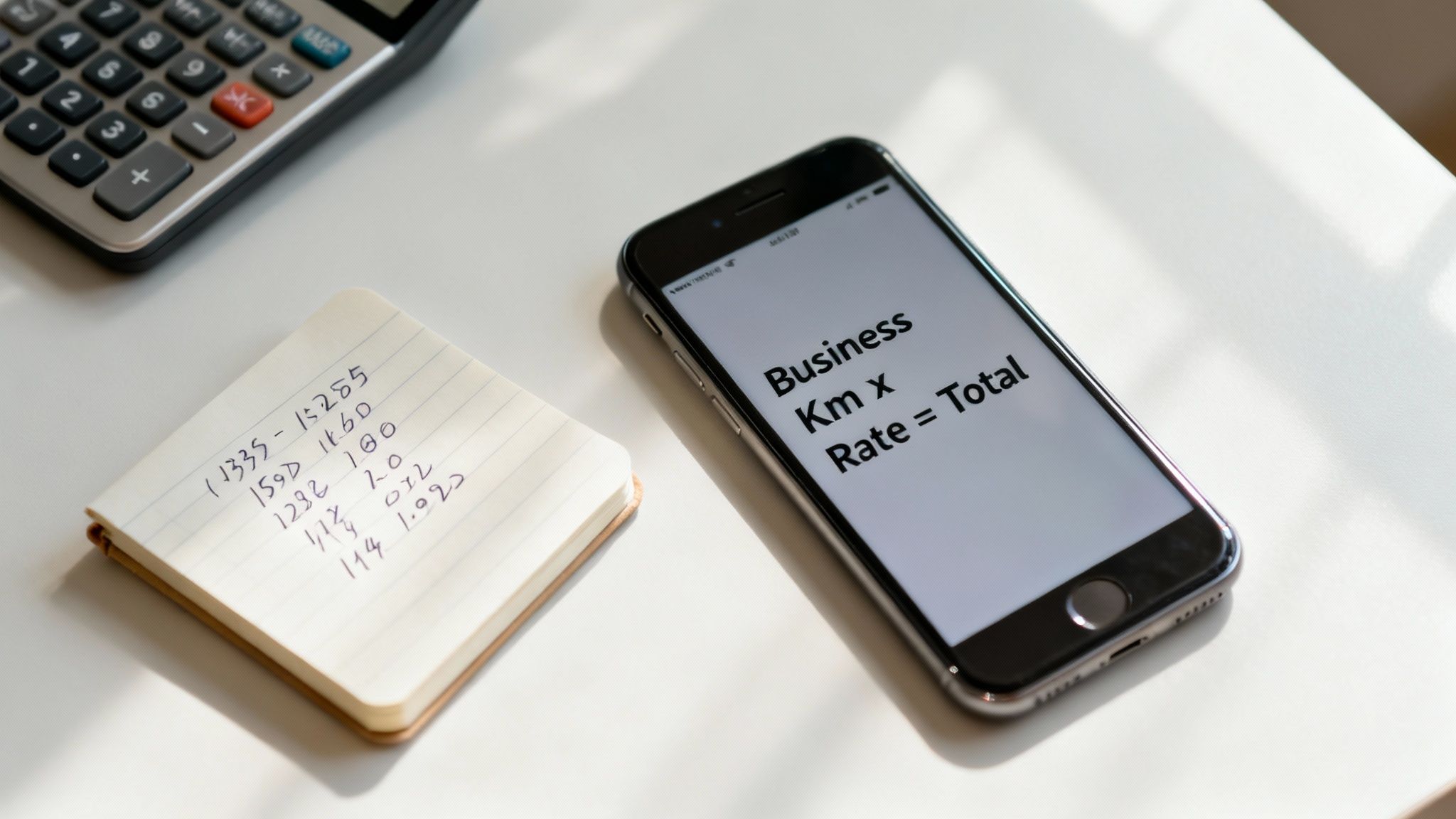
Working out your car expense deduction with the cents per kilometre method is refreshingly straightforward. Forget about digging through shoeboxes full of fuel receipts or wrestling with complex spreadsheets. It all comes down to a simple formula.
By following these three clear steps, you can confidently calculate the total amount to claim on your tax return. The whole process is based on one key number: the total work-related kilometres you drove, multiplied by the official ATO rate for the year. It’s designed for simplicity, and the calculation reflects that.
Step 1: Tally Your Business Kilometres
First, you need to add up every kilometre you drove for work-related reasons during the financial year. This is where keeping a record comes in handy—whether it’s a diary, a simple spreadsheet, or a dedicated app on your phone.
For every work trip, you should have noted the date, the reason for the journey, and how far you travelled. Once the financial year wraps up, just add the kilometres from all those individual trips to get your annual total. This number is the bedrock of your entire claim.
Step 2: Check The 5,000 Kilometre Limit
With your total kilometres in hand, it's time for a quick check against the ATO’s cap for this method. The cents per kilometre method lets you claim a maximum of 5,000 business kilometres per car, per year.
If your total is 5,000 km or less, you can move on to the final step using your actual figure. If you drove more than 5,000 business kilometres, you must cap your claim at the 5,000 km limit. You can only use 5,000 for the calculation.
Step 3: Apply The Correct ATO Rate
The final step is the easiest. Just multiply your business kilometres (up to that 5,000 km cap) by the official ATO rate for the relevant financial year. The result is your total deduction. It’s a good idea to understand all your options, and you can learn more about how to claim your car expenses for your tax deduction in our detailed guide.
Let’s break it down with a simple formula:
Calculation Flow:

[Start: Gather Trip Records]
       |
       v
[Sum Total Business Kilometres for the Year]
       |
       v
[Is Total > 5,000 km?] --(Yes)--> [Use 5,000 km for Calculation]
       |
     (No)
       |
       v
[Use Actual Total Kilometres]
       |
       v
[Multiply Kilometres by the Official ATO Rate for the FY]
       |
       v
[Result: Total Claimable Deduction ($)]
Here’s how it works in the real world:
Brisbane Example:Meet Sarah, a freelance graphic designer living in Fortitude Valley. Over the year, she drove a total of 3,800 km for work, travelling between client meetings in the CBD, South Brisbane, and West End. Her total is well under the 5,000 km limit, so she can use her actual figure.Assuming the ATO rate for the financial year is 88 cents per kilometre, her calculation looks like this:3,800 km × $0.88 = $3,344Sarah can now claim a $3,344 deduction on her tax return.
What Records You Actually Need To Keep

It’s a common myth that the cents per kilometre method is a "no records needed" shortcut. While you can avoid keeping fuel receipts and servicing invoices, you absolutely cannot skip documenting your travel.
The Australian Taxation Office (ATO) still requires you to show how you calculated your total business kilometres. Without that proof, your claim is just a number on a form—and it could easily be rejected if the ATO decides to take a closer look. Think of it this way: the cents per kilometre rate simplifies the cost part of the equation, but you’re still fully responsible for proving the distance you travelled.
What The ATO Expects To See
To back up your claim, you’ll need a diary, a simple logbook, or a digital record that clearly shows a breakdown of your work-related journeys. It doesn’t need to be fancy, but it does need to be consistent and capture key details for every single trip.
Here’s what the ATO will be looking for:
The date of the trip.
The start and end locations of your journey.
The total kilometres travelled.
The specific reason for the trip (e.g., "Client meeting at ABC Corp" or "Site inspection in Sunnybank").
Keeping a simple notebook in your glovebox or running a basic spreadsheet are perfectly acceptable methods.
A Simple Record-Keeping Checklist
Getting your records right is straightforward if you capture the correct details from day one.
Be Contemporaneous: Log your trips as they happen or at the end of each day. Trying to reconstruct a year's worth of travel right before your tax deadline is a recipe for errors.
Be Specific: Vague notes like "work trip" are insufficient. You need to be specific about who you met, what you did, or where you went.
Use Odometer Readings: While not strictly mandatory for this method, occasionally jotting down your car's odometer reading adds a strong layer of proof to your records.
Keep Records for Five Years: The ATO has the right to request your records for up to five years after you lodge your tax return.
Proof of Ownership: You must be able to prove you own or lease the car.
Proper documentation isn't just a suggestion; it’s a non-negotiable part of claiming any tax deduction. For a deeper dive, check out our guide on essential tax record-keeping practices.
Choosing Between The Cents Per Kilometre And Logbook Methods
Deciding between the cents per kilometre and logbook methods is a critical choice that directly impacts your tax return. There isn’t a single "best" option; the right one depends on your driving habits, your car's running costs, and how much record-keeping you are willing to do.
Think of it like this: the cents per kilometre method is the simple, low-admin choice for those who do less work-related driving. In contrast, the logbook method is the detailed, higher-reward option built for those who travel extensively for work. Your decision could be the difference between a modest deduction and a more substantial one.
Comparing The Two Methods
To make the right call, it helps to see the two methods side-by-side. The key differences boil down to the claim limits, the evidence you need to keep, and who benefits most. A small business owner in Brisbane who only makes a few client visits a month might find the simplicity of the cents per kilometre method is perfect. But a sales representative covering a large territory would almost certainly achieve a larger tax deduction by using the logbook method.
Here’s a quick comparison of the core features:
Feature | Cents Per Kilometre Method | Logbook Method |
|---|---|---|
Claim Limit | Capped at 5,000 business km per car | No kilometre limit |
Record-Keeping | Simple diary or app to track trips | Detailed 12-week logbook + all receipts |
Calculation | Business km x ATO rate | Total car costs x business use percentage |
Best For | Lower mileage drivers (<5,000 km) | High mileage drivers (>5,000 km) |
Evidence Needed | Diary or digital log to show how you calculated km | Logbook, plus receipts for fuel, insurance, etc. |
Who Benefits Most From Each Approach
The cents per kilometre method is tailor-made for people who want a legitimate deduction without the headache. If you drive less than 5,000 work-related kilometres a year, it strikes a fantastic balance between ease and value.
On the other hand, the logbook method is the clear winner for anyone who drives extensively for work. If your business travel consistently exceeds the 5,000 km cap, or if you drive a vehicle with high running costs (like a large ute or an expensive car with high depreciation), the logbook is likely to result in a larger deduction. For a complete walkthrough, check out our definitive guide to keeping a car logbook for the ATO.
Ultimately, choosing correctly requires an honest assessment of your annual travel. A simple estimate of your yearly kilometres can quickly tell you which path will be more financially rewarding for your situation.
Common Mistakes to Avoid When Making Your Claim
Using the cents per kilometre method is designed to be straightforward, but a few common slip-ups can easily attract unwanted attention from the ATO. Knowing these pitfalls is the best way to lodge a clean, defensible tax return.
The most frequent error is guessing kilometres at tax time. The ATO is clear that your claim must be based on records kept during the year, not a rough estimate. Without a diary or log, your claim has no real foundation and will likely be disallowed if audited.
Exceeding the Kilometre Cap
There's a hard rule with this method: the 5,000-kilometre limit. This cap applies per car, per financial year. It’s tempting to claim the full distance you drove, but the system is designed to stop you at that 5,000 km mark. If you drove 6,500 business kilometres, you must cap your claim at 5,000 km in your calculation.
Brisbane Example:Imagine a consultant based in Brisbane who drove 5,800 km visiting clients. When it's time to do their tax, they must cap their claim at 5,000 km. Claiming the full 5,800 km is a compliance breach and is the kind of error that can be flagged by the ATO’s systems.
Claiming the Daily Commute
This is a critical point. You cannot include the regular trip from your home to your main workplace. The ATO considers this private travel, and it’s not deductible. It doesn’t matter if you have a long drive or work odd hours—the rule still applies.
Work-related travel is generally the driving you do between two separate workplaces, from your office to a client’s site, or travel to an alternative workplace that isn’t your usual location.
Double-Dipping on Expenses
The cents per kilometre rate is an all-inclusive figure. It’s designed to cover all your car's running costs—fuel, registration, insurance, servicing, and even depreciation. A classic mistake is to claim using the cents per kilometre amount and then also try to claim a separate deduction for petrol or a new set of tyres.
This is called double-dipping, and it’s not permitted. When you choose this method, you forgo claims for any other individual car expenses for that vehicle.
For a deeper dive into what is and isn't allowed, you can explore the complexities of car tax deductions in Australia in our related article.
Frequently Asked Questions (FAQs)
Here are answers to some of the most common questions about the cents per kilometre method.
Can I claim for more than one car?
Yes, absolutely. The ATO allows you to claim deductions for multiple cars, as long as each one is used for work. The 5,000 business kilometre cap applies to each car individually. So, if you used one car for 3,000 business kilometres and a second car for 1,500 business kilometres in the same financial year, you can make a separate claim for both.
What does the ATO consider a 'business kilometre'?
A 'business kilometre' is any kilometre you drive while earning your income. Generally, this includes travel such as:
Driving between two separate workplaces.
Trips from your normal workplace to a client's site.
Travel to and from work-related conferences or training sessions that are not at your usual office.Crucially, your daily commute between home and your main workplace is not considered a business kilometre. The ATO views this as private travel.
Do I have to own the car to make a claim?
Yes, this is a key requirement. To use the cents per kilometre method, you must either own the car or have it leased (or under a hire-purchase agreement). You cannot use this method for a company car provided by your employer or for using a car owned by someone else (like a spouse or parent) unless a formal lease or similar arrangement is in place.
Can I switch between the cents per km and logbook methods?
Yes, you can. You have the flexibility to choose the method that best suits your circumstances each financial year for a particular car. You might find the cents per kilometre method is perfect one year, but if your work-related driving increases, switching to the logbook method the next year for the same car could be more beneficial. However, once you choose a method for a car in a specific financial year, you must stick with it for that entire year.
Summary
Simplicity: The cents per kilometre method is a straightforward way to claim work-related car expenses without needing to keep receipts for every cost.
Kilometre Cap: The claim is limited to a maximum of 5,000 business kilometres per car, per financial year.
ATO Rate: The ATO sets a flat rate per kilometre each year, which covers all running costs, including fuel, insurance, and depreciation.
Record-Keeping is Essential: You must keep a diary or log to show how you calculated your business kilometres. You cannot just estimate the total.
No Double-Dipping: You cannot claim other car expenses like fuel or servicing if you use this method.
Check Your Eligibility: The method is best for those who travel less than 5,000 km for work annually. High-mileage drivers may benefit more from the logbook method.
This information is general in nature and does not constitute financial or tax advice. Your individual circumstances can significantly affect the outcome of your tax claims. It is always recommended to seek personalised advice from a qualified tax professional to ensure you are compliant and maximising your entitlements.
Baron Tax & Accounting
Website: https://www.baronaccounting.com
Email: info@baronaccounting.com
Phone: +61 1300 087 213
Whatsapp: 0450 468 318
Comments