
A Practical Guide to Car FBT for Australian Businesses

If you provide a company car to an employee in Australia, you've entered the world of Car Fringe Benefits Tax (FBT). This is a tax employers pay when a company-owned or leased vehicle is available for an employee's private journeys. The Australian Taxation Office (ATO) considers the daily commute to and from work a private trip, making it a taxable non-cash benefit. This article is based on the Current Financial Year (FY YYYY–YY) at the time of writing.
From our experience at Baron Tax & Accounting, we observe that many Brisbane business owners are surprised that an FBT liability can be triggered simply by allowing an employee to garage a work vehicle at home. The key trigger is availability, not actual private use. Structuring vehicle arrangements correctly from the outset is a crucial compliance step we assist our clients with, preventing unexpected tax bills.
What Is Car FBT and How Does It Work?
When your business makes a car available for an employee's personal use, you have provided a fringe benefit. The ATO requires you to calculate the value of this benefit and pay tax on it, which is separate from the employee's regular income tax.
The definition of 'private use' is broad. It includes not just weekend trips but any travel that is not directly related to the employee performing their job duties.
The critical point is that availability for private use is the trigger, not just the actual use. If the car is kept at an employee's home with the keys accessible, the ATO deems it available for private use, and FBT may apply.
Step-by-Step: The Two Pathways for Calculation
To calculate the taxable value of the car benefit, the ATO provides two methods. Choosing the right one is essential for managing your tax liability effectively.
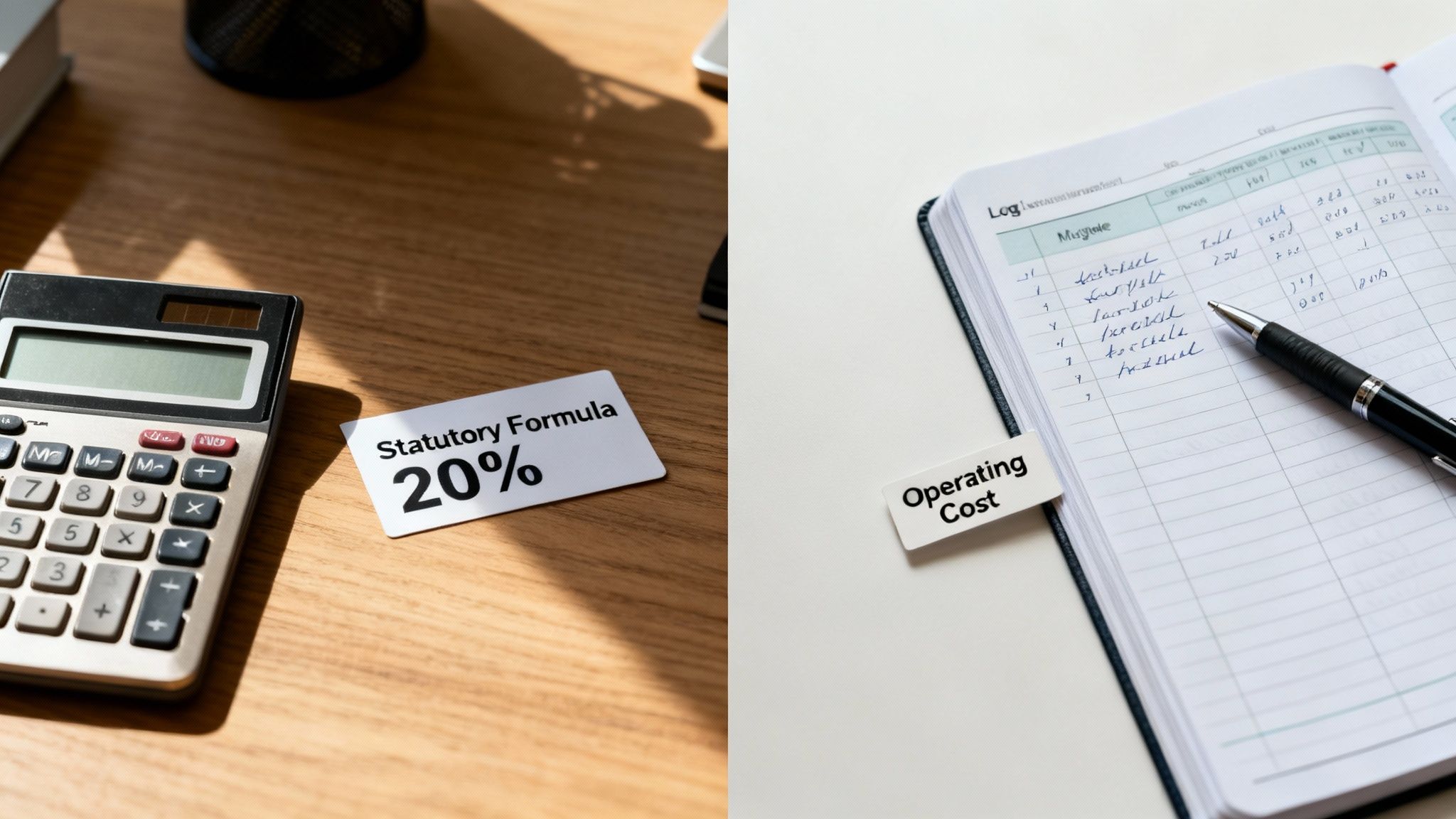
Statutory Formula Method: This is the simpler option. It applies a flat statutory rate of 20% to the car's base value. It is popular due to its simplicity and minimal record-keeping requirements.
Operating Cost Method: This method is more detailed. It calculates the FBT based on the actual costs of running the car, multiplied by the percentage of private use. This requires detailed records, typically an ATO-compliant logbook, but can result in significant tax savings if the vehicle is used heavily for business purposes.
Why Understanding Car FBT Is Essential
Managing Car FBT is more than a compliance task. Failure to comply can lead to ATO audits, penalties, and interest charges.
For any business providing vehicles—from a construction firm in North Lakes to a professional services firm in Brisbane's CBD—understanding these rules is about making informed financial decisions to legally minimise your tax obligations. For a deeper look at FBT in general, see our comprehensive guide to Australian FBT guidelines.
Choosing Your Car FBT Calculation Method
The method you choose to calculate your car FBT liability will significantly affect your final tax bill and administrative workload. This is a strategic decision based on how your business uses its vehicles.
One method offers simplicity and a predictable cost, while the other provides flexibility and potential savings for those prepared to track details meticulously.
The Statutory Formula Method: The Simple Approach
The Statutory Formula Method is the straightforward option. It simplifies the car FBT calculation by applying a flat statutory rate of 20% to the car's base value, regardless of the kilometres driven for business or private purposes.
Pros & Cons:
Pros: Certainty, predictability, and minimal paperwork.
Cons: Can be more expensive if the vehicle has low private use, as the tax is based on the car's value, not its actual usage.
The base value is the car's original purchase price (including GST and dealer delivery) plus any non-business accessories. It does not include registration or stamp duty. The formula is: .
The Operating Cost Method: The Detailed Approach
The Operating Cost Method calculates FBT based on the actual running costs of the car, multiplied by the percentage of private use. A meticulously kept, ATO-compliant logbook is non-negotiable for this method.
To use this method, you must track all vehicle running costs for the FBT year, including:
Fuel and oil
Repairs and maintenance
Registration and insurance
Deemed depreciation and imputed interest (for owned cars) or lease payments
Pros & Cons:
Pros: Can significantly reduce FBT liability for vehicles with high business use.
Cons: High administrative burden and strict record-keeping requirements.
This method often results in substantial tax savings for vehicles that are consistently on the road for work purposes.
Comparing the Two Methods
The right method depends on your specific circumstances. A car for a sales representative constantly visiting clients is a strong candidate for the Operating Cost Method. A vehicle provided mainly as a perk with high private use is likely better suited to the Statutory Formula Method.
Feature | Statutory Formula Method | Operating Cost Method |
|---|---|---|
Calculation Basis | Flat 20% of the car's base value. | Actual running costs × private use %. |
Record-Keeping | Minimal; need base value and days available. | Extensive; requires a valid logbook and all cost receipts. |
Best For | High private use, administrative simplicity. | High business use (e.g., >70%). |
Biggest Pro | Simple and predictable. | Potential for significant tax savings. |
Biggest Con | Can be costly for cars with low private use. | High administrative burden. |
Ultimately, calculating the FBT liability under both scenarios is the only way to determine which method is more cost-effective for your business.
How to Master ATO Logbook Requirements

For the Operating Cost Method, an ATO-compliant logbook is your essential evidence. Without a valid logbook, you cannot prove the business-use percentage, and the ATO may assess the benefit based on 100% private use.
A compliant logbook must be maintained for a continuous period of at least 12 weeks. This period must be representative of the car's normal travel patterns. A single, properly kept 12-week logbook can remain valid for up to five FBT years, provided the business use percentage does not change significantly (by more than 10%).
What to Record for Every Business Journey
For every business trip during the 12-week period, you must record the following details contemporaneously (i.e., as the trip happens):
Date of the journey.
Odometer readings at the start and end of the journey.
Total kilometres travelled.
Clear purpose for the journey. Vague descriptions like "client visit" are insufficient. Be specific, for example: "Travel to 123 Eagle St, Brisbane for project meeting with XYZ Corp".
While you don't need to detail private trips, you must record the total kilometres travelled during the logbook period to calculate the total private kilometres. For more on vehicle deductions, especially for sole traders, you can read about the cents per km method.
Calculating Your Business-Use Percentage
After the 12-week period, calculating the business-use percentage is straightforward. The formula is: (Total Business Kilometres ÷ Total Kilometres Travelled) × 100 = Business-Use Percentage (%)
For example, a Brisbane-based consultant travelled 8,000 km during their logbook period, with 6,400 km being for documented business trips. The calculation is . This means FBT applies to only 20% of the car's total operating costs for the year.
Putting Car FBT Calculations Into Practice
To understand car FBT, it's helpful to see it applied with real-world numbers. The difference between the statutory and operating cost methods becomes clear with practical examples.
Example 1: Brisbane Executive (Statutory Formula Method)
A Brisbane-based company provides an executive with an SUV for the entire FBT year. Private use is high, including school runs and weekend trips.
Car's Base Value (incl. GST): $60,000
Days Available for Private Use: 365
Employee Post-Tax Contribution: $3,000
Statutory Rate: 20%
Calculation Steps:
Calculate Statutory Value:
Deduct Employee Contribution:
The final taxable value for the car fringe benefit is $9,000. The employer uses this figure to calculate the FBT payable.
Example 2: The Operating Cost Method
A tradesperson at a construction firm uses a ute to travel between job sites across Brisbane. Private use is minimal.
Total Annual Operating Costs: $15,000 (fuel, insurance, rego, maintenance, deemed depreciation)
Business-Use Percentage (from logbook): 90%
Private-Use Percentage: 10% (100% - 90%)
Employee Post-Tax Contribution: $0
Calculation Steps:
Calculate Total Private Use Cost:
The final taxable value is $1,500. This demonstrates the significant savings achievable with the Operating Cost Method for high business-use vehicles. These calculations also impact what appears on an employee's income statement, which you can learn more about by understanding what reportable fringe benefits are and why they matter.
A Quick Decision-Making Flowchart
This simple decision tree helps visualise which path to take.
Employer Provides Car for Private Use
            |
            V
Is the car's business use high?
   /                \
 YES                 NO
  |                  |
  V                  V
Maintain Logbook     No Logbook Needed
  |                  |
  V                  V
Use Operating Cost   Use Statutory Formula
Method               Method
  |                  |
  V                  V
(Total Costs x      (Base Value x 20%)
 Private Use %)      - Employee Contributions
- Employee           = Taxable Value
  Contributions
  = Taxable Value
The primary question is the vehicle’s main purpose. If it's a workhorse, the effort of record-keeping for the Operating Cost Method is usually worthwhile.
Common FBT Exemptions and Mistakes to Avoid
Understanding available exemptions and common pitfalls is crucial for compliance and can save your business significant time and money.
A common misconception is that commercial vehicles like utes are automatically exempt from FBT. This is not the case; the exemption depends entirely on how the vehicle is used.
Understanding Commercial Vehicle Exemptions
The most common FBT exemption applies to eligible commercial vehicles, such as single-cab utes or panel vans designed to carry a load of one tonne or more.
For the exemption to apply, any private use by an employee must be minor, infrequent, and irregular. The ATO defines this as:
Home-to-Work Travel: Generally permitted.
Minor Deviations: Occasional, small detours (e.g., stopping for milk on the way home) are usually acceptable.
Infrequent Private Journeys: An occasional non-work trip may be acceptable.
If the work ute is used for regular weekly grocery shopping or frequent weekend trips, it fails this test, and the FBT exemption is lost. You can find more detail in our guide on how to get an FBT exemption for a car in Australia.
Common and Costly FBT Mistakes
Many businesses in a busy city like Brisbane inadvertently make errors that lead to ATO penalties. Here are the most common mistakes:
Incorrect Base Value: When using the statutory method, the 'base value' must include the original cost, GST, and dealer delivery, but exclude registration and stamp duty.
Inadequate Logbooks: Vague entries, missing odometer readings, or a non-representative 12-week period will lead to the ATO rejecting the logbook.
Confusing Employee Contributions: Only post-tax employee contributions reduce the car's taxable value. Pre-tax salary sacrifice arrangements do not provide the same FBT reduction.
Forgetting Car Parking FBT: Providing a car park can be a separate fringe benefit, especially in areas like the Brisbane CBD where parking is at a premium.
It's also important to note the tax rules for different business structures. While this article focuses on FBT for employees, sole traders have different rules for vehicle expenses, and it is important to understand the various sole trader tax deductions available.
Summary: Key Takeaways for Car FBT Compliance
Managing car FBT effectively comes down to choosing the right calculation method for each vehicle and maintaining immaculate, ATO-compliant records.
Method Choice is Key: The Statutory Formula Method offers simplicity for cars with high personal use. The Operating Cost Method, supported by a detailed logbook, provides significant tax savings for vehicles with high business use.
Records are Non-Negotiable: Accurate logbooks and receipts for all running costs are essential. Without them, you cannot use the Operating Cost Method.
Exemptions Have Strict Rules: Commercial vehicle exemptions depend on private use being minor, infrequent, and irregular.
Avoid Common Errors: Ensure the car's base value is correct, logbooks are detailed, and employee contributions are post-tax.
Integrating FBT compliance into your wider effective fleet management practices is not just about meeting ATO requirements; it's about running a more cost-effective and efficient business.
Car FBT Compliance Checklist
Use this checklist to manage your car FBT obligations throughout the FBT year.
[ ] Assess Vehicle Use: Determine if each car is primarily for business or has significant private use.
[ ] Choose Calculation Method: Select the most cost-effective method (Statutory or Operating Cost) for each vehicle.
[ ] Calculate Base Value Correctly: For the statutory method, ensure the base value is accurate.
[ ] Maintain an ATO-Compliant Logbook: For the operating cost method, keep a detailed 12-week logbook.
[ ] Track All Operating Costs: File receipts for all vehicle-related expenses (fuel, insurance, maintenance, etc.).
[ ] Record Employee Contributions: Document all post-tax payments made by employees towards vehicle costs.
[ ] Lodge FBT Return on Time: Prepare and lodge your annual FBT return by the due date.
[ ] Retain Records for Five Years: Keep all FBT records for a minimum of five years after lodgement.
FAQs: Your Car FBT Questions Answered
Here are answers to some of the most frequently asked questions about car fringe benefits tax.
What does the ATO consider private use of a work car?
The ATO defines private use broadly as any use of a car by an employee that is not for work-related purposes. This includes the daily commute between home and the regular workplace. The key trigger is availability. If an employee can use the car for private journeys (e.g., it is garaged at their Brisbane home), an FBT liability may arise, regardless of whether it was actually used for private travel.
Can I switch between the Statutory and Operating Cost methods?
Yes, you can and should. Employers can choose the most tax-effective method for each car, each FBT year. It is a good practice to calculate the liability under both methods annually to determine which results in a lower tax bill, especially if an employee's driving patterns change.
How does an employee contribution reduce FBT?
An employee contribution is a post-tax payment made by the employee to the employer for the private use of the car. This payment directly reduces the taxable value of the fringe benefit on a dollar-for-dollar basis. For example, if a car's taxable value is $9,000 and the employee contributes $2,000 from their after-tax salary, the final taxable value becomes $7,000.
Are electric vehicles (EVs) treated differently for car FBT?
Yes. To encourage the adoption of cleaner transport, the Australian government has an FBT exemption for eligible zero or low-emissions vehicles. To qualify, the vehicle must be a battery electric, hydrogen fuel cell, or plug-in hybrid electric vehicle, and its value must be below the luxury car tax threshold for fuel-efficient vehicles at the time it was first held and used. While the benefit is exempt from FBT, it is still a reportable fringe benefit on the employee's income statement.
What are the consequences of not keeping a logbook correctly?
The consequences can be costly. If a logbook is incomplete, has vague entries, was not kept for a continuous 12-week period, or is not representative of normal use, the ATO can reject it. If this happens, you lose the ability to use the Operating Cost Method. The car FBT calculation will default to the Statutory Formula Method, which almost always results in a higher FBT liability for vehicles with high business use.
If you’re unsure whether a work vehicle is “available for private use” (which is often the real trigger), it’s worth doing a quick review before the FBT year ends. Small changes—such as clarifying garaging arrangements, keeping an ATO-compliant logbook, or rechecking which calculation method best matches your actual usage—can materially change the outcome and reduce compliance risk.
If your vehicle setup, records, or calculation method isn’t clear, it can be helpful to check it early—before you finalise your FBT position for the year.
The information provided in this article is general in nature and does not constitute professional financial advice. Your personal circumstances can significantly affect your tax obligations. We recommend seeking personalised advice to ensure you apply the rules correctly to your circumstances.
Baron Tax & Accounting
Website: https://www.baronaccounting.com
Email: info@baronaccounting.com
Phone: +61 1300 087 213
Whatsapp: 0450 468 318
Comments