
Navigating Penalties for Late Tax Returns in Australia

Updated: Jul 20, 2025
It’s a scenario no one wants to find themselves in, but missing a tax deadline happens. If you've lodged your tax return late, you might be picturing a complicated and stressful penalty process. The good news is that the Australian Taxation Office (ATO) has a pretty clear-cut system for this.
So, what actually happens when you lodge late? Let's break it down.
Late Tax Return Penalties: What to Expect First
When you miss the lodgement deadline, the ATO applies what's officially known as a Failure to Lodge (FTL) penalty. This isn't some arbitrary figure plucked out of thin air; it’s a structured fine designed to encourage everyone—from individuals to large companies—to get their paperwork in on time.
One of the biggest misconceptions is that you’ll only be penalised if you owe tax. That’s not the case. The FTL penalty is for the act of lodging late, plain and simple. Even if you’re expecting a hefty refund, the penalty can still apply.
How FTL Penalties Are Calculated
The ATO uses a system based on "penalty units" to calculate the fine. Think of a penalty unit as a standardised measurement for fines across various government departments. The value of this unit is set and updated by the government.
The formula is straightforward:
You are charged one penalty unit for every 28-day block (or part of a block) your return is overdue.
For individuals and small businesses, this penalty maxes out at five penalty units.
Basically, the longer the delay, the higher the fine, but it’s capped for smaller entities. It’s a methodical approach that ensures the penalty fits the delay.
The Current Cost of a Penalty Unit
Right now, one penalty unit is valued at $330 AUD.
Since you’re charged one unit for every 28-day period you're late, the fine builds up. If you're a couple of months late, that's two penalty units, or $660. The maximum fine for an individual or small business is five units, which comes to $1,650 AUD. You can get more details on late tax return penalties in Australia if you need a deeper dive.
Key Takeaway: Remember, the FTL penalty is automatic and based on when you lodge, not how much you owe. You can be fined for filing late even if the ATO owes you money, so hitting that deadline is crucial no matter what.
ATO Failure to Lodge (FTL) Penalty Rates by Entity Size
Of course, the ATO doesn’t treat a sole trader the same way it treats a multinational corporation. The maximum penalty you can face depends on the size of your entity, which is determined by your annual turnover or assessable income.
Here’s a quick overview of how the penalties scale up.
Entity Size | Turnover / Assessable Income | Penalty per 28-Day Period | Maximum Penalty (5 Units) |
|---|---|---|---|
Small Entity | Less than $1 million | $330 (1 unit) | $1,650 (5 units) |
Medium Entity | $1 million to less than $20 million | $660 (2 units) | $3,300 (10 units) |
Large Entity | $20 million or more | $1,650 (5 units) | $8,250 (25 units) |
Significant Global Entity (SGE) | Part of a group with over $1 billion global income | $82,500 (250 units) | $412,500 (1,250 units) |
As you can see, while the base penalty for a 28-day delay starts at $330 for small entities, it increases significantly for larger businesses. This tiered system ensures the penalty is a genuine deterrent for organisations of all sizes.
How the ATO Calculates Your Late Lodgement Penalty
Figuring out the penalties for a late tax return can feel a bit daunting, but the Australian Taxation Office (ATO) doesn’t just pull a number out of thin air. There's a clear formula at play, and understanding it is the first step to getting the situation under control.
The system is built around what the ATO calls penalty units. Think of a penalty unit as a standard building block for government fines. The government sets its value, and right now, one penalty unit is $330. This single figure is the starting point for almost all Failure to Lodge (FTL) penalties.
So, how does it work? The ATO uses a simple time-based calculation. For every 28-day period (or even part of a period) that your tax return is overdue, one penalty unit is applied. The clock starts ticking the day after your deadline and won't stop until you've lodged.
The image below perfectly captures the pressure so many people feel when they’re up against a deadline with a mountain of paperwork.
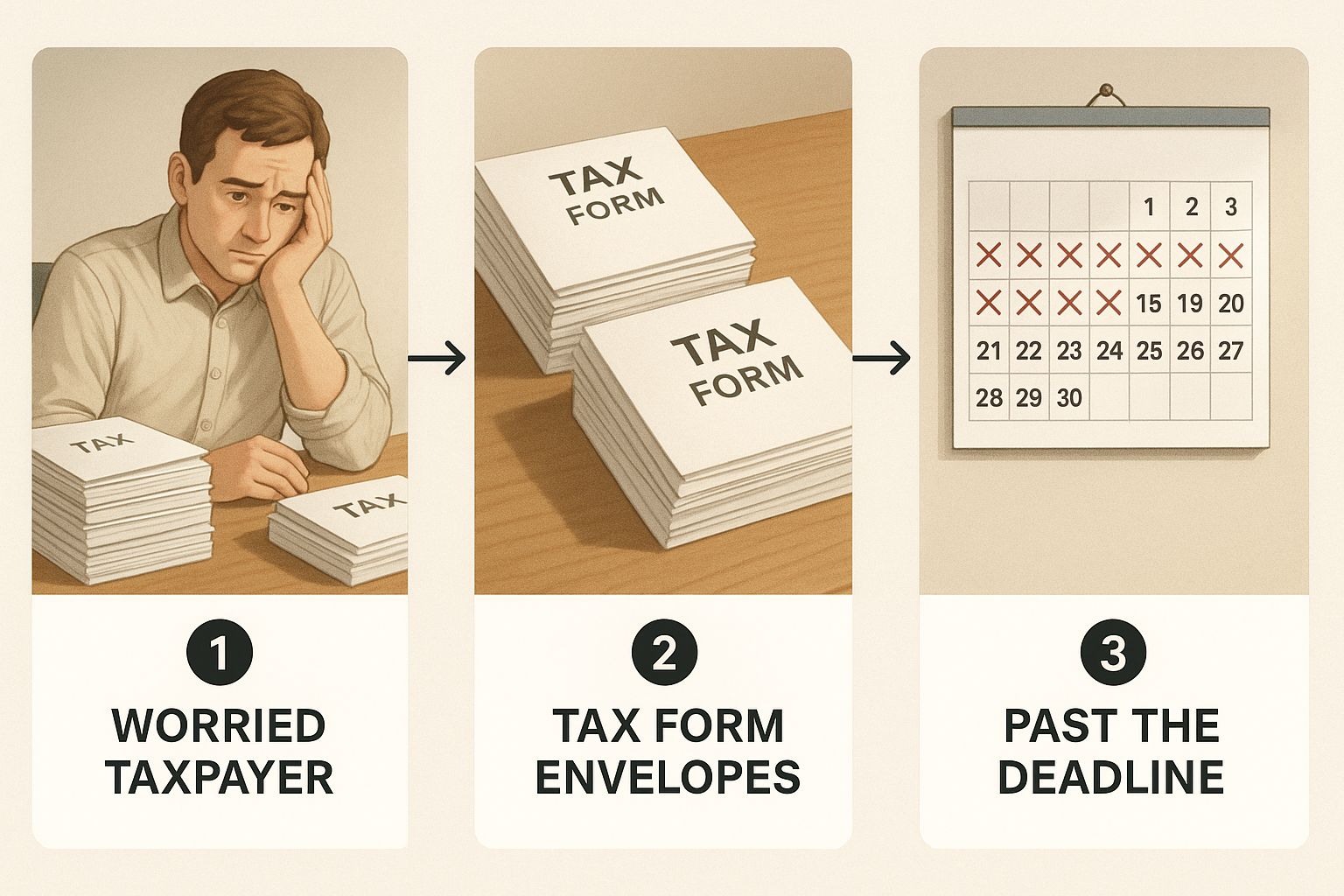
This feeling of time running out is exactly what the ATO’s penalty structure is designed to discourage. Every day you delay could have a real financial consequence.
The Penalty Unit Clock in Action
For individuals and small businesses (those with a turnover under $1 million), the penalty is capped. The meter stops running after five 28-day blocks.
Here’s a quick breakdown of how it adds up:
1 to 28 days late: 1 penalty unit = $330
29 to 56 days late: 2 penalty units = $660
57 to 84 days late: 3 penalty units = $990
85 to 112 days late: 4 penalty units = $1,320
113+ days late: 5 penalty units = $1,650 (Maximum)
Let's put this into a real-world context.
Example A: The Sole Trader Sarah, a sole trader, got swamped with work and completely forgot about her tax return. She finally lodged it 40 days past the due date. Because her lodgement falls into the second 28-day block, she’s up for two penalty units. Calculation: 2 penalty units x $330 = $660 fine.
This shows that being just one day into the next 28-day window is enough to trigger the full penalty for that entire block.
How Penalties Escalate for Businesses
While the calculation is straightforward for individuals, the ATO raises the stakes significantly for larger businesses. The core idea of applying penalty units for every 28-day block is the same, but the number of units—the multiplier—shoots up based on the business's size. This ensures the penalty is a genuine deterrent, regardless of turnover.
Medium Entities (turnover of $1 million to less than $20 million) have their penalty units doubled.
Large Entities (turnover of $20 million or more) have their penalty units multiplied by five.
Let’s look at our example again, but this time with a company.
Example B: The Small Company A company with an annual turnover of $2.5 million lodges its return 70 days late. This puts it in the third 28-day block, which is normally three penalty units. However, as a medium entity, this base penalty is doubled. Calculation: (3 penalty units x 2) x $330 = $1,980 fine.
As you can see, late tax return penalties can quickly become a serious cost for businesses. Staying on top of all your lodgement obligations is absolutely vital, and this goes beyond your annual tax return. For business owners, things like ABN compliance are just as critical. You can learn more in our guide to ABN and tax return compliance to make sure you have all your bases covered.
Of course. Here is the rewritten section, crafted to sound like it was written by an experienced human expert, following all your specified requirements.
What Triggers a Late Lodgement Penalty? It’s More Than Just Your Tax Return
Many people assume late lodgement penalties are only for your annual tax return. That’s a common and costly mistake. The Australian Taxation Office (ATO) actually casts a much wider net when it comes to deadlines.
The Failure to Lodge (FTL) penalty system isn’t just about one form. It applies to a whole range of documents and reports you’re required to submit. Thinking only your main tax return matters can lead to some nasty surprises and unexpected fines from the ATO.
The Most Common Culprits for Late Penalties
For most individuals and almost every business, tax obligations don't stop at the end-of-financial-year return. Each of these reports has its own due date, and if you miss it, you're looking at the same FTL penalty framework.
Here are some of the key documents that often trip people up:
Business Activity Statements (BAS): If your business is registered for GST, you need to lodge a BAS, usually monthly or quarterly. Failing to get your BAS in on time is one of the most frequent reasons business owners get hit with an FTL penalty.
Pay As You Go (PAYG) Withholding Annual Reports: As an employer, you have to submit an annual report that summarises all the tax you've withheld from your employees' pay. Miss this deadline, and a penalty is sure to follow.
Fringe Benefits Tax (FBT) Returns: Do you provide benefits like a company car for private use? You’ll need to lodge an FBT return. This is a separate obligation with its own deadline.
Single Touch Payroll (STP) Reports: Businesses must report payroll details to the ATO every single time they pay their employees through STP-enabled software. The ATO can, and does, apply penalties for consistently late or missing STP reports.
The Bottom Line: The ATO treats all your lodgement deadlines with the same level of importance. A late BAS is taken just as seriously as a late income tax return, which is why you need a solid handle on all your reporting duties.
The ATO's Automated System is Always Watching
The ATO's compliance process is heavily automated. Its systems are built to talk to each other, cross-reference data, and automatically flag any "lodgement obligation" that hasn't been met by its deadline. Once a due date passes, the system can issue an FTL penalty without a human ever lifting a finger.
This automated approach means there’s very little wiggle room. This system for late lodgement covers a massive range of documents, from tax returns and activity statements to FBT returns, PAYG withholding annual reports, and GST returns.
This broad scope just reinforces how crucial it is to know all your deadlines. Whether you’re a sole trader juggling quarterly BAS or a larger company with multiple reporting requirements, staying organised is your best defence. Getting a complete picture of your financial responsibilities is the key to avoiding these completely preventable fines.
The Hidden Cost of General Interest Charge on Unpaid Tax
Beyond the initial sting of a Failure to Lodge (FTL) penalty, another, more relentless cost often works silently in the background: the General Interest Charge (GIC). It’s absolutely critical to understand that GIC is not a penalty. Think of it as interest charged by the Australian Taxation Office (ATO) on any tax you haven't paid.
It works just like the interest on a credit card debt. Even after you’ve dealt with any late fees, the interest keeps building every single day until the outstanding balance is cleared. Many taxpayers make the mistake of thinking that just lodging their overdue return stops all financial consequences. In reality, lodging the return is only half the battle; paying the tax you owe is what finally stops the GIC clock.
How the ATO Calculates General Interest Charge
The ATO doesn’t just pull the GIC rate out of thin air. It’s calculated using a specific, transparent formula set by law. The rate is based on the 90-day Bank Bill Accepted Rate—a key benchmark in Australian financial markets—plus an "uplift factor" of 7 percentage points.
The real kicker? This interest is calculated on your outstanding tax debt daily and it compounds. This daily compounding is what can make GIC so damaging over time, turning a manageable tax debt into something much larger if it's left unpaid. You can always find the current and historical GIC rates on the official ATO website.
Key Insight: Lodging your return determines the FTL penalty. Paying your tax debt determines the GIC. If you don't pay, your debt will grow every single day, even if your return was filed on time.
GIC in Action: A Real-World Example
Let's see how a small debt can quickly escalate. Imagine a small business owner, Alex, lodges his tax return and discovers he owes $5,000. He’s relieved to have lodged but decides to hold off on paying for a few months to help with cash flow.
Let's assume the annual GIC rate is 11% (a realistic figure based on recent history).
Initial Debt: $5,000
Daily Interest Rate: 11% / 365 days = roughly 0.03% per day
Interest after 90 days: After about three months, Alex would owe over $135 in interest alone. And because it compounds, this amount will continue to grow faster as the interest is added to the new, larger balance.
While $135 might not sound like the end of the world, it’s money that was completely avoidable. For larger debts or longer delays, the GIC can easily add thousands of dollars to the original tax bill, creating serious financial pressure. Ensuring you have all your documents ready from the start can prevent these kinds of delays. For a helpful guide, check out our comprehensive [tax return checklist](https://www.baronaccounting.com/post/tax-return-checklist).
Stopping the Interest Clock
The only way to stop GIC from piling up is to pay the primary tax debt in full. It’s that simple. Once the original tax amount is paid, the interest clock stops ticking on that balance.
If you can't pay your entire tax debt at once, it is vital to contact the ATO or your registered tax agent immediately. You may be able to arrange a payment plan. While GIC will still apply to the outstanding balance, proactively engaging with the ATO shows good faith and can prevent more severe collection actions. Ignoring the debt is the worst possible strategy, as the interest will only continue to mount.
That penalty notice from the Australian Taxation Office (ATO) for a late tax return can really make your heart sink. But don't despair – it’s not always the final word. The ATO can, and often does, show leniency by cancelling (or "remitting") penalties and interest charges if you have a genuinely good reason.
Success hinges on building a clear, convincing case. This isn't about finding a loophole; it's about showing that your failure to lodge on time was due to circumstances genuinely beyond your control or that this was a rare slip-up in an otherwise perfect compliance history. A well-prepared request can make a huge difference, potentially saving you hundreds or even thousands of dollars.
What Does the ATO Consider a Valid Reason?
The ATO looks at every remission request on a case-by-case basis. They’re looking for specific, legitimate reasons for the delay, so vague excuses like "I was too busy" or "I just forgot" almost never work.
Generally, a successful request will be based on reasons like these:
Serious Illness or Accident: A significant health issue that affected you or a close family member, directly preventing you from managing your tax affairs.
Natural Disasters: Events like floods, bushfires, or cyclones that physically stopped you from accessing your records or lodging your return.
Unforeseen Personal Circumstances: A death in the family or another serious personal crisis that understandably took priority over your tax obligations.
Lost or Damaged Records: If your crucial tax documents were destroyed or became inaccessible due to something you couldn't control, like a house fire or flood.
Good Compliance History: If you have a squeaky-clean record of lodging and paying on time, the ATO is much more likely to forgive a one-off mistake. Think of it as a "first-time offender" consideration.
Key Insight: When you ask for a remission, your job is to tell a clear story backed up by solid evidence. The stronger your proof, the better your chances are of the ATO agreeing to waive the penalties for your late tax return.
The Steps to Requesting a Remission
Requesting a remission is a formal process, not a casual chat. You need to gather your evidence, frame your argument clearly, and send it through the right channels. Taking the time to do it properly is key.
1. Gather Supporting Evidence
Evidence is everything. You can't just say you were sick; you need to prove it.
For Illness: Get a letter from your doctor. It should detail the nature of your illness and the specific period you were incapacitated.
For Natural Disasters: Collect insurance claims, photos, news articles, or official disaster declarations for your area.
For Personal Trauma: A death certificate or other relevant official documents can support your case.
For Lost Records: A police report (for theft) or an insurance claim (for fire/flood) is powerful evidence.
2. Write a Persuasive Request
Your written request should be clear, concise, and respectful. Explain exactly what happened, how it stopped you from lodging on time, and what you’ve done since to get back on track. A calm, well-structured letter is far more powerful than an emotional or angry one.
It’s also helpful to show you’re trying to understand your obligations. For example, explain how the situation impacted your ability to get your head around complex topics, like the rules for the tax-free threshold in Australia.
3. Submit Your Request Correctly
You’ve got a few options for submitting your request:
Online: Using your myGov account (for individuals) or Online services for business is usually the fastest way.
By Phone: You can call the ATO, but make sure you have all your details and evidence organised and in front of you before you dial.
Through a Tax Agent: An experienced tax agent can manage the entire process for you. Their expertise and familiarity with the system often lead to a better outcome.
The 'Safe Harbour' Provision for Tax Agents
Here’s one of the biggest advantages of using a registered tax or BAS agent: the 'safe harbour' provision.
This rule protects you from certain late-lodgment penalties if the failure to lodge was your agent's fault, not yours. To qualify for this protection, you must be able to prove that you gave your agent all the necessary information well before the deadline, giving them everything they needed to lodge your return correctly and on time. It’s a great safety net that highlights the value of having a professional in your corner.
Proactive Strategies to Avoid Future ATO Penalties
Getting hit with a penalty notice is stressful, but let's be honest—the best way to handle a penalty for a late tax return is to never get one in the first place. Making the switch from a reactive to a proactive mindset isn't just about dodging fines. It's about taking back control of your finances and giving yourself some well-earned peace of mind. The most powerful way to stay compliant and secure is by building good systems and habits.

The secret to good tax management is surprisingly simple: organisation. If you only start thinking about your finances when June rolls around, you’re just setting yourself up for a frantic, mistake-filled tax season. The trick is to treat tax compliance like a year-round job, not a once-a-year headache.
Create Your Tax Compliance Calendar
One of the easiest yet most effective things you can do is set up a tax calendar. You don't need expensive software for this; a simple digital calendar or even a planner on your wall works perfectly.
Start by plotting out all your key lodgement dates for the financial year.
Annual Income Tax Return: This is usually due by 31 October if you're lodging it yourself.
Business Activity Statements (BAS): Mark down the quarterly deadlines, which are typically 28 October, 28 February, 28 April, and 28 July.
PAYG Instalments: Note the due dates for your quarterly payments.
Superannuation Payments: Make sure you pay super for your employees by the quarterly deadlines to steer clear of the costly Superannuation Guarantee Charge.
By seeing your deadlines laid out visually, you turn abstract tasks into real, manageable goals. A date on a calendar is a simple nudge that prompts you to act, helping you stay ahead of the game and avoid that last-minute panic.
Master Your Financial Record-Keeping
Messy records are the number one reason for tax-time stress and delays. That shoebox overflowing with faded receipts? It’s a recipe for disaster. The solution is to digitise and organise your records as you go.
Here are a few simple habits that make a world of difference:
Use Accounting Software: Tools like Xero or MYOB can automate a huge chunk of your bookkeeping, saving you countless hours.
Snap Receipts Instantly: Use your phone to take a photo of every business receipt the moment it lands in your hand. Store these in a dedicated cloud folder (like Google Drive or Dropbox), neatly sorted by month.
Reconcile Your Accounts Regularly: Block out just 30 minutes each week or month to reconcile your bank accounts. This simple step makes preparing your BAS or annual return incredibly straightforward.
Of course, lodging on time is only half the battle. For small business owners, a truly proactive strategy means understanding all your tax obligations, including how to optimise your deductions. This not only keeps you compliant but also minimises the risk of future problems.
Engage a Professional for Ultimate Security
While these DIY strategies are fantastic, the ultimate proactive move is to bring a registered tax agent on board. A good agent does so much more than just lodge your return; they become your strategic partner in compliance.
They provide a vital safety net, manage your deadlines, ensure everything is accurate, and can even secure lodgement extensions that might push your due date as late as May of the next year. Having that expert oversight is invaluable for preventing any future penalties for a late tax return.
Frequently Asked Questions
It's natural to have a few nagging questions when you're dealing with late tax returns. Let's tackle some of the most common worries we hear from clients, one by one.
What If I Am Due a Refund but Lodge Late?
This is a really common scenario. The good news is that if you're due a refund or have a 'nil' tax position (meaning you don't owe anything), the ATO generally won't hit you with a Failure to Lodge (FTL) penalty.
But don't treat this as a free pass. Lodging late will, of course, delay your refund from hitting your bank account. More importantly, the ATO keeps track. Consistently lodging late, even when you’re owed money, can flag your account as higher risk, potentially leading to more scrutiny down the track.
Can I Go to Jail for Not Lodging a Tax Return?
Let's be clear: this is incredibly rare for an average person who is simply running behind. However, it is a criminal offence to flat-out refuse to lodge a tax return after receiving a formal demand from the ATO.
Prosecution is the ATO's last resort. It's typically reserved for people who deliberately and repeatedly ignore their obligations over many years. So, while jail time is technically possible, it's not a realistic concern for the everyday late filer.
How Far Back Can the ATO Chase Unlodged Returns?
Technically, there's no statute of limitations. The ATO can pursue unlodged returns from many years ago, and they often do. Their data-matching systems are sophisticated and can easily identify if you earned taxable income in a past year where you failed to lodge.
It's always, always better to get on the front foot and voluntarily catch up. Waiting for the ATO to track you down is a far more stressful and complicated process.
Still Unsure? Let's Talk It Through
Wrestling with late tax returns and trying to make sense of the ATO’s rules can be a real headache. It's a confusing space, and let's face it, nobody wants to get it wrong.
If you're staring at an overdue return or just want to make sure you’re staying on the right side of the ATO, our team of registered tax agents is here to help. We can cut through the noise, clarify exactly what you need to do, and even speak to the ATO for you. Our goal is to help you build a clear path forward, giving you long-term financial peace of mind.
Don't let tax stress get the better of you. We offer free, no-obligation chats to go over your situation and figure out the best next steps.
• Need assistance? We offer free online consultations: – Phone: 1800 087 213 – LINE: barontax – WhatsApp: 0490 925 969 – Email: info@baronaccounting.com – Or use the live chat on our website at www.baronaccounting.com
📌 Curious about your tax refund? Try our free calculator: 👉 www.baronaccounting.com/tax-estimate
For more resources and expert tax insights, visit our homepage: 🌐 www.baronaccounting.com


Comments