
How to Set Up a Trust in Australia: A Step-by-Step Guide

Setting up a trust in Australia is the process of creating a formal legal relationship where one person or entity—the trustee—holds assets for the benefit of others, known as beneficiaries. This structure is established through a legal document called a trust deed. It is a primary strategy for anyone serious about asset protection, effective tax planning, and managing wealth for their family or business partners. Understanding this structure is critical, as failure to comply with Australian Taxation Office (ATO) and legal standards can lead to significant financial penalties.
Why Do I Need a Trust in Australia?

It’s important to remember that a trust is not a separate legal entity like a company; it is a powerful legal relationship. You have a trustee (a person or company) who legally holds and manages property for the benefit of the beneficiaries. The person who initiates the process is the settlor, who provides the initial asset to formally establish the trust.
Here at Baron Tax & Accounting in Brisbane, we often assist clients in transitioning from a sole trader structure to a trust once their business or investment portfolio grows. A common oversight we observe is the underestimation of the strict annual compliance duties. For example, a Brisbane-based client running a successful e-commerce store might set up a trust to protect their assets, but they may not initially realise the importance of the annual trustee resolution to distribute income. Missing the 30 June deadline for this resolution can result in the trust's income being taxed at the highest marginal rate, a costly and avoidable mistake.
The rulebook for the entire arrangement is the trust deed. This legally binding document lays out everything: the powers of the trustee, the rights of the beneficiaries, and how the trust must operate. It’s the single most critical document, shaping how the trust functions for its entire life.
Key Roles Within a Trust Structure
Understanding who does what is the first step to ensuring a trust operates legally and effectively.
Settlor: This is the person or company that officially establishes the trust. They provide the initial asset (often a symbolic $10) to bring it into existence. Critically, the settlor cannot also be a beneficiary, as this would invalidate the trust.
Trustee: The trustee is the legal owner of the trust's assets. They have a strict fiduciary duty to manage these assets purely for the benefit of the beneficiaries, always following the rules set out in the trust deed. A trustee can be one or more individuals or, more commonly, a company (known as a corporate trustee).
Beneficiaries: These are the individuals or entities who stand to benefit from the trust's income and capital. In a discretionary trust—the most common type for families—the trustee has the power to decide which beneficiaries receive a distribution each financial year. For more detail, see our guide on what a discretionary trust is.
Compliance and Regulatory Scrutiny
Operating a trust is a significant responsibility. The Australian Taxation Office (ATO) closely monitors trust arrangements, especially how income is distributed and taxed. Failing to meet your legal obligations can lead to severe consequences.
According to the ATO, one of the most significant compliance risks is the failure to properly distribute income. If a trust’s net income is not effectively distributed to its beneficiaries by the 30 June deadline, the trustee can be assessed on that income at the highest marginal tax rate—currently 45% plus the Medicare levy.
This penalty rate underscores the importance of proper administration and timely decision-making. A trust is not a "set and forget" vehicle; it requires active, ongoing management to remain compliant and achieve its financial objectives. The potential for tax efficiency and asset protection draws people to trusts, similar to how understanding real estate syndication tax benefits is vital for property investors seeking optimal returns.
Choosing the Right Trust for Your Goals
Selecting the correct trust structure from the outset is the most critical decision in this process. An inappropriate choice can lead to adverse tax outcomes, inadequate asset protection, and persistent administrative burdens. Your trust structure must align perfectly with your personal, family, or business objectives.
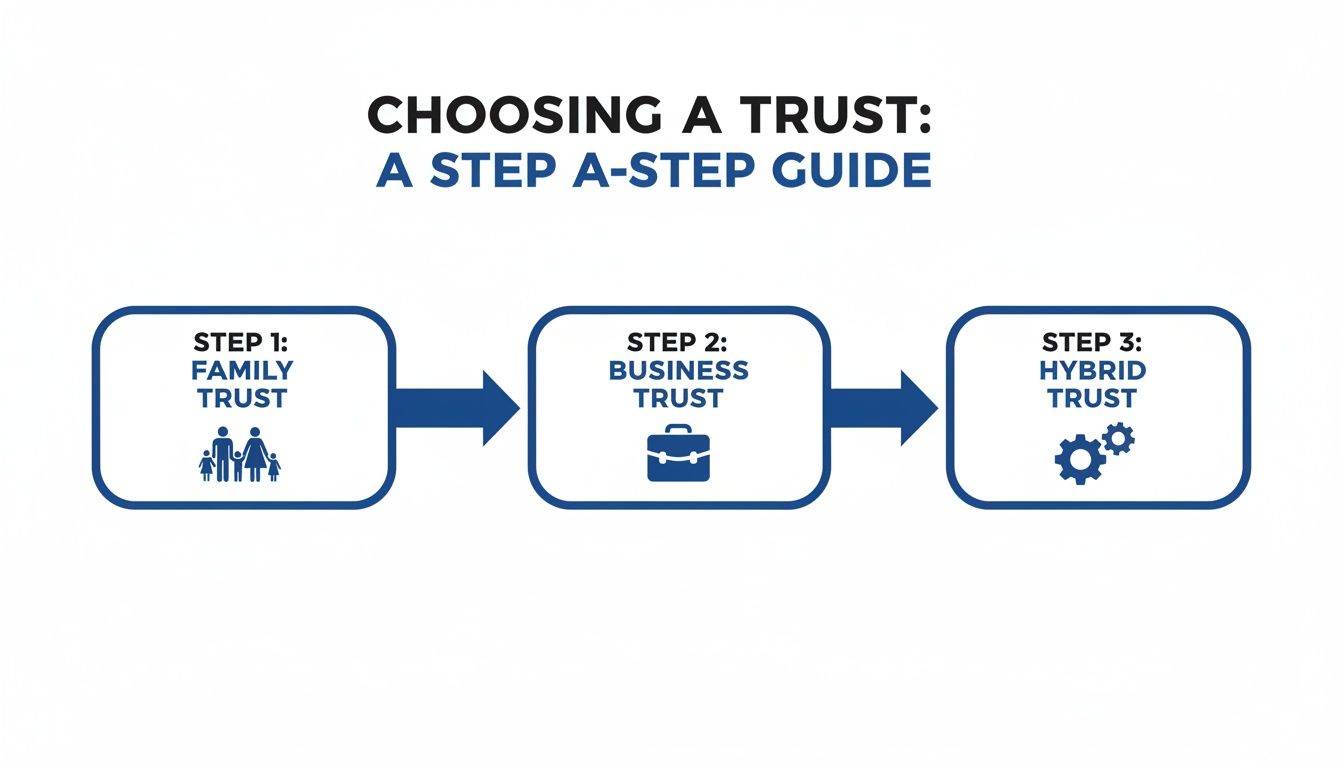
In Australia, several types of trusts are available, each governed by different rules and suited for specific purposes. The most common are Discretionary Trusts (often called Family Trusts) and Unit Trusts, with more specialised options like Hybrid and Testamentary Trusts for specific scenarios.
Discretionary Trusts (Family Trusts)
The Discretionary Trust is the preferred structure for Australian families and their businesses due to its flexibility. Its key feature is that the trustee has the discretion to decide which beneficiaries receive income or capital from the trust, and in what proportion, each financial year.
This discretion is a powerful tool for tax planning. It allows for the "streaming" of income to family members on lower marginal tax rates, such as a non-working spouse or adult children attending university. When executed correctly, this can significantly reduce the family's overall tax liability.
Best For: Families seeking to protect assets, manage tax obligations across different family members, and hold appreciating assets like property or shares.
Pros: Unmatched flexibility in annual income distribution.
Cons: The trust deed strictly defines the class of potential beneficiaries. Critically, the trustee's distribution decisions must be documented in a formal resolution before 30 June each year to be legally effective.
Unit Trusts
In contrast to the flexibility of a Discretionary Trust, a Unit Trust is fixed and rigid. Similar to a company, ownership is divided into "units," and each unitholder's entitlement to the trust's income and capital is directly proportional to the number of units they hold.
This fixed structure makes it unsuitable for a single family seeking tax flexibility but ideal for joint ventures between unrelated parties. Each party's stake in the assets and profits is clearly defined from the beginning.
Best For: Unrelated business partners or investors pooling capital to acquire an asset, such as a commercial property.
Pros: Provides absolute certainty regarding entitlements.
Cons: Lacks any discretion to alter income distributions. If you hold 40% of the units, you receive 40% of the income.
To help clarify, this table summarises the key differences.
Comparison of Common Australian Trust Structures
Trust Type | Key Feature | Best For | Income Distribution |
|---|---|---|---|
Discretionary Trust | Trustee has full discretion over distributions. | Family asset protection and tax planning. | Flexible; decided annually by the trustee. |
Unit Trust | Beneficiaries have fixed entitlements based on units held. | Joint ventures between unrelated parties. | Fixed; proportional to the number of units held. |
Hybrid Trust | Combines features of both discretionary and unit trusts. | Complex arrangements needing both fixed and flexible elements. | Varies; can be a mix of fixed and discretionary. |
Choosing between these structures often requires comparing them to other business vehicles. Our detailed guide on a family trust vs a company provides a deeper analysis for various situations.
Step-by-Step Guide to Legally Establish Your Trust
A trust is a formal legal structure that must be established through a series of precise, legally mandated steps. Omitting or incorrectly performing any of these foundational actions can invalidate the entire structure, jeopardising your assets and creating significant tax complications. The process begins with the trust deed.
Step 1: Draft the Trust Deed
The trust deed is the constitution of your trust. It is a legally binding document, prepared by a solicitor, that outlines all the rules: who the beneficiaries are, the trustee's powers and limitations, and how income and capital must be handled. Using generic, off-the-shelf legal document templates can seem cost-effective but may lead to significant issues if the deed is not tailored to your specific circumstances.
A robust trust deed must include:
Identification of Parties: Clearly names the initial trustee(s) and defines the class of potential beneficiaries.
Trustee Powers: Specifies exactly what the trustee is permitted to do, such as investing assets, borrowing funds, and distributing income.
Vesting Date: Sets the termination date for the trust. By law, this cannot be more than 80 years from its creation (the "perpetuity period").
Step 2: Appoint the Key Roles and Settle the Trust
Once the deed is drafted, the next step is to formally appoint the individuals or entities who will manage the trust.
First, the Settlor formally creates the trust by transferring the initial asset, known as the "settled sum," to the trustee. This is typically a nominal amount, such as $10. This is a one-time action, and it is crucial that the settlor is not a beneficiary.
Next, the trust is 'settled'. The settlor signs the trust deed and gives the settled sum to the trustee. This act legally establishes the trust, ensuring its assets are completely separate from the personal assets of the parties involved.
Step 3: Select the Right Trustee
Choosing the trustee is a critical decision. The trustee holds legal title to the trust's assets and has a significant fiduciary responsibility to manage them according to the deed and general trust law. There are two primary options.
Individual Trustee: This can be one or more individuals. It is simpler to establish but carries significant risks. If an individual trustee dies, declares bankruptcy, or is sued, the trust's assets can become entangled in their personal affairs.
Corporate Trustee: This involves establishing a proprietary limited (Pty Ltd) company for the sole purpose of acting as the trustee.
A corporate trustee is the recommended standard for asset protection and succession planning. It creates a clear legal separation between the trust's assets and the personal assets of the company's directors. If a director changes, ownership of the trust's assets remains securely with the company, avoiding costly legal processes to transfer title.
While it involves additional paperwork and ongoing ASIC fees, the protection afforded by a corporate trustee is almost always worth the investment, particularly when the trust holds valuable assets like a business or property.
ATO Registration: ABN and TFN for Your Trust
Once your trust deed is signed and settled, the trust legally exists. However, to operate—whether investing, trading, or earning income—it must be registered with the Australian Taxation Office (ATO). This involves obtaining a unique Tax File Number (TFN) for the trust and, if it operates an enterprise, an Australian Business Number (ABN).
These registrations are not optional; they are essential for the trust to meet its tax obligations from day one.
Applying for a Trust TFN and ABN
Every trust that earns income in Australia requires its own TFN, which is distinct from the personal TFNs of the trustee or beneficiaries. This number is used to lodge the trust's annual tax return.
If the trust is established to carry on a business, it will also need an ABN. This public number is used on invoices and is required for claiming GST credits.
You can apply for both the TFN and ABN simultaneously through the Australian Business Register (ABR) website. You will need the executed trust deed, as the application requires specific details such as the trust's exact name, establishment date, and trustee information. For more on this, see our guide to ABN and tax return compliance.
When to Register for GST
Holding an ABN does not automatically require GST registration. This depends on the trust's turnover.
Mandatory Registration: If your trust's current or projected annual turnover is $75,000 or more, GST registration is compulsory.
Voluntary Registration: If turnover is below this threshold, you may still choose to register. This can be advantageous if you have significant initial setup costs, as it allows you to claim back GST credits on those purchases.
The downside of voluntary registration is the administrative burden of lodging Business Activity Statements (BAS), so you must weigh the value of GST credits against the compliance effort.
Meeting Your Ongoing Trustee and Compliance Duties
Establishing a trust is just the start; ongoing management is key. Running a trust correctly is a serious, long-term commitment with strict legal and tax obligations. As a trustee, you have a fiduciary duty—a legal requirement to always act in the best interests of the beneficiaries, safeguard the trust's assets, and adhere strictly to the rules in the trust deed.
This active role demands constant, careful oversight to ensure the trust remains a compliant and effective vehicle for asset protection and wealth management. Neglecting these duties can nullify the benefits the trust was designed to provide and attract harsh penalties from the ATO.
The Cornerstone of Compliance: Trustee Resolutions
Every significant decision made for the trust must be formally documented in a trustee resolution. This written record proves what decisions were made, when, and why. These are not merely for good record-keeping; they are a legal necessity and your primary defence if the ATO questions the trust's activities.
The most critical of these is the annual income distribution resolution. Each year, before the 30 June deadline, the trustee must formally decide and document how the trust's net income will be distributed among the eligible beneficiaries.
ATO Warning: Failure to make a valid resolution to distribute all trust income by 30 June will result in the trustee being assessed for tax on the undistributed income at the highest individual marginal rate. This is a punitive measure to ensure compliance.
This deadline is absolute. A resolution dated 1 July is too late, and the financial consequences can be severe.
Keeping Meticulous Records
As a trustee, you are legally required to keep detailed and accurate records that tell the complete financial story of the trust.
Key records you must maintain include:
A signed copy of the trust deed and any subsequent amendments.
All trustee resolutions, especially the annual distribution minutes.
Detailed financial statements, including a balance sheet and profit and loss statement.
Annual trust tax returns and copies of all lodged Business Activity Statements (BAS).
Bank account statements for all accounts held in the trustee's name on behalf of the trust.
Records of all assets and liabilities, such as purchase contracts, property valuations, and loan agreements.
Generally, these records must be kept for at least five years.
Lodging the Annual Trust Tax Return
Any trust that earns income must lodge an annual trust tax return with the ATO. This return details all income earned and, crucially, how that income was distributed to the beneficiaries.
Beneficiaries then receive a statement of distribution, which they must include in their personal tax returns. The trust itself typically does not pay tax, provided all income is distributed. It acts as a "flow-through" entity, passing the tax liability to the beneficiaries.
Annual Trust Compliance Checklist
This checklist outlines the key annual obligations for a trustee to ensure the trust remains compliant with legal and ATO requirements.
Compliance Task | Key Deadline | Purpose | ATO Reference |
|---|---|---|---|
Review Trust Deed | Annually (e.g., May) | Ensure compliance with all clauses and identify any needed updates. | General Law |
Pass Distribution Resolution | Strictly before 30 June | Legally document the distribution of all net trust income to beneficiaries to avoid penalty tax. | ATO: Trust income |
Prepare Financial Statements | After 30 June | Create a profit and loss statement and balance sheet for the financial year. | ATO: Record keeping for business |
Lodge Trust Tax Return | By 31 October (or later via a tax agent) | Report all trust income and distributions to the ATO. | ATO: Lodging your trust tax return |
Issue Statements to Beneficiaries | With Tax Return Lodgement | Provide beneficiaries with the necessary information for their individual tax returns. | ATO: Trust income |
FAQ: Setting Up a Trust in Australia
Here are answers to some of the most common questions about setting up and running a trust in Australia, based on current ATO and ASIC regulations.
1. How much does it cost to set up a trust in Australia?
The cost can vary significantly. While basic online services may offer a trust deed for a few hundred dollars, a professionally established trust tailored to your specific needs typically costs between $1,500 and $5,000. This higher fee generally includes expert advice on the most appropriate structure, a customised trust deed drafted by a solicitor, the setup of a corporate trustee (including ASIC fees), and all necessary ABN and TFN registrations. This initial investment ensures the structure is sound and delivers the intended asset protection and tax benefits.
2. Can a trustee also be a beneficiary?
Yes, this is common, particularly in family discretionary trusts where parents act as trustees (or directors of a corporate trustee) and are also listed as beneficiaries. The trust deed must be carefully drafted to manage potential conflicts of interest, as a trustee has a legal duty to act in the best interests of all beneficiaries. The ATO scrutinises arrangements where trustees appear to favour themselves, so all distribution decisions must be commercially justifiable and documented in a formal resolution. A critical legal point, cited in trust law, is that one person cannot be the sole trustee and sole beneficiary, as this would merge legal and beneficial ownership and dissolve the trust.
3. What happens if a trust doesn’t distribute all its income?
This is a major compliance risk. If a trust has taxable income at the end of the financial year that has not been distributed to beneficiaries through a valid resolution by 30 June, the trustee becomes personally liable for tax on that income. According to the ATO, this undistributed income is taxed at the highest marginal tax rate (currently 45%) plus the Medicare Levy. This penalty is designed to enforce the annual distribution of income.
4. What is the difference between an individual and a corporate trustee?
This choice has significant implications for asset protection and long-term administration.
Individual Trustee: One or more individuals hold trust assets in their personal names. It is simpler and cheaper to start but exposes personal assets to trust liabilities. Succession is also complex; if a trustee dies or retires, all assets must be legally transferred to the new trustee's name, which is costly and time-consuming.
Corporate Trustee: A proprietary limited (Pty Ltd) company is established solely to act as the trustee. This is the recommended structure for superior asset protection, as it creates a "corporate veil" separating trust liabilities from the directors' personal assets. It also offers perpetual succession; if a director changes, the trust's assets remain in the company's name, simplifying administration.
Summary of Key Takeaways
Purpose: Trusts are established for asset protection, tax planning, and wealth management.
Key Document: The trust deed is the legal foundation that governs the trust's operation.
Core Roles: A trust involves a settlor, a trustee (who manages assets), and beneficiaries (who benefit from them).
Types: The most common types are flexible Discretionary (Family) Trusts and rigid Unit Trusts.
Setup Steps: The process involves drafting a deed, appointing a trustee, settling the trust with an initial sum, and registering for a TFN and ABN.
Critical Compliance: The trustee must make an annual resolution to distribute all income before 30 June to avoid penalty tax rates.
Trustee Choice: A corporate trustee is strongly recommended over an individual trustee for superior asset protection and easier succession.
Need Personalised Advice?
Setting up and managing a trust involves complex legal and tax considerations. The information provided here is general in nature and should not be taken as financial or legal advice. To ensure your trust is structured correctly to meet your specific goals and remains compliant, it is essential to seek professional guidance.
Contact Baron Tax & Accounting for an expert consultation on setting up a trust in Australia.
Baron Tax & Accounting
Website: https://www.baronaccounting.com
Email: info@baronaccounting.com
Phone: +61 1300 087 213
Whatsapp: 0450468318
Line: Barontax
Comments