
What Does Claiming the Tax-Free Threshold Mean in Australia?

Claiming the tax-free threshold is a formal instruction you give your employer via a Tax File Number (TFN) Declaration form. It directs them not to withhold tax from the first $18,200 you earn in a financial year. This is a fundamental feature of the Australian tax system, administered by the Australian Taxation Office (ATO), designed to ensure tax is only paid on income above this specific amount.
Understanding this concept is critical for managing your take-home pay and ensuring tax compliance. Incorrectly claiming the threshold, particularly from multiple employers, can lead to a significant tax debt at the end of the financial year. The ATO requires that you only claim it from one employer at a time, which is a key compliance obligation for all Australian resident taxpayers.
What Is the Tax-Free Threshold and Why Is It Important?

The tax-free threshold is not a bonus or a tax deduction; it is the amount of income you can earn each year before your employer is required to withhold tax under the Pay As You Go (PAYG) system. For the current financial year, the ATO has set this amount at $18,200.
When you commence employment, you complete a Tax File Number (TFN) Declaration. Your response to the question "Do you want to claim the tax-free threshold from this payer?" directly determines how much tax is withheld from each pay cycle. This decision impacts your regular cash flow and your final tax position when you lodge your annual tax return.
How It Affects Your Pay
When you correctly claim the threshold from your main employer, they apply a lower tax rate to your initial earnings, resulting in higher take-home pay throughout the year. If you choose not to claim it, or are not eligible, tax is withheld from the first dollar you earn. This reduces your regular cash flow but typically leads to a larger tax refund upon lodging your return.
The most significant compliance risk arises when an individual claims the threshold from more than one employer simultaneously. This common error results in insufficient tax being withheld across all income sources. When the ATO assesses your total income for the year, a substantial tax liability is almost certain.
The ATO's guidance is explicit: you must only claim the tax-free threshold from one employer at any given time. It is best practice to claim it from your primary source of income—the one that pays you the most—to ensure your tax obligations are met accurately throughout the year.
Tax-Free Threshold at a Glance
This table summarises the key details as per Australian Taxation Office (ATO) regulations.
Attribute | Details (ATO Rules) |
|---|---|
Current Threshold Amount | $18,200 per financial year |
Who Can Claim It? | Australian residents for tax purposes |
How to Claim | Tick 'Yes' on your Tax File Number Declaration form |
When to Claim | From one employer at a time, typically your highest paying job |
Impact of Claiming | Less tax withheld, higher take-home pay during the year |
Impact of Not Claiming | More tax withheld, lower take-home pay, larger potential refund |
To gain a complete understanding, refer to our comprehensive Australian tax-free threshold guide. For those looking to further optimise their financial position, exploring ATO-compliant tax-efficient investing strategies is a logical next step.
Who Is Eligible to Claim the Tax-Free Threshold?
Eligibility to claim the tax-free threshold is determined by a single, critical factor set by the Australian Taxation Office (ATO): you must be an Australian resident for tax purposes.
This is a common point of confusion. Tax residency is distinct from your visa status, citizenship, or country of birth. The ATO assesses your circumstances as a whole to determine your residency status for tax purposes.
What Does "Resident for Tax Purposes" Mean?
The ATO primarily uses the "resides test" to determine tax residency. This is not based on a single rule but rather a holistic assessment of your connections to Australia.
Key factors considered include:
Physical Presence: The duration of your stay in Australia and your intention to remain.
Social and Living Arrangements: Family ties, property ownership or leasing, and community involvement that indicate Australia is your settled home.
Economic Ties: The location of your primary bank accounts, business interests, and other significant assets.
Intention and Behaviour: Whether your actions demonstrate that you are treating Australia as your permanent base.
If the balance of these factors indicates you live in Australia with a degree of continuity, you will likely be considered a resident for tax purposes.
It is crucial to understand that being a tax resident means you are taxed on your worldwide income, not just income earned in Australia. In return, you gain access to benefits like the tax-free threshold. Non-residents are generally taxed only on their Australian-sourced income, typically from the first dollar earned.
Special Rules for Temporary Visitors
The rules differ for individuals on specific temporary visas. For example, those on working holiday maker visas (subclasses 417 and 462) are generally treated as non-residents for tax purposes. This means they cannot claim the tax-free threshold and are subject to specific tax rates from the first dollar earned. It is vital to understand these distinctions.
Correctly determining your residency status from the outset is the most important step. An incorrect claim of the tax-free threshold will almost certainly result in an unexpected tax debt.
How to Correctly Claim the Threshold on Your TFN Declaration
When you begin a new job, the Tax File Number (TFN) Declaration is a mandatory form that instructs your employer on how much tax to withhold from your pay.
The most critical section is Question 8: ‘Do you want to claim the tax-free threshold from this payer?’ Answering 'Yes' authorises your employer not to tax the first $18,200 of your annual income. If this is your sole source of employment income, 'Yes' is the correct choice.
Making the Right Choice: Yes or No
The Australian Taxation Office (ATO) provides a clear rule to guide this decision: you must only claim the threshold from one employer at a time.
If you have a second job, you must select 'No' on the TFN Declaration for that employer. This instructs them to withhold tax from the first dollar earned. While this reduces your take-home pay from the second job, it is a necessary step to prevent a tax shortfall at the end of the financial year.
Claiming the threshold from two or more employers is a common error. When you lodge your tax return, the ATO aggregates all income sources. If insufficient tax has been paid because multiple employers have applied the tax-free benefit, you will be liable for the outstanding amount.
Remember, you must first be an Australian resident for tax purposes to be eligible.
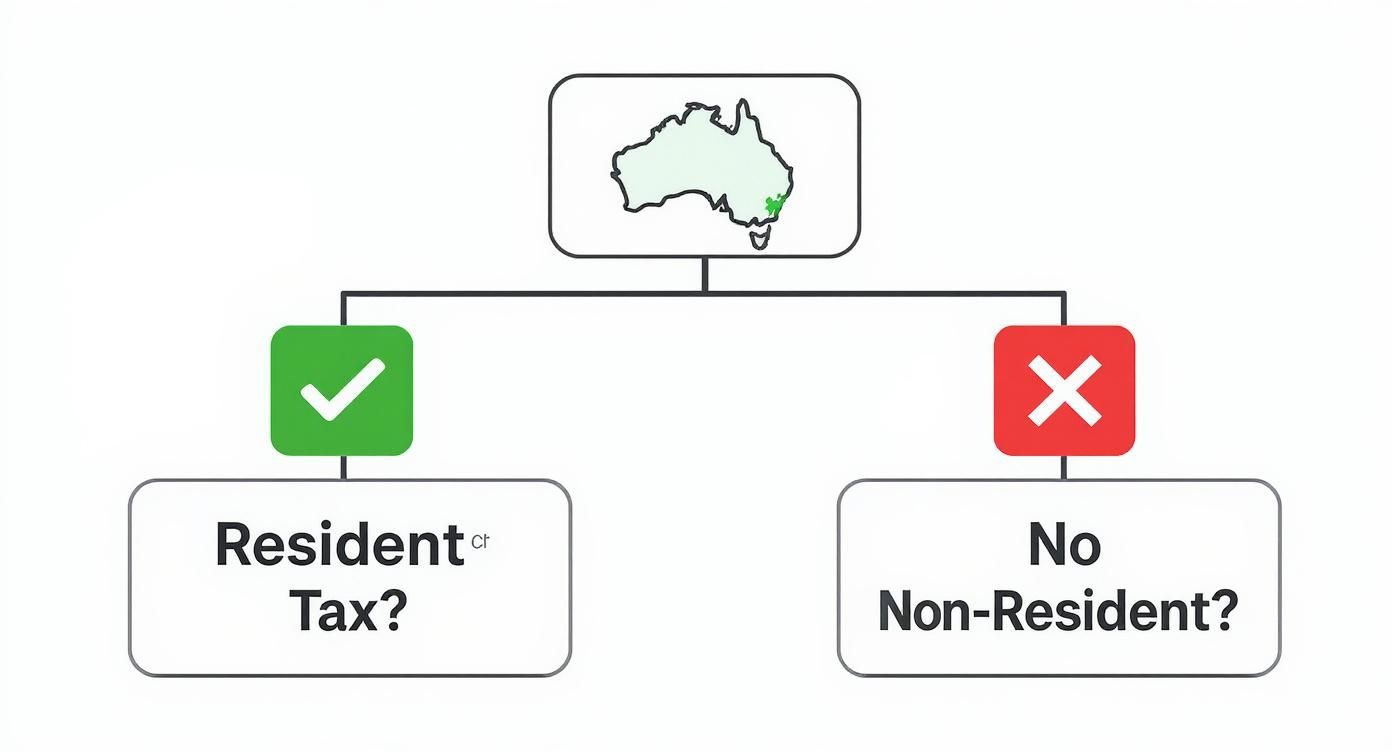
As this illustrates, determining your residency status is the foundational step before completing the TFN Declaration.
Correctly completing your TFN Declaration is a proactive tax management strategy. It is essential for avoiding financial stress and maintaining compliance with the ATO.
Your employer uses this form to calculate your Pay As You Go (PAYG) withholding, which is reported on your end-of-year income statement. To learn more, read our guide on how to get your PAYG summary.
How to Manage the Tax-Free Threshold with Multiple Jobs
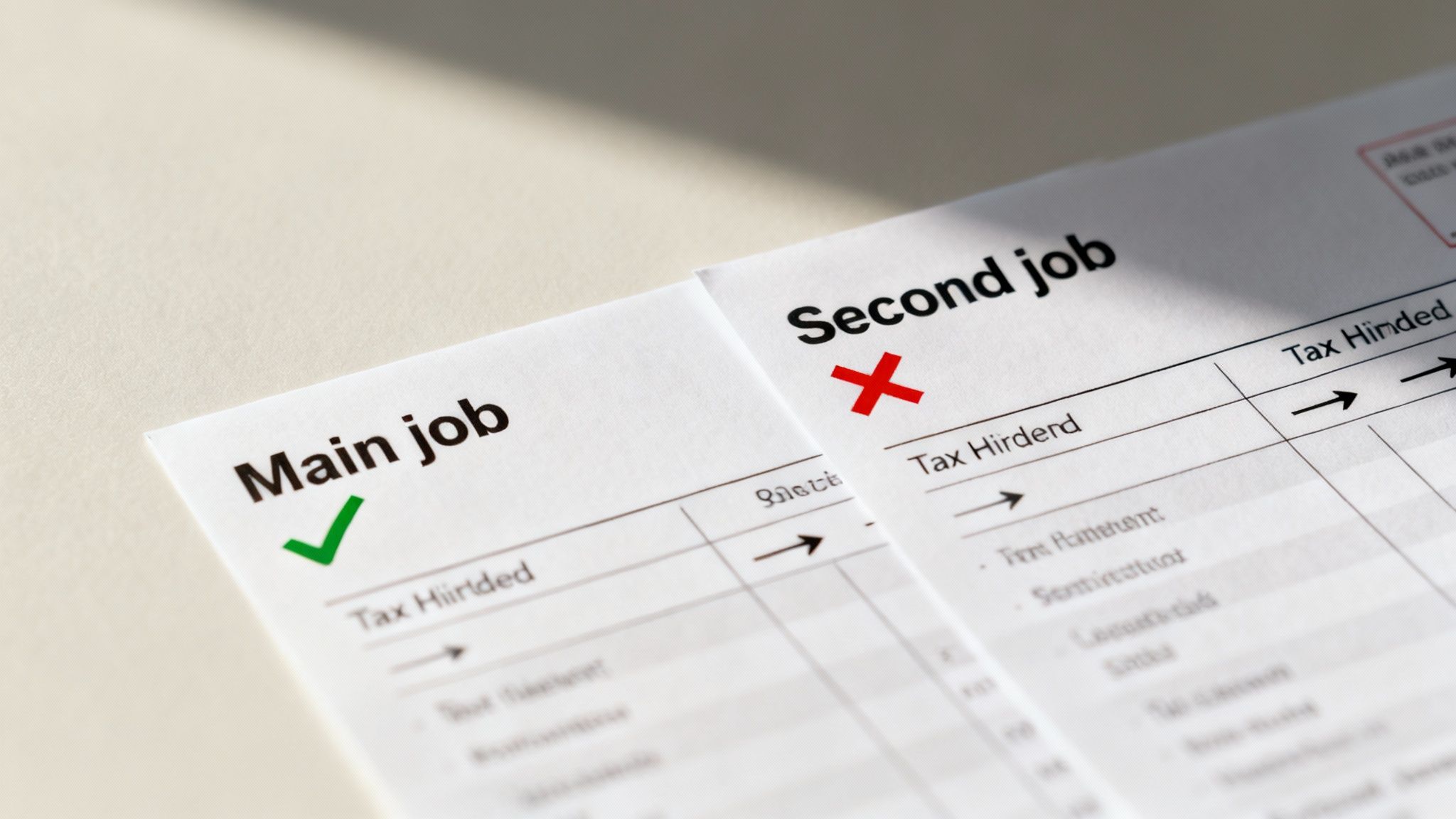
Holding multiple jobs requires careful tax planning to ensure compliance. The Australian Taxation Office (ATO) has a strict, non-negotiable rule to prevent end-of-year tax debts: you can only claim the tax-free threshold from one employer at a time.
The standard and recommended practice is to claim the threshold from your highest-paying job. For all subsequent jobs, you must indicate on your TFN Declaration that you do not wish to claim it. This ensures your secondary employer withholds tax from the first dollar earned, which helps cover your total tax liability across all income streams.
Correct vs. Incorrect Claiming: A Practical Example
Getting this right is the difference between a predictable tax outcome and a significant liability. When you manage your claims correctly, the total tax withheld throughout the year closely aligns with your actual tax obligation. This typically results in a small refund or a minor amount payable.
Conversely, claiming the threshold from two jobs means both employers apply the $18,200 tax-free buffer. This leads to a significant under-withholding of tax relative to your combined income. When you lodge your return, the ATO's calculation will almost certainly reveal a substantial and unexpected tax debt.
The tax-free threshold is a single entitlement provided by the ATO. Applying it to your highest-paying job ensures you receive the maximum cash-flow benefit correctly, while your other jobs contribute the appropriate amount of tax from the start.
For more information on how tax offsets interact with your income, our guide on understanding the Low Income Tax Offset provides valuable context.
Claiming the Tax-Free Threshold With One vs Two Jobs
This table illustrates the different financial outcomes based on your TFN Declaration choices.
Scenario | Job 1 (Claiming Threshold) | Job 2 (Not Claiming Threshold) | End-of-Year Outcome |
|---|---|---|---|
Correct Method | Tax is calculated after the $18,200 threshold is applied. Less tax is withheld from this income source. | Tax is withheld from the first dollar earned, typically at a higher marginal rate. | The total tax withheld is generally accurate, leading to a predictable tax outcome (small refund or minor bill). |
Incorrect Method | Tax is calculated after the $18,200 threshold is applied here... | ...and the $18,200 threshold is incorrectly applied again at your second job. | This creates a significant tax shortfall throughout the year, resulting in a large and unexpected debt to the ATO. |
Proper administration when commencing employment can prevent significant financial stress later. The goal is to pay the correct amount of tax as you earn it, not to face a large liability at year-end.
Common Mistakes and How to Correct Them
Even with clear rules, mistakes with the tax-free threshold are common. Proactively identifying and correcting these errors is key to managing your tax obligations.
The most frequent error is claiming the threshold from more than one employer. This almost always leads to insufficient tax being withheld and results in a tax debt upon lodging your return.
Another common oversight is failing to update your TFN Declaration when your circumstances change. For example, if a part-time job becomes your primary source of income, you must adjust which employer you claim the threshold from. If you fail to do so, you will continue claiming the threshold from the lower-paying job, leading to under-taxation on your higher income and a future tax bill.
How to Fix Declaration Errors
Fortunately, these errors are correctable. The key is to act as soon as you identify the issue to minimise the potential tax shortfall.
To Stop Claiming: Submit a new Tax file number declaration form to the relevant employer. On this form, tick 'No' at the question asking if you want to claim the tax-free threshold.
To Start Claiming: The process is the same. If a different job becomes your primary income source, provide that employer with a new TFN declaration and tick 'Yes' to claim the threshold.
You can also use a Withholding declaration (NAT 3093) for more specific adjustments. This form allows you to request that your employer withholds an additional amount of tax from each pay, which is useful for catching up on a tax shortfall during the year.
What if you don't claim the threshold when you are entitled to? This will not result in a penalty from the ATO, but it negatively impacts your personal cash flow. You are effectively providing an interest-free loan to the government, which is returned to you as a larger refund. The solution is the same: submit a new TFN declaration to your employer and tick ‘Yes’.
If you discover an error after lodging your tax return, it can still be fixed. Our guide explains how to amend a tax return in Australia.
Summary: Key Takeaways
Definition: The tax-free threshold allows you to earn up to $18,200 each financial year without paying income tax.
Eligibility: You must be an Australian resident for tax purposes to claim it.
The Golden Rule: Claim the threshold from only one employer at a time—ideally your highest-paying job.
Process: Make your claim by ticking 'Yes' on the Tax File Number (TFN) Declaration form when you start a new job.
Multiple Jobs: For any additional jobs, you must tick 'No' on the TFN Declaration to ensure sufficient tax is withheld.
Correction: You can update your claim anytime by submitting a new TFN Declaration to your employer(s).
Frequently Asked Questions (FAQ)
What happens if I forget to claim the tax-free threshold?
If you are eligible but forget to claim the threshold, your employer will withhold tax from the first dollar you earn. This means you will receive less take-home pay throughout the year. The overpaid tax will be returned to you as a refund when you lodge your annual tax return with the ATO. You can correct this at any time by providing your employer with a new TFN Declaration.
Can I change which employer I claim the tax-free threshold from during the year?
Yes. It is important to update your claim if your employment circumstances change. For instance, if your second job becomes your primary source of income, you should submit a new TFN Declaration to your former primary employer to stop claiming the threshold and another to your new primary employer to start claiming it. This is done using the ATO's Tax file number declaration (NAT 3092).
Does the tax-free threshold apply to my superannuation payments?
No. The $18,200 tax-free threshold applies specifically to employment income (salary and wages). Superannuation income streams and lump-sum payments are taxed under a separate set of rules defined by superannuation law. While these rules include their own tax-free components (e.g., for individuals over 60), they are entirely distinct from the PAYG withholding system for employment.
What are the rules for non-residents claiming the tax-free threshold?
Generally, foreign residents for tax purposes are not entitled to claim the tax-free threshold. They are typically taxed on their Australian-sourced income from the first dollar earned. Specific tax rates apply depending on the type of income and the individual's circumstances. For example, working holiday makers are subject to different tax rates, as detailed on the ATO website.
I have income from investments and a job. How does the threshold apply?
The tax-free threshold is applied to your total taxable income for the year, which includes salary, bank interest, dividends, and other investment income. However, it is only claimed through an employer for PAYG withholding purposes on your salary. Tax on investment income is not withheld at the source in the same way, and you will be liable for it when you lodge your tax return.
Need Personalised Tax Advice?
The information provided in this guide is general in nature. Your personal circumstances may affect how these tax rules apply to you. To ensure you meet your obligations and optimise your tax position, we recommend seeking professional advice.
Baron Tax and Accounting
Website: https://www.baronaccounting.com
Email: info@baronaccounting.com
Phone: +61 1300 087 213
Comments