
What Can a Nurse Claim on Tax? 8 Key Deductions for 2025

As a nurse in Australia, your dedication to patient care is unmatched. But when tax time arrives, are you getting the financial recognition you deserve? The Australian Taxation Office (ATO) allows for numerous work-related deductions that can significantly increase your tax refund, yet many nurses miss out on thousands of dollars simply by not knowing what they're eligible to claim. This guide is designed to change that, empowering you to maximise your return.
We will provide a clear, comprehensive breakdown of exactly what can a nurse claim on tax, with practical examples and ATO-compliant advice for each category. From the specific requirements for claiming your uniform and laundering expenses to the costs associated with your ongoing professional development, we cover the essential deductions you need to know.
This listicle will serve as your go-to resource for the 2025 financial year, ensuring you don't overlook valuable claims. We'll explore vehicle expenses for home care visits, the tools of your trade like stethoscopes, and even the portion of your phone and internet bills used for work. By understanding these key areas, you can confidently prepare your tax return and ensure you claim every cent you are legally entitled to. Let's begin.
1. Compulsory Uniforms & Protective Clothing
One of the most significant and frequently asked questions about what a nurse can claim on tax relates to their work attire. If your employer requires you to wear a specific uniform, particularly one that features a logo, you can claim the expenses associated with buying, repairing, and cleaning it.
This deduction isn't just for your standard scrubs. It extends to a range of compulsory and protective items that are essential for your role and not suitable for private, everyday wear. The key is that the clothing must be either specific to your occupation, protective in nature, or part of a compulsory uniform.
What You Can Claim
Your claims can cover a broad spectrum of work-related clothing and laundry expenses:
Buying the Items: The initial purchase cost of logo-emblazoned scrubs, trousers, and shirts.
Specialised Footwear: Costs for non-slip, enclosed nursing shoes required for safety and hygiene.
Protective Gear: Expenses for items like safety glasses, aprons, and other personal protective equipment (PPE) not provided by your employer.
Cleaning Costs: The ongoing expense of laundering your uniforms.
Key Insight: You can’t claim for conventional clothing like plain black trousers or a white shirt, even if your employer tells you to wear them. The clothing must be distinctive to your role, such as scrubs or an item with your employer's logo.
Practical Scenarios
An aged care nurse can claim the cost of specialised, supportive non-slip footwear required for safety on polished floors.
A surgical nurse can deduct the purchase and regular laundering of multiple sets of sterile scrubs.
An emergency department nurse can claim deductions for both their compulsory uniform and the protective eyewear they must wear on shift.
Actionable Tips for Maximising Your Claim
To ensure you get the full deduction you're entitled to, meticulous record-keeping is vital.
Laundry Log: For home laundry, use the ATO's set rate method. As of the current financial year, you can claim $1 per load for washes containing only your work uniforms and 50 cents per load for mixed washes. Keep a simple diary or spreadsheet logging your wash frequency.
Keep Receipts: Always get a receipt for uniform and footwear purchases. Take a photo or scan it immediately to create a digital copy before the ink fades.
Photograph Your Gear: Take pictures of your uniform and any protective items. This serves as clear evidence of their work-specific and non-conventional nature.
2. Continuing Professional Development and Education
As a nurse, your commitment to learning doesn't end after graduation. Continuing Professional Development (CPD) is crucial for maintaining your registration and staying current with best practices. The good news is that expenses for courses, conferences, and training directly related to your current nursing role are generally tax-deductible.
This deduction applies to education that maintains or improves the specific skills and knowledge you use in your job. The key principle is that the study must have a clear connection to your current employment, helping you become more effective in your role or increasing your potential income within that role.
What You Can Claim
You can claim a variety of self-education expenses, provided they are directly linked to your nursing duties:
Course Fees: The full cost of seminars, workshops, and courses for certifications or specialised training.
Travel Costs: Expenses for travel to and from the educational venue, including flights, accommodation, and meals for overnight stays.
Stationery and Books: The cost of textbooks, professional journals, and any stationery required for your studies.
Tools and Equipment: The purchase of necessary equipment, such as a dedicated stethoscope or reference materials for a specialty course.
Key Insight: You cannot claim a deduction for education that is only generally related to your job or is designed to get you a new job in a different field. For instance, a general nursing degree to get your first nursing job is not claimable, but a post-graduate certificate in emergency nursing for a current ED nurse is.
Practical Scenarios
A critical care nurse can claim the $3,000 fee for an Intensive Care Unit (ICU) certification course that enhances their skills for their current position.
A paediatric nurse attending a national conference in another state can deduct the cost of their flights, accommodation, and conference registration fees.
A nurse educator can claim the cost of an online course focused on new teaching methodologies relevant to training student nurses.
Actionable Tips for Maximising Your Claim
Proper documentation is essential to substantiate your self-education claims and ensure compliance.
Keep Course Outlines: Retain course syllabuses, certificates of completion, and registration documents. These prove the direct relevance of the education to your nursing role.
Log Your Travel: If you drive to a course, use a logbook to accurately record your kilometres. This allows you to claim using the cents per kilometre method or the logbook method for a higher deduction if applicable.
Save Employer Correspondence: Keep any emails or letters from your employer that encourage or require you to undertake the training. This strengthens the link between the expense and your employment.
3. Vehicle and Travel Expenses
Another key area for tax deductions relates to work-related travel. While your daily commute from home to your primary place of work is generally not claimable, many nurses incur significant vehicle expenses for other essential duties. If you use your personal car to travel between different work locations, visit patients at home, or attend training and conferences, you can claim these costs.
This deduction is particularly relevant for nurses in community health, agency roles, or management positions who are frequently on the road. The core principle is that the travel must be a direct requirement of performing your job, not just getting to your regular workplace.

What You Can Claim
Your claims can include the running costs of using your personal vehicle for work purposes:
Travel Between Jobs: The cost of driving directly from one hospital or clinic to another during the same day.
Home Visits: Expenses incurred by community health nurses travelling to provide patient care in their homes.
Attending Meetings/Training: Costs for travelling to off-site conferences, training sessions, or meetings away from your usual workplace.
Transporting Bulky Equipment: If you're required to transport heavy or bulky work equipment that can't be stored at work, you may be able to claim your home-to-work travel.
Key Insight: You cannot claim the cost of normal daily travel between your home and your main place of employment. This is considered a private expense, even if you have to work irregular hours or do minor work-related tasks on the way.
Practical Scenarios
A community nurse who drives their own car to multiple patient homes each day can claim the kilometres travelled on their rounds.
An agency nurse working shifts at three different hospitals in one week can claim the travel costs between each hospital.
A Nurse Unit Manager can claim the expense of driving to an off-site regional health planning meeting.
Actionable Tips for Maximising Your Claim
Accurate record-keeping is crucial for claiming vehicle expenses, as the ATO requires clear evidence of work-related travel.
Keep a Logbook: To claim your actual expenses, you must keep a detailed logbook for a continuous 12-week period. This establishes a business-use percentage that you can apply for up to five years.
Use the Cents Per Kilometre Method: For simpler claims, you can use the set rate method (currently 88 cents per kilometre for the 2024-25 financial year) for up to 5,000 business kilometres, without needing a detailed logbook. You just need to show how you calculated the kilometres.
Organise All Receipts: Keep all receipts for fuel, insurance, registration, servicing, and any other car-related costs. Digital copies are highly recommended.
4. Professional Equipment and Medical Instruments
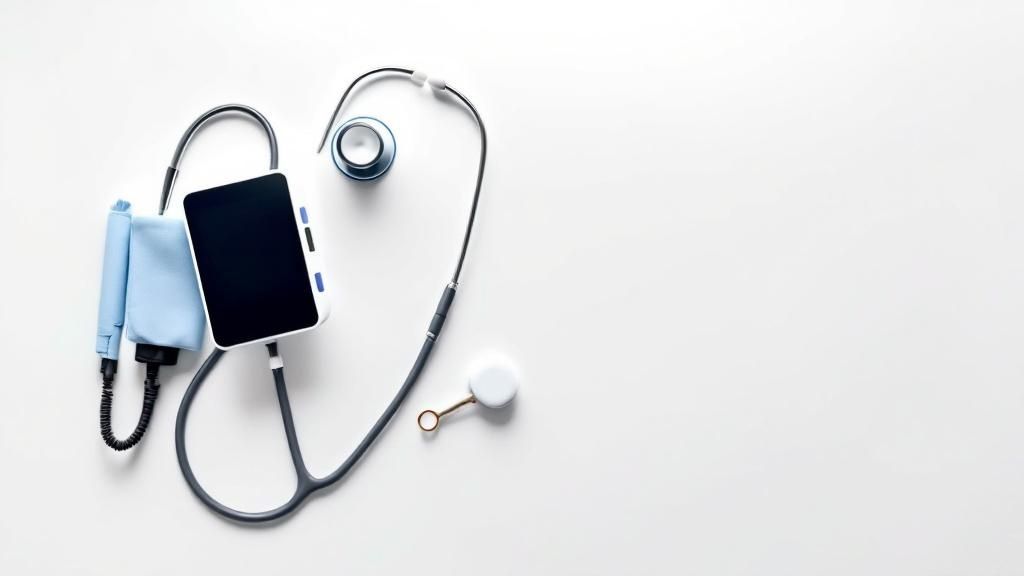
Beyond your uniform, many nurses purchase specialised equipment to perform their duties effectively. If you buy tools and instruments for work that your employer doesn't provide or reimburse you for, you can claim these expenses as a tax deduction. This covers everything from traditional medical instruments to modern digital tools essential for patient care.
The core principle here is that the equipment must be directly related to earning your income as a nurse. This can include items you use for diagnostics, patient monitoring, and administrative tasks. Nurses often invest in various professional equipment and medical instruments. This can extend to digital tools like specialised medical documentation software that streamlines administrative tasks.
What You Can Claim
Your claims can include a wide variety of tools essential for your nursing speciality:
Diagnostic Tools: The cost of stethoscopes, blood pressure monitors, fob watches, and thermometers.
Specialised Instruments: Items like protective eyewear, penlights, or specific wound care assessment tools.
Technology: The work-related portion of a tablet or phone used for medical apps, patient charting, or accessing drug databases.
Reference Materials: Costs for medical textbooks, journals, or digital subscriptions relevant to your field.
Key Insight: For items costing more than $300, you must claim the depreciation (decline in value) over the effective life of the equipment, rather than an immediate full deduction. For items under $300, you can usually claim an immediate deduction for the full cost.
Practical Scenarios
A cardiac nurse purchases a high-quality $250 stethoscope for more accurate patient assessments and can claim the full amount in that financial year.
An ICU nurse claims the work-related portion of a tablet computer used for accessing patient monitoring apps and drug calculation tools.
A wound care nurse buys specialised assessment tools not supplied by the hospital to improve patient treatment outcomes.
Actionable Tips for Maximising Your Claim
Proper documentation is crucial for claiming equipment expenses.
Keep All Receipts: Always store receipts and warranty information for any professional tools you buy. Digital copies are an excellent backup.
Apportion Private Use: If you use an item like a phone or tablet for both work and personal reasons, you must calculate the work-related percentage. Keep a log for a representative period to justify your claim.
Invest in Quality: Buying durable, high-quality equipment is not only better for your work but can also provide better long-term value for your tax claims through depreciation. Learn more about the specific tax tips for medical professionals and how to manage these claims effectively.
5. Home Office and Study Space
The nature of nursing work has evolved, with many roles now requiring significant administrative, research, or study tasks to be completed outside of the hospital or clinic. If you use a dedicated area of your home for these work-related activities, you may be able to claim a portion of your home office expenses on tax.
This deduction applies when you perform duties like completing patient documentation, undertaking continuing professional development (CPD), attending online training, or conducting telehealth consultations from home. The key is having a genuine, dedicated workspace and incurring additional running costs as a direct result of your work.
What You Can Claim
Your home office claims can be categorised into two main types of expenses:
Running Costs: The direct expenses from using your home office, such as electricity for lighting and cooling, internet access, and the depreciation of office furniture.
Occupancy Expenses: In specific cases, such as if your home is your primary place of work, you might claim a portion of rent, mortgage interest, or council rates. This is less common for nurses but may apply to roles like full-time telehealth nursing.
Key Insight: To claim home office expenses, you must be working from home to fulfil your employment duties, not just carrying out minimal tasks or working from home by choice. It's essential to have a record of the hours you work from home.
Practical Scenarios
A Clinical Nurse Specialist can claim the running costs for their home study, which they use several hours a week for research, writing reports, and preparing educational materials.
An Agency Nurse who manages their schedule, completes timesheets, and undertakes mandatory online training from a dedicated desk can claim the associated costs for the hours spent on these tasks.
A Nurse Practitioner running telehealth consultations from a specific room in their house can claim a portion of their home running expenses.
Actionable Tips for Maximising Your Claim
Accurate calculations and records are crucial for claiming home office expenses correctly.
Choose the Right Method: The ATO offers a 'fixed rate' method (70 cents per hour from 1 July 2024) which is a simple way to claim running costs. For more detailed information, you can learn more about work-from-home tax deductions on baronaccounting.com.
Keep a Diary: Maintain a log or timesheet of the hours you work from home. This is a mandatory requirement for substantiating your claim, regardless of the method you use.
Photograph Your Space: Take clear photos of your home office setup. This provides visual evidence of a dedicated work area, which is particularly useful in an audit.
6. Professional Memberships and Registration Fees
Maintaining your professional standing is a non-negotiable part of a nursing career, and the associated costs are a key area where you can claim on tax. Any compulsory fees you pay to maintain your registration or memberships with professional bodies and unions are considered direct costs of earning your income, making them fully tax-deductible.
These expenses are essential for you to legally practise and stay current in your field. From your annual AHPRA registration to your union dues, these are not optional extras but fundamental requirements of your profession. The ATO recognises this, allowing you to claim the full amount you've paid within the financial year.
What You Can Claim
Your claims can cover a range of mandatory professional expenses required to keep you working:
Annual Registration: The fee you pay to the Nursing and Midwifery Board of Australia (NMBA) via AHPRA.
Union Fees: Full membership fees paid to unions like the Australian Nursing and Midwifery Federation (ANMF).
Professional Association Dues: Costs for joining bodies relevant to your specialty, such as the Australian College of Nursing (ACN) or specialist critical care associations.
Journal Subscriptions: Fees for professional publications or journals that are directly related to your nursing role.
Key Insight: You can only claim these fees in the financial year you paid them. If your registration fee is due on 30 June, ensure you pay it before the cutoff to claim it in that year's tax return.
Practical Scenarios
A registered nurse can claim their $180 annual AHPRA registration fee as a direct deduction.
A union delegate nurse who pays $550 in annual dues to the ANMF can claim the full amount.
A critical care nurse can deduct the fees for both their AHPRA registration and their membership with the Australian College of Critical Care Nurses (ACCCN).
Actionable Tips for Maximising Your Claim
Proper documentation is straightforward for these claims, but staying organised is key to not missing out.
Keep Digital Records: As soon as you pay a fee, save the digital receipt or membership confirmation email to a dedicated "Tax" folder on your computer or cloud storage.
Set Calendar Reminders: Set reminders for when your fees are due. This not only helps you avoid late penalties but also ensures you pay them within the financial year you want to claim them in.
Check Your Payslips: If your union fees are deducted directly from your pay, your income statement (formerly group certificate) will show the total amount paid. It’s a good idea to cross-reference this with your union's statement.
7. Work-Related Phone and Internet Expenses
In today's digitally connected healthcare environment, your personal phone and home internet are often essential tools of the trade. If you use your personal devices for work-related tasks, such as communicating with your team, accessing rosters, or undertaking telehealth duties, you can claim a portion of these running costs as a tax deduction.
This deduction acknowledges that modern nursing extends beyond the hospital floor, requiring constant connectivity. The key principle is to calculate the percentage of your usage that is directly related to your employment. You can't claim 100% of your bill, but you can claim the portion that genuinely reflects your work activities.
What You Can Claim
You can claim the work-related portion of costs associated with your personal devices and services:
Mobile Phone Bills: The cost of your monthly plan, apportioned for work use.
Internet Bills: The cost of your home NBN or internet service, apportioned for work activities like online training or telehealth.
Data Usage: Costs for additional data required to use patient management apps or communicate on the go.
Business Calls: The specific cost of any work-related calls if you can identify them on an itemised bill.
Key Insight: You must have a clear and reasonable method for calculating your work-related percentage. Simply guessing or claiming a standard amount without justification is not sufficient for the ATO.
Practical Scenarios
A hospital nurse regularly uses their mobile to check shift changes on a scheduling app and communicate with colleagues in a work-specific messaging group. They could reasonably claim 30% of their monthly phone bill.
A community health nurse relies on their phone's data to access and update patient records via a cloud-based system while in the field. They can claim the work-related portion of their data costs.
A telehealth nurse who conducts video consultations from a home office can claim a percentage of their home internet bill, calculated based on the hours they work from home.
Actionable Tips for Maximising Your Claim
To substantiate your claim for phone and internet expenses, accurate records are non-negotiable.
Keep a Usage Diary: For a representative four-week period, keep a log of your work-related calls, messages, and data usage versus your private usage. This will help you establish a reasonable percentage to apply for the entire year.
Review Your Bills: Go through your itemised phone and internet bills to highlight work-related usage. This provides strong evidence to support your calculations.
Consider a Separate Phone: If your work usage is substantial, it may be simpler to maintain a separate mobile phone and service purely for work purposes, allowing you to claim 100% of those costs. Learn more about the mobile phone tax deduction on baronaccounting.com.
8. Reference Materials and Professional Literature
Staying current with the latest medical advancements and nursing practices is a core part of your professional responsibility. The costs associated with purchasing textbooks, reference guides, and professional journal subscriptions are often deductible, as they directly relate to maintaining and improving the specific skills and knowledge required for your nursing role.
This deduction covers a wide range of educational materials that help you perform your duties more effectively. Whether you're buying a physical textbook for a specialty course or subscribing to an online medical database, these expenses are a legitimate part of what a nurse can claim on tax, provided they are directly linked to your current employment.
What You Can Claim
You can claim the cost of technical or professional publications relevant to your nursing field, including:
Textbooks and Reference Manuals: Costs for specialised books related to your specific area of practice, such as pharmacology guides or trauma care manuals.
Journal and Magazine Subscriptions: Fees for subscriptions to professional publications like the Australian Nursing & Midwifery Journal or other specialty-specific journals.
Digital Subscriptions: Costs for accessing online medical databases, e-books, or other digital resources essential for your work.
Professional Libraries: The cost of building a professional library, where you can depreciate the value of assets over $300 over their effective life.
Key Insight: The materials must be directly relevant to your current role. You generally cannot claim for publications that are only vaguely related to your job or are designed to help you get a different job in a new field.
Practical Scenarios
An oncology nurse can claim the annual subscription fee for a journal focused on the latest cancer treatments and patient care protocols.
An emergency department nurse can deduct the cost of purchasing the latest edition of a critical care or advanced life support (ALS) textbook.
A paediatric nurse studying to specialise further within their current role can claim the cost of textbooks for their bridging course.
Actionable Tips for Maximising Your Claim
Proper documentation is key to successfully claiming these professional development expenses.
Keep Digital and Physical Receipts: Retain all invoices and receipts for books, journals, and digital subscriptions. A dedicated folder in your email or a physical file works well.
Log Usage: Make a note in a diary or on the receipt itself about how the material is used in your work. For example, "Used for researching new paediatric medication protocols."
Consider Digital Options: Digital subscriptions can be more cost-effective and provide easier access to a wider range of information. They also come with clear digital invoices, simplifying record-keeping. Additionally, consider that professional expenses, such as subscribing to one of the leading HIPAA compliant email hosting providers for secure communication, may also be deductible as they are essential for handling sensitive patient data.
Tax Claim Comparison for Nurses: 8 Key Expense Categories
Item | Implementation Complexity 🔄 | Resource Requirements ⚡ | Expected Outcomes 📊 | Ideal Use Cases 💡 | Key Advantages ⭐ |
|---|---|---|---|---|---|
Work Clothing and Uniforms | Low - straightforward expense tracking | Moderate - purchase and maintenance costs | Moderate - tax savings on uniform-related costs | Nurses required to wear compulsory, occupation-specific uniforms | Covers cleaning and maintenance; claimable despite allowances |
Continuing Professional Development and Education | Moderate - requires documentation of course relevance | High - course fees, travel, materials | High - supports career advancement and skill improvement | Nurses engaging in skill maintenance or improvement | Includes travel costs; claims on study equipment |
Vehicle and Travel Expenses | Moderate to High - record-keeping for logbooks or km method | Moderate - vehicle expenses, fuel, maintenance | Moderate to High - substantial deductions for work travel | Nurses traveling between work sites or attending work events | Multiple calculation methods; covers full vehicle running costs |
Professional Equipment and Medical Instruments | Moderate - depreciation rules may apply | Moderate to High - equipment purchase and upkeep | Moderate - improves work efficiency and patient care | Nurses purchasing tools not supplied by employer | Immediate deduction for items under $300; repair claims |
Home Office and Study Space | High - requires accurate cost allocation | Moderate - utilities, furniture, internet | Moderate - deductions for dedicated work space | Nurses working or studying from home | Multiple calculation methods; covers running and occupancy costs |
Professional Memberships and Registration Fees | Low - straightforward annual fee claim | Low - fee payments | Low to Moderate - maintains professional standing | Nurses maintaining licensure and memberships | Easy documentation; fully deductible fees |
Work-Related Phone and Internet Expenses | Moderate - requires work-use apportionment | Moderate - phone/internet bills | Moderate - reduces communication expenses | Nurses using phone/internet for professional communication | Covers equipment and ongoing bills; percentage-based claim |
Reference Materials and Professional Literature | Low to Moderate - track purchases and subscriptions | Low to Moderate - books, subscriptions fees | Moderate - supports evidence-based practice | Nurses maintaining current knowledge and specialty skills | Covers physical and digital resources; easy receipt substantiation |
Making Your Tax Return Work for You
Navigating the landscape of tax deductions is a crucial skill for every Australian nurse. From the uniform you wear on your shift to the professional development courses that keep your skills sharp, each allowable expense is an opportunity to reduce your taxable income and increase your tax refund. Throughout this guide, we've explored the most significant areas where you can claim, including vehicle expenses for home visits, the tools of your trade like stethoscopes and fob watches, and the costs associated with maintaining your professional registrations.
The key to unlocking these savings lies not just in knowing what you can claim, but in diligently tracking your expenses. Meticulous record-keeping is the foundation of a successful tax return. Whether you use a dedicated app, a simple spreadsheet, or a physical logbook, capturing every receipt and documenting every kilometre travelled is non-negotiable. This discipline ensures you can substantiate every claim and provides peace of mind in the event of an ATO review.
Key Takeaways for Maximising Your Refund
To truly master what a nurse can claim on tax, remember these core principles:
The Three Golden Rules: The expense must be directly related to earning your income, you must have paid for it yourself without reimbursement, and you must have a record to prove it. This is the ATO's fundamental test for any deduction.
Apportionment is Essential: For expenses that have both a work and private purpose, such as your phone or internet, you must calculate and claim only the work-related portion. Guessing is not a strategy; a logbook or a detailed analysis of your bills is required.
Documentation is Your Defence: Keep digital or physical copies of all receipts, invoices, bank statements, and logbooks for at least five years. This is your evidence to support your claims.
By applying these principles to the categories we've covered, from self-education to home office costs, you transform tax time from a stressful obligation into a strategic financial exercise. To get a clearer picture of how these deductions might impact your final return, using a tool like an income tax calculator can provide a valuable estimate and help you plan your finances more effectively.
Ultimately, understanding your entitlements empowers you to take control of your financial health. The dedication you show your patients deserves to be matched by the diligence you apply to your own finances, ensuring you keep more of your hard-earned money.
Are you ready to maximise your tax return but unsure where to start? The expert team at Baron Tax and Accounting specialises in helping healthcare professionals like you navigate the complexities of the tax system. Let us handle the details so you can be confident you're claiming every entitlement you deserve.
• Need assistance?
We offer free online consultations:
– LINE: barontax
– WhatsApp: 0490 925 969
– Email: info@baronaccounting.com
– Or use the live chat on our website at www.baronaccounting.com
📌 Curious about your tax refund? Try our free calculator:👉 www.baronaccounting.com/tax-estimate
For more resources and expert tax insights, visit our homepage:🌐 www.baronaccounting.com


Comments