
Tax Guide for Hospitality Industry Employees
- Baron Tax & Accounting

- Sep 6, 2025
- 14 min read
If you’re one of Australia's many hospitality industry employees, you know it’s a dynamic and vital sector. You're also probably familiar with the tricky financial side of things—juggling fluctuating tips, understanding allowances, and deciphering complex pay structures. It's no wonder that navigating your tax obligations can feel overwhelming.
This guide is here to cut through the confusion. We'll simplify the process so you can manage your taxes with confidence and maybe even get a bigger refund back in your pocket.
Your Go-to Guide for Hospitality Industry Employees Taxes
Welcome to your essential resource for getting a handle on Australian tax as a hospitality professional. This industry is a true cornerstone of the Aussie economy. In fact, projections suggest the broader travel and tourism sector will support around 1.7 million jobs by 2025—that's over 11.5% of the entire country's employment.
Think of this guide as your roadmap. We'll cover everything from declaring your income correctly to uncovering all the industry-specific tax deductions you might be missing out on. Our goal is to give you the knowledge you need to feel in control and stay on the right side of the Australian Taxation Office (ATO).
What You Will Learn
We’ll build your understanding from the ground up, starting with the absolute basics before diving into the more detailed stuff. By the end, you'll be across:
Reporting Your Income: How to correctly declare your wages, tips, and any allowances.
Claiming Deductions: Identifying all the work-related expenses you're entitled to claim.
Record-Keeping: The best and simplest ways to keep proof for your claims, just in case the ATO asks.
Lodging Your Return: Key dates and different methods to make tax time as stress-free as possible.
The ATO actually provides specific guidance for hospitality workers to help clear up common questions. It’s a great starting point, and here’s a peek at their dedicated information page.

As you can see, the ATO clearly breaks down what counts as income and what you can claim as a deduction. This really drives home how important it is to get these core concepts right. Follow along with this guide, and you’ll have the confidence to manage your tax affairs accurately and efficiently.
Getting Your Head Around Income and Allowances
When you work in hospitality, your income isn't always a simple, fixed salary. It’s often a mix of your regular wages, tips, and various other payments. To keep the Australian Taxation Office (ATO) happy, it’s crucial to get the recipe right and declare everything correctly.
Your main source of income is, of course, your salary or wages, which your employer reports straight to the ATO. But what about all the extra bits and pieces? Any tips and gratuities you receive, whether through a card machine or as cash in your hand, are considered assessable income. That means you’re legally required to declare every single dollar.
The Real Deal on Tips and Cash in Hand
The ATO is crystal clear on this: all tips are taxable. It's a common myth that cash tips can fly under the radar, but failing to declare this income can land you in hot water with some serious penalties. The easiest way to stay on top of it is to keep a simple diary or even just a note on your phone to track your cash tips throughout the financial year.
On a more serious note, any "cash-in-hand" payments from an employer instead of proper wages are flat-out illegal. These dodgy arrangements usually mean you're missing out on superannuation contributions and other important entitlements. It puts both you and your employer at major risk with the ATO.
The ATO’s position is firm: income is income, no matter how you receive it. Declaring everything you earn, including every last tip and gratuity, is the only way to stay compliant and avoid a tax headache down the line.
Making Sense of Your Allowances
Allowances are extra payments your boss might give you to cover specific costs related to your job. They’re pretty common in the hospitality world, but you need to know which ones count as taxable income.
Here are a few common allowances you might see:
Meal Allowances: Usually paid when you have to work overtime.
Tool Allowances: For chefs and cooks who need to buy and maintain their own gear, like a good set of knives.
Uniform Allowances: To help with the cost of buying or cleaning a compulsory uniform.
Most of the time, these allowances are just added to your salary and taxed as part of your normal income. If an allowance shows up on your income statement, you have to declare it. This can be confusing, especially for young people just starting out. If you're in a training role, our guide on tax tips for apprentices and trainees offers more specific advice for managing your money and tax obligations early in your career.
How PAYG Withholding Works
To stop you from getting a massive tax bill at the end of the year, your employer uses the Pay As You Go (PAYG) withholding system. It’s a simple idea: they take out a bit of tax from each paycheque and send it directly to the ATO for you.
The amount they withhold is calculated based on the details you give them on your Tax File Number declaration form. It's designed to be an estimate of what you'll owe for the year. If they withhold a bit too much, you get a tax refund. If they don't withhold enough, you'll have a bill to pay.
Unlocking Your Hospitality Tax Deductions
Getting the most out of your tax refund is all about knowing what you can legitimately claim. For anyone working in the hospitality industry, there’s a whole range of work-related expenses you can deduct from your taxable income. This could easily put hundreds, or even thousands, of dollars back where they belong – in your pocket.
To do this, you just need to follow the ATO’s three golden rules.
The ATO's Golden Rules for Deductions:1. You must have spent the money yourself and weren't reimbursed for it.2. The expense must be directly related to earning your income.3. You must have a record to prove it (like a receipt).
Think of these rules as the foundation for every single claim you make. If your expense ticks all three boxes, you're on the right track.
Common Deductions for Hospitality Workers
The hospitality industry is huge, covering everything from cafes and bars to restaurants and hotels. Just how big is it? According to recent data, the cafe, restaurant, and takeaway food services sector alone employed nearly 697,500 people in Australia.
That’s a staggering 73.2% of the entire accommodation and food services workforce, which highlights just how many people stand to benefit from knowing their entitlements.
So, what are the most common things hospo workers can claim? Let’s break it down.
Common Tax Deductions for Hospitality Workers
Here’s a quick checklist of potential work-related expenses you might be able to claim. Just remember the golden rule: keep every single receipt!
Deduction Category | Examples | Key ATO Requirement |
|---|---|---|
Uniform & Protective Clothing | Compulsory branded shirts/aprons, chef's pants, non-slip shoes, steel-capped boots. | The uniform must be compulsory and/or have the employer's logo. Protective gear must be necessary for your safety. |
Laundry Expenses | Washing, dry-cleaning, or ironing your compulsory uniform or protective gear. | You can claim $1 per load for a uniform-only wash, or 50 cents per load if mixed with other clothes. Or claim actual dry-cleaning costs. |
Tools & Equipment | Chef's knives, bartending kits, specialised cake decorating tools, industry-specific software. | If an item costs more than $300, you'll claim its depreciation (decline in value) over time, not the full cost upfront. |
Self-Education | TAFE courses (e.g., Cert IV in Commercial Cookery), Responsible Service of Alcohol (RSA) renewal, sommelier courses, barista training. | Must be directly related to your current job and likely to improve your skills or increase your income in that role. |
Car Expenses | Driving between two separate jobs, travelling from your main job to a second job, or attending work-related conferences away from your usual workplace. | Travel between home and your regular workplace is generally not claimable. You must keep a logbook or use the cents-per-kilometre method. |
Other Deductions | Union fees, professional association memberships, work-related phone calls, industry magazine subscriptions, the work-related portion of your internet bill if you work from home. | You must be able to prove the expense and show how it relates to your job. Apportion costs if they're for both work and private use. |
This is just a starting point, of course. Your specific role will determine exactly what's relevant to you, but it gives you a solid idea of where to look for potential savings.
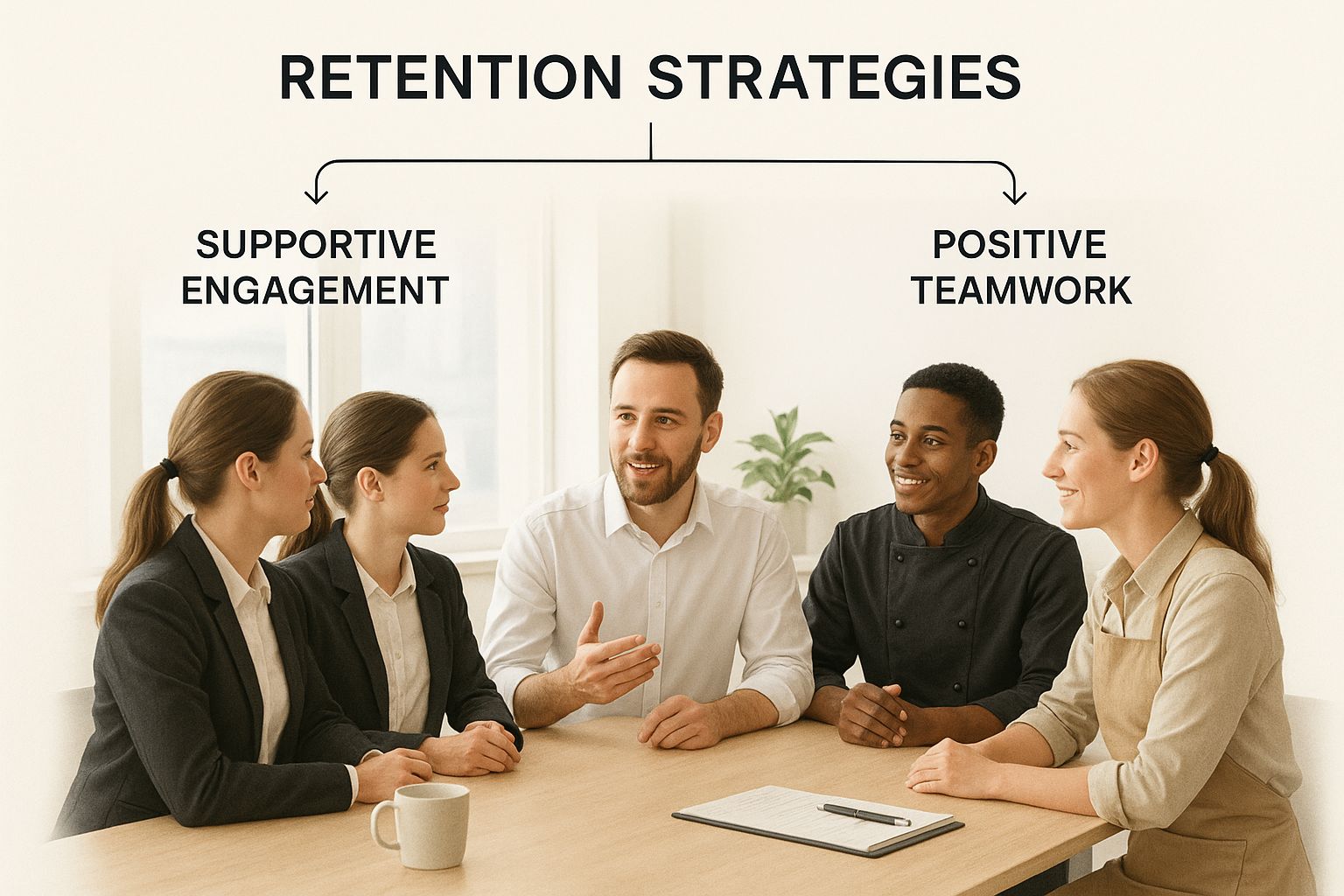
As the image shows, teamwork and professional growth are vital in hospitality. Investing in your own skills and having the right tools for the job is a huge part of that – and thankfully, the ATO often allows you to claim these costs back.
Self-Education and Professional Development
Are you taking a course to sharpen your skills or get ahead in your current job? Good news – you might be able to claim a deduction for those self-education expenses.
For a course to be deductible, it needs a direct connection to your current employment. It must either:
Maintain or improve the specific skills and knowledge you need for your job right now.
Be likely to lead to an increase in your income from your current role.
A great example is a sommelier taking an advanced wine certification or a chef completing a specialised patisserie course. Both are directly tied to their roles and could be claimed.
Just be careful: you can't claim a deduction if the course is only loosely related to your job or is designed to help you land a completely new one. It has to be about getting better at what you already do.
Getting Your Head Around Car and Travel Claims
Claiming car and travel expenses is easily one of the most confusing parts of tax time for anyone working in hospitality. But getting it right can seriously boost your refund, so it’s worth understanding the rules. The Australian Taxation Office (ATO) has a very clear line between what they see as work-related travel and what’s just your daily commute.
Let’s get the most important rule out of the way first: you almost never get to claim the cost of travelling between your home and your main workplace. This is considered a private expense. It doesn't matter if you work odd hours, split shifts, or live miles away—the ATO views where you live as a personal choice.
But don't worry, there are still plenty of travel situations where you absolutely can make a claim.
What Travel Can You Actually Claim?
This is where you can start clawing back some money. Work-related travel is any trip you have to make as part of your job, completely separate from that initial drive to get to work.
You can likely claim the cost of travel when you’re:
Driving between two different jobs (like from your day job at a cafe to your evening shift at a restaurant).
Travelling from your usual workplace to another location for work (e.g., your boss sends you from your home restaurant to another venue for a special event).
Sent out to pick up supplies or make deliveries for your employer during your shift.
Here’s a simple way to think about it: if your trip starts at home and ends at your usual workplace for a normal shift, it’s probably a non-deductible commute. But if your employer tells you to go somewhere else during your workday, that travel is almost certainly deductible.
How to Claim Your Car Expenses
If you're using your own car for these work-related trips, the ATO gives you two ways to calculate your deduction. You have to pick one method for the whole financial year—you can't chop and change between them.
Cents per Kilometre Method This is the simple, no-fuss option. For the 2024-25 financial year, you can claim 88 cents per kilometre for up to a maximum of 5,000 work-related kilometres. You don't need a folder full of receipts, but you do need to be able to show the ATO how you worked out the kilometres, like with a diary or notes of your trips.
Logbook Method This one takes more effort but can lead to a much bigger claim, especially if you drive a lot for work. You need to keep a detailed logbook for 12 consecutive weeks to figure out the business-use percentage of your car. Once you have that percentage, you can claim that portion of all your car’s running costs—we’re talking fuel, insurance, rego, services, and even the decline in its value (depreciation).
Choosing the right method is key to getting the best outcome. To see which approach makes more sense for you, it’s a great idea to read through a detailed guide on how to claim your car expenses as a tax deduction.
What About Other Travel Costs?
Your car isn't the only thing you can claim. Think about any other travel-related costs you've had. If you caught public transport, an Uber, or a taxi for a work-related reason, you can claim those fares. The same goes for any parking fees or road tolls you had to pay while you were on the clock.
Just remember the golden rule for all these claims: keep your receipts or records as proof. No receipt, no deduction.
Mastering the Art of Record Keeping
The Australian Taxation Office (ATO) has a golden rule that every hospitality worker should live by: no receipt, no deduction. It’s that simple. Think of your financial records like a chef’s ‘mise en place’—getting everything organised beforehand turns tax time into a smooth, stress-free process instead of a last-minute scramble. Good record-keeping isn't just a good habit; it's your best defence and the key to getting the biggest possible refund.
For anyone working in the hospitality industry, proving your work-related expenses is non-negotiable. This means doing more than just stuffing a few crumpled receipts in your car's glovebox. Your goal is to create a crystal-clear paper trail that justifies every single deduction you claim.
What Documents You Must Keep
Your records need to tell the full story of your expenses. To keep the ATO happy, make sure you’re holding onto the following:
Receipts and Tax Invoices: These are your most important pieces of evidence. A proper receipt will show who you paid, how much you paid, what you bought, and the date you bought it.
Bank or Credit Card Statements: While a receipt is always better, bank statements can serve as backup proof that a transaction actually happened.
Diaries or Logbooks: Absolutely essential for tracking things like cash tips or calculating the work-related percentage of your car or personal phone use.
PAYG Payment Summaries/Income Statements: Your employer gives you this document, and it's what you use to report your income correctly.
With the tourism sector booming, developing these habits is more crucial than ever. Recently, Australian tourism employed around 706,400 people, a jump of 3.0% from the previous year. The accommodation subsector alone added 17,700 new jobs. As more people join the industry, staying organised is the best way to avoid common (and costly) tax mistakes. You can discover more insights on the latest tourism labour statistics from the ABS.
How to Stay Organised
Forget the old shoebox overflowing with faded receipts. Technology has made record-keeping incredibly easy.
Consider using a dedicated expense-tracking app on your phone—you can just snap a photo of a receipt and categorise it on the spot. If apps aren't your thing, a simple folder system on your computer or a cloud drive (like Google Drive or Dropbox) works perfectly. Just create folders for each financial year and subfolders for different expense types.
According to the ATO, you must keep all your tax records for at least five years from the day you lodge your tax return. This way, you'll have everything ready if they ever ask for proof of your claims down the track.
So, what happens if you genuinely lose a receipt? For tiny expenses—under $10 each and totalling no more than $200 for the whole year—you might be able to claim them without a receipt. However, you’ll still need some kind of record, like a diary entry noting the purchase. But relying on this is risky. The safest bet is always to make digital copies of everything.
Lodging Your Tax Return with Confidence
You’ve done the hard work of gathering your records, so now for the final step: lodging your tax return.
If you’re a hospitality industry employee tackling it yourself, you need to circle 31 October on your calendar. That’s the firm deadline set by the ATO, so it definitely pays to get everything sorted well before then.
Feeling the pressure of that cut-off date? Don't stress. By engaging a registered tax agent, like us here at Baron Accounting, you automatically get an extension. This often pushes your deadline well into the following year, giving you (and us) plenty of breathing room to get it right.

Choosing Your Lodgement Method
When it comes to actually lodging your return, you’ve got three main paths you can take. Each has its pros and cons.
myTax via myGov: This is the ATO’s free online portal. It’s a great option if your tax affairs are pretty straightforward and you’re comfortable doing it yourself.
Paper Form: The old-school way. While it’s still an option, be prepared for a much slower process. Your lodgement and any refund will take significantly longer to come through.
Registered Tax Agent: Working with a professional does more than just buy you time. An expert can spot eligible deductions you might have missed and ensures everything is compliant, which often means a better refund and complete peace of mind.
Using an agent removes the guesswork. You can be sure an expert has reviewed every detail to get you the best possible outcome.
Final Checklist for Success: Before you hit ‘submit,’ do one last check. Have you declared all your income (tips included!)? Do you have receipts for all your deductions? Does the ATO's pre-fill information look correct? A quick final review is the best way to catch simple mistakes and ensure a hassle-free process.
Your Questions Answered
Working in the fast-paced world of hospitality means you often have specific, on-the-spot questions about your tax obligations. This section gives you quick, clear answers to some of the most common queries we hear from hospitality industry employees, helping you tackle tax time with confidence.
Can I Claim My Non-Slip Kitchen Shoes?
Yes, you absolutely can. The ATO is pretty clear on this one: if you're required to wear specific footwear to protect you from injury at work, you can claim it as a deduction.
This covers things like the non-slip shoes essential for a commercial kitchen or steel-capped boots for lugging kegs around the storeroom. But remember, conventional shoes—even if they’re plain black ones your boss insists on—are considered a private expense and can't be claimed. Just make sure you hang onto the receipt.
Are My Cash Tips Taxable Income?
Yep, they sure are. Every dollar you earn from your job is considered assessable income by the ATO, and that includes all cash tips and gratuities. Forgetting to declare this income can lead to some pretty hefty penalties if the ATO finds out.
The best way to handle this is to keep a simple diary or a running note on your phone. Just jot down your cash tips as you get them throughout the year. It makes reporting your total income accurately so much easier when it's time to lodge.
The ATO takes the view that all income must be declared, no matter how you receive it. Keeping a diligent record of your cash tips is the only way to stay compliant and avoid a potential headache from a tax audit.
I Work Split Shifts. Can I Claim Travel Between Home and Work?
Unfortunately, no. Travel between your home and your regular place of work is nearly always considered a private expense by the ATO. This rule applies whether you're working one long shift or a couple of split shifts in a single day.
Those trips just aren't deductible. The main exception is if you have to travel to an alternative workplace during your shift—say, driving from your usual restaurant to a sister venue to cover for someone. That specific trip could be claimable.
What if My Employer Has Not Finalised My Income Statement?
Your employer is legally required to finalise your income statement through Single Touch Payroll (STP) by the 14 July deadline. The first thing to do is check its status by logging into your myGov account and heading to the ATO section.
If the deadline has passed and your statement still isn't marked as 'Tax ready,' your first move should be to contact your employer. If that doesn't sort it out, you'll need to give the ATO a call for assistance before you can lodge your return accurately. On another note, for those looking to climb the ladder in hospitality, mastering your tools is key. Proper commercial kitchen equipment training is invaluable for both safety and efficiency.
Need a Hand with Your Tax Return?
Let's be honest, figuring out tax in the hospitality industry can be a real headache. Between tips, special allowances, and knowing exactly what you can claim, it’s easy to feel like you're missing something. But you don’t have to do it all on your own.
Our team of registered tax agents live and breathe this stuff. We're here to make sure you claim every single dollar you're entitled to, keep everything above board with the ATO, and help you get the best possible refund. Why risk leaving money on the table or making a simple mistake that could cost you later?
Getting professional help takes the guesswork and stress out of tax time. Whether you just have a quick question or need someone to handle the whole lodgement from start to finish, we're here to give clear, straightforward advice for your specific situation.
• Need assistance? We offer free online consultations:
– LINE: barontax
– WhatsApp: 0490 925 969
– Email: info@baronaccounting.com
– Or use the live chat on our website at www.baronaccounting.com
📌 Curious about your tax refund? Try our free calculator:👉 www.baronaccounting.com/tax-estimate
For more resources and expert tax insights, visit our homepage:🌐 www.baronaccounting.com

Comments