
How to Set Up a Trust in Australia: A Practical Step-by-Step Guide

Setting up a trust in Australia is a formal legal process, not just a simple administrative task. It involves creating a specialised legal document called a trust deed, appointing a trustee to hold and manage assets, and formally settling the trust for its intended beneficiaries. When structured correctly, a trust is a powerful tool for asset protection, strategic tax planning, and managing intergenerational wealth transfer.
Why does getting it right from the start matter? An incorrectly established or poorly managed trust can lead to significant compliance risks, including severe tax penalties from the Australian Taxation Office (ATO). The process demands a clear understanding of your obligations, from choosing the appropriate trust type to registering for a Tax File Number (TFN) and meeting ongoing compliance duties.
Understanding the Role of a Trust in Australia
In the Australian legal and financial context, a trust is a formal relationship where a person or a company (the trustee) holds and manages assets for the benefit of other people or entities (the beneficiaries). The entire relationship is governed by a foundational legal document: the trust deed.
This structure is widely used by Australian families and businesses to achieve specific financial objectives, such as splitting investment income effectively, shielding personal or business assets from potential creditors, and ensuring a smooth succession of wealth.

Here at Baron Tax & Accounting, we frequently assist Brisbane-based clients who are exploring trusts for the first time. It often begins with a query about asset protection, which quickly evolves into a detailed discussion about the long-term benefits of income streaming and estate planning. A common scenario involves a client with a growing investment portfolio who realises that holding all assets in their personal name is no longer a tax-effective strategy.
Key Compliance and Regulatory Considerations
Navigating the rules set by the ATO and the Australian Securities and Investments Commission (ASIC) is non-negotiable. An improperly established or mismanaged trust can trigger serious financial and legal consequences.
Key compliance risks include:
Invalid Trust Deed: A poorly drafted or executed deed can render the trust void, leaving assets exposed to creditors and legal challenges.
Incorrect Trustee Appointments: Errors in appointing a trustee, such as using a corporate trustee that has not been properly registered with ASIC, can lead to administrative chaos and invalidate trustee decisions.
Severe Tax Penalties: Failure to make and document a valid trust distribution resolution before the 30 June deadline is a critical error. The ATO can tax the trust's income at the highest marginal rate of 47% (for the 2025-26 financial year, including the Medicare levy).
Stamp Duty Non-Compliance: Each Australian state and territory has its own specific rules and deadlines for "stamping" the trust deed. Missing these deadlines can result in financial penalties and may affect the deed's legal standing.
Understanding these compliance points from the outset is essential. A properly structured trust offers significant advantages, but only if it is set up and maintained in strict accordance with Australian law.
Choosing the Right Trust Structure for Your Goals
Selecting the correct trust structure is the foundational step in the process. This decision will dictate how assets are managed, the degree of flexibility you have, and your tax outcomes for years to come. It’s about more than just tax; it’s about control, asset protection, and long-term wealth management.
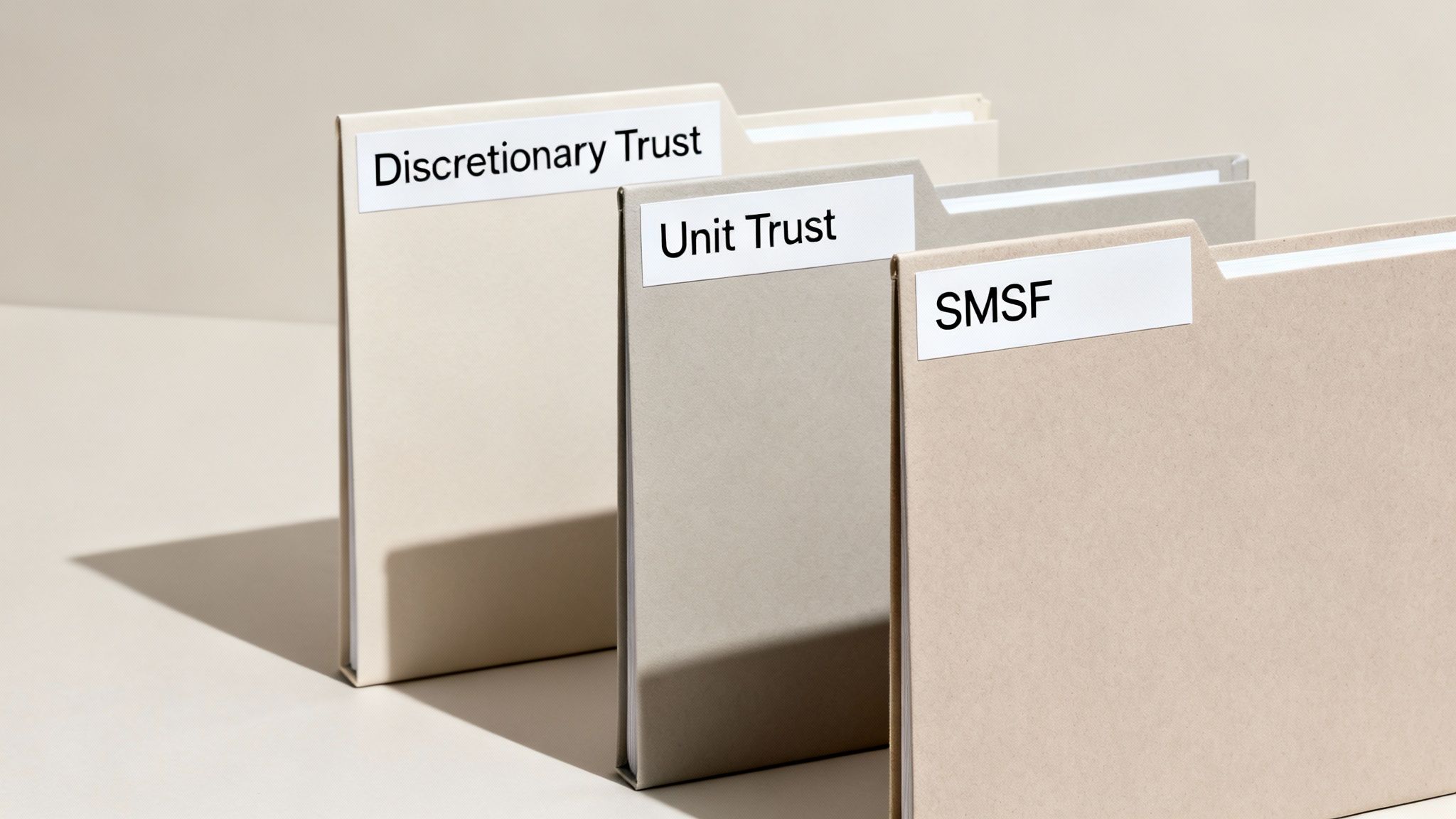
Let's examine the most common trust structures in Australia to help you determine which one aligns with your objectives.
Discretionary Trusts (Family Trusts)
The Discretionary Trust, commonly known as a Family Trust, is the preferred structure for many Australian families and small businesses due to its inherent flexibility. The trustee has the 'discretion' to decide which beneficiaries receive income or capital, and in what proportions, each financial year.
This feature is a cornerstone of effective tax planning, allowing the trustee to stream income to family members on lower personal tax brackets, thereby reducing the family's overall tax liability.
Key benefits include:
Income Streaming: The ability to direct profits to different beneficiaries annually based on their changing financial circumstances and tax positions.
Asset Protection: Assets held within the trust are generally shielded from the creditors of individual beneficiaries. If a beneficiary's personal or business finances are compromised, the trust's assets typically remain secure.
Succession Planning: It provides a structured and efficient mechanism for passing control of family assets to the next generation.
Discretionary trusts are ideal for holding family business interests, shares, and investment properties, as the ability to adapt distributions annually provides a significant strategic advantage.
Unit Trusts
In contrast to the flexibility of a discretionary trust, a Unit Trust operates on certainty and fixed entitlements. The trust's assets are divided into 'units,' similar to shares in a company. Each beneficiary (or 'unitholder') owns a specific number of units, which dictates their fixed entitlement to the trust's income and capital.
This rigid structure makes unit trusts highly suitable for joint ventures and investments between unrelated parties, as everyone’s stake is clearly defined from the outset, preventing future disputes.
A unit trust is generally preferred when:
You are pooling funds with business partners or unrelated investors.
Clearly defined, fixed ownership interests are required for all parties.
The ownership structure may need to change, as units can be bought and sold.
Comparison of Common Australian Trust Structures
Feature | Discretionary (Family) Trust | Unit Trust |
|---|---|---|
Primary Use | Family wealth management, asset protection, and small business ownership. | Joint ventures, property syndicates, and investments between unrelated parties. |
Distribution Flexibility | High. The trustee has full discretion to distribute income and capital among a class of beneficiaries each year. | Low. Entitlements to income and capital are fixed according to the number of units held. |
Asset Protection | Strong. Assets are generally protected from the creditors of the beneficiaries. | Moderate. A unitholder's units may be at risk if they face bankruptcy or legal action. |
Tax Implications | Allows for tax-effective income streaming to beneficiaries on lower tax rates. | Income and capital gains are distributed based on fixed unit holdings, offering less tax planning flexibility. |
Ownership Transfer | Complex. Changing control often requires amending the trust deed or changing the trustee/appointor. | Simple. Units can be bought, sold, or transferred, similar to shares in a company. |
Other Specialised Trust Structures
Beyond these common types, several other specialised trusts serve specific purposes.
A Testamentary Trust is established within a will and only becomes active after the person's death. It is a powerful estate planning tool used to protect inheritances for beneficiaries who may be young, vulnerable, or financially inexperienced.
A Self-Managed Super Fund (SMSF) is a private superannuation fund that you manage yourself. Legally, an SMSF is a type of trust, established for the sole purpose of providing retirement benefits to its members. According to ATO data, SMSFs are a significant part of Australia's superannuation landscape.
Your choice of trust is also a core component of long-term business strategy, particularly when considering strategies for business valuation and succession planning.
The Core Process for Legally Forming Your Trust
Once you've selected the appropriate trust structure, the next phase is to establish it legally. This involves several critical steps that must be executed correctly to ensure the trust is valid and functions as intended under Australian law.
It all begins with the trust deed, the foundational legal document that acts as the rulebook for the trust. It outlines the powers of the trustee, the rights of the beneficiaries, and the trust's objectives. A poorly drafted deed can lead to significant legal and tax complications, potentially invalidating the entire structure.

Drafting the Trust Deed
Given its importance, the trust deed must be drafted with precision to comply with relevant legislation and common law principles. While generic, off-the-shelf deeds are available, they often lack the specific clauses required for unique family or business situations.
Engaging a solicitor specialising in trust law is highly recommended. A specialist will ensure the deed:
Accurately reflects your intentions and objectives.
Grants the trustee the appropriate powers to manage assets effectively.
Avoids ambiguous clauses that could trigger unintended tax consequences or legal disputes.
Investing in professional legal advice, such as finding experienced legal guidance, ensures the deed is tailored to your circumstances and legally robust.
Appointing the Trustee
With the deed prepared, you must appoint a trustee—the person or company legally responsible for managing the trust's assets. There are two main options:
Individual Trustee: Often a founder or a trusted family member. This option is simpler but exposes the individual to personal liability for the trust's debts.
Corporate Trustee: A proprietary limited (Pty Ltd) company is established to act as the trustee. This is the preferred method for asset protection, as it creates a legal separation between the directors' personal assets and the trust's liabilities.
While establishing a corporate trustee involves an ASIC registration fee (currently $611 for a standard company for the 2025-26 financial year), the enhanced asset protection and smoother succession planning it provides are significant long-term benefits.
Settling the Trust
A trust is formally brought into existence through the act of settlement. This involves an independent person, known as the settlor, giving an initial sum of money (the 'settled sum') to the trustee to be held on the terms of the trust deed.
The settled sum is typically a nominal amount, such as $10. It is crucial that the settlor is not a beneficiary of the trust to avoid adverse tax consequences. Once the trustee receives this sum and signs the trust deed, the trust is officially established.
State-Based Stamping and Registration Obligations
After the deed is signed and settled, it must comply with state or territory-specific requirements, primarily stamp duty. Most Australian states and territories require the trust deed to be stamped by their respective revenue office, which involves paying a fee to legally validate the document. Deadlines are strict and vary by jurisdiction:
New South Wales: Within 3 months of execution.
Victoria: Within 30 days of execution.
Queensland: Within 30 days of execution.
Tasmania: Within 3 months of the first execution.
Failing to meet these deadlines can result in penalties, and an unstamped deed may not be recognised in court, jeopardising the trust's legal standing.
With these foundational steps completed, you can proceed with applying for the trust's Tax File Number (TFN) and Australian Business Number (ABN). For a clear guide on these requirements, see our article on ABN and tax return compliance.
Getting Your Trust on the Official Radar: ATO & ASIC Registrations
Once your trust deed is signed and settled, the trust exists legally. However, for it to operate—open a bank account, acquire assets, or earn income—it must be officially registered with government bodies, primarily the Australian Taxation Office (ATO).
This is a mandatory part of Australian compliance that transforms your trust from a legal document into a functioning financial entity.
First, you must obtain a Tax File Number (TFN) from the ATO. This is the trust’s unique identifier for all tax-related matters. Without a TFN, the trust cannot lodge its annual tax return, and any income it earns may be taxed at the highest marginal rate.
Next is the Australian Business Number (ABN). An ABN is required if the trust is 'carrying on an enterprise'. The ATO defines this term broadly to include most business activities, as well as holding investments like shares or rental properties for the purpose of generating income.
How to Get Your TFN and ABN
Applying for a TFN and an ABN can typically be done simultaneously through the Australian Business Register (ABR) online portal.
You will need the trust deed and key details, including the trust's full name, date of establishment, and trustee information. While you can complete the application yourself, using a registered tax agent ensures all information is submitted correctly, avoiding potential delays.
Do You Need to Register for GST?
GST registration depends on the trust's activities and turnover. According to ATO rules, GST registration is compulsory if:
The trust is carrying on an enterprise.
Its annual GST turnover is $75,000 or more (or is projected to be).
Properly assessing your GST obligations from the start is crucial. For a detailed walkthrough, refer to our guide on how to register for GST in Australia.
Where Trusts Fit in Australia's Business Landscape
Trusts are a popular structure for managing assets and risk in Australia's dynamic business environment. According to ABS data, the number of actively trading businesses in Australia continues to grow, highlighting the need for robust structures like trusts to support new and expanding ventures.
Opening the Trust Bank Account
Once the ABN and TFN have been issued, you must open a dedicated bank account in the name of the trust. This is a fundamental duty of the trustee.
Crucial Compliance Step: Never mix trust funds with personal or other business funds. This practice, known as co-mingling, is a serious breach of trustee duties, creates an administrative nightmare, invites ATO scrutiny, and can undermine the asset protection benefits of the trust.
To open the account, you will need:
A certified copy of the stamped trust deed.
The trust's ABN and TFN confirmation details.
Proof of identity for all trustees (or directors of the corporate trustee).
A separate bank account provides a clear, auditable trail of all financial transactions, which is essential for preparing accurate financial statements and tax returns.
Your Ongoing Duties and Best Practices as a Trustee
Establishing a trust is the first step; ongoing management is the long-term commitment. As a trustee, you are bound by a fiduciary duty—a legal obligation to act solely in the best interests of the beneficiaries. This is an active role that requires diligent decision-making, meticulous record-keeping, and adherence to the trust deed.
This duty underpins every action you take, from investing trust funds to distributing income. You must avoid conflicts of interest, manage assets prudently, and maintain a clear paper trail. Failure to do so can expose you to personal liability and potential legal action from beneficiaries.
The Annual Distribution Resolution
One of the most critical annual tasks is preparing the trustee distribution resolution. This is a formal, written decision made before 30 June each year that specifies how the trust’s taxable income will be distributed among the beneficiaries.
The tax consequences of failing to do this correctly are severe. If a valid resolution is not made by the deadline, the ATO can assess the trustee on the trust's entire net income at the highest marginal tax rate—47% for the 2025-26 financial year (including the Medicare levy).
Record Keeping and Financial Reporting
Your fiduciary duty includes maintaining immaculate records. This is essential for demonstrating compliance to the ATO, keeping beneficiaries informed, and protecting you as the trustee.
Key record-keeping obligations include:
Financial Statements: Preparing an annual balance sheet and profit and loss statement.
Tax Returns: Lodging an annual trust tax return with the ATO.
Minutes of Meetings: Documenting all significant decisions, including investment strategies, asset acquisitions, and the annual distribution resolution.
Bank Statements: Retaining all statements from the trust’s dedicated bank account.
The ATO generally requires these records to be kept for at least five years.
Annual Trust Compliance Checklist
A structured checklist helps ensure no compliance tasks are missed.
Compliance Task | Key Action Required | Typical Deadline |
|---|---|---|
Review Trust Performance | Assess investment returns and ensure strategies align with the trust deed and beneficiary interests. | Annually, typically May/June |
Formally decide and document how the trust's income will be distributed among the beneficiaries. | Strictly before 30 June | |
Prepare Financial Statements | Compile the trust's balance sheet and profit and loss statement for the financial year. | July to October |
Lodge Trust Tax Return | Prepare and lodge the annual trust income tax return with the ATO. | Typically 31 October (or later if using a tax agent) |
Distribute Income to Beneficiaries | Make the physical payments of distributed income to beneficiaries as per the resolution. | As per trust deed, usually post-tax return |
Review Trust Deed | Periodically review the deed with a legal advisor to ensure it remains current with legislation. | Every 3-5 years or upon major life events |
FAQ: Common Questions About Setting Up a Trust in Australia
1. How much does it cost to set up a trust in Australia?
The initial cost to establish a standard discretionary or unit trust typically ranges from $1,100 to $5,000. This covers legal fees for drafting a compliant trust deed, the ASIC company registration fee if using a corporate trustee (approximately $611 for the 2025-26 financial year), and state-based stamp duty. Ongoing annual costs for accounting and tax compliance generally range from $2,000 to $4,000, depending on the trust's complexity and level of activity.
2. Can I be both a trustee and a beneficiary?
Yes, it is common for an individual to be a trustee (or a director of a corporate trustee) and a beneficiary, particularly in a family trust. However, a sole trustee cannot also be the sole beneficiary. This is because Australian trust law requires a separation of legal and beneficial ownership. To maintain the validity of the trust, there must be at least one other beneficiary.
3. Why is a trust distribution resolution so important?
A trust distribution resolution is a legally binding document that must be made before 30 June each year. It specifies how the trust’s taxable income will be distributed among its beneficiaries. According to ATO regulations, if a valid resolution is not made on time, the trustee can be taxed on the trust's entire net income at the highest marginal rate, which is 47% for the 2025-26 financial year. The resolution must be clear and unambiguous to be considered valid by the ATO.
4. Does my trust need a separate bank account?
Yes, absolutely. A dedicated bank account in the trust's name is a legal and financial necessity. It is a core trustee duty to keep trust assets separate from personal or other business funds. Co-mingling funds undermines asset protection, creates significant record-keeping problems, and is a major compliance red flag for the ATO.
5. What happens if I don’t pay stamp duty on the trust deed?
Failing to pay stamp duty within the deadlines set by your state or territory revenue office can have serious consequences. These include financial penalties for late payment and the risk that the trust deed may not be admissible as evidence in court, potentially making it legally unenforceable. This could jeopardise the asset protection strategy the trust was established to provide.
For more detailed information on family trusts, see our guide on what a discretionary trust is and how it works for asset protection.
Summary: Key Takeaways
Setting up and managing a trust in Australia requires careful planning and strict adherence to legal and tax obligations.
Choose the Right Structure: Select a trust type (e.g., Discretionary or Unit) that aligns with your asset protection, tax planning, and investment goals.
Professional Drafting is Crucial: The trust deed must be professionally drafted by a solicitor to ensure it is legally valid and meets your specific needs.
Appoint the Right Trustee: Using a corporate trustee is the recommended approach for superior asset protection and smoother succession planning.
Complete All Registrations: Obtain a TFN and ABN for the trust and open a dedicated bank account immediately after establishment.
Meet Ongoing Duties: The trustee has a fiduciary duty to act in the beneficiaries' best interests, maintain meticulous records, and make a valid distribution resolution before 30 June each year.
Need Tailored Tax Advice?
The information in this guide is general in nature. Establishing and managing a trust involves complex legal and tax considerations specific to your personal and financial circumstances.
For tailored advice on setting up a trust that meets your objectives while ensuring full compliance with Australian law, contact a qualified professional.
Baron Tax and Accounting
Website: https://www.baronaccounting.com
Email: info@baronaccounting.com
Phone: +61 1300 087 213
Whatsapp: 0450468318
Comments