
Uniform Expenses ATO: Your Ultimate Guide to Claiming Tax Deductions

Figuring out tax deductions for your work uniform can feel complex, but it's often more straightforward than you think. The Australian Taxation Office (ATO) allows you to claim the cost of buying, renting, mending, or cleaning certain types of work clothes. However, the clothing must qualify as a compulsory uniform, a registered non-compulsory uniform, or protective clothing.
This article is based on the Current Financial Year at the time of writing.
From our experience at Baron Tax & Accounting, one of the most common points of confusion for employees across Brisbane is the distinction between a deductible uniform and a simple dress code. Many people assume any clothing their employer requires them to wear is claimable, but the ATO's rules are very specific. A client working in retail, for example, was surprised to learn their "all black" dress code didn't qualify, highlighting how crucial it is to understand the official categories.
What Are Deductible Uniform Expenses?
The ATO's rules for uniform expenses are designed to ensure you only claim costs directly linked to earning your income. Many people mistakenly believe any clothing worn for work is a valid deduction, but the guidelines are precise. The core principle is that the clothing must be uniquely identifiable to your job or protective in nature, not something you would wear in your everyday life.
This guide will clarify what the ATO considers a deductible uniform expense. We'll cover how to calculate related costs like laundry, the records you must keep, and the common mistakes that could lead to your claim being rejected.
Key Principles of Uniform Claims
To claim a uniform expense deduction, you must meet the ATO's core requirements:
You must have spent the money yourself and not have been reimbursed by your employer.
The expense must be directly related to earning your income.
You must have a record to prove it, such as a receipt or a detailed logbook for laundry costs.
The clothing must fit into one of the three eligible categories defined by the ATO.
Understanding this from the start is the key to a smooth and successful tax return. This guide will make these rules clear so you can lodge your claim with confidence.
What Work Clothing Can You Actually Claim?
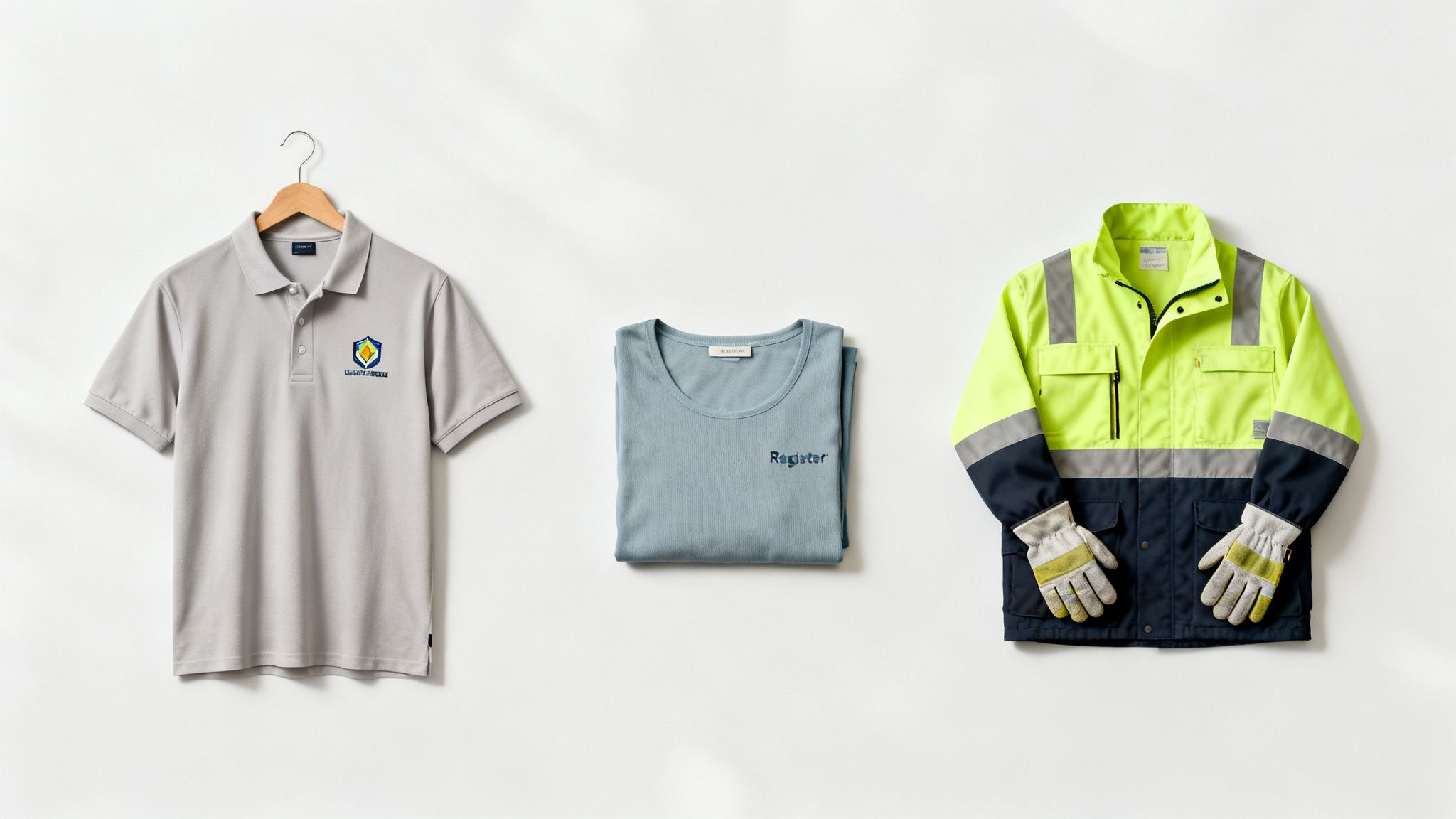
One of the most frequent questions is, "Can I claim my work clothes on tax?" The answer depends entirely on whether your work gear fits into one of three specific categories defined by the Australian Taxation Office (ATO).
A general dress code—like being asked to wear "black pants and a white shirt"—is not sufficient. The ATO classifies this as conventional clothing and a private expense, even if your employer insists on it. The real test is whether the clothing is uniquely identifiable to your employer or genuinely protective.
Compulsory Uniforms
This is the most straightforward category. A compulsory uniform is a specific set of clothing your employer requires you to wear as a mandatory condition of your employment.
The key feature is that the uniform must be distinctive and clearly identify your organisation. This means items with a permanently attached logo, a unique design, or a specific colour scheme that is synonymous with your employer.
Example: A Brisbane Airport customer service agent wearing a shirt, jacket, and trousers, all featuring the airline’s embroidered logo.
Key Test: Your employer’s policy makes wearing it mandatory, and you would not wear it outside of work.
If you are required to wear this type of uniform, you can claim the costs of buying, renting, and repairing it.
Non-Compulsory Registered Uniforms
This category is less common. It applies when your employer has an approved, non-compulsory uniform that has been officially registered with AusIndustry.
Even though wearing it is not mandatory, the formal registration allows employees who choose to buy and wear it to claim a deduction. This system ensures only specific, pre-approved designs qualify, preventing claims for everyday clothing.
ATO Perspective: The registration process acts as a gatekeeper. It officially confirms that the clothing design is unique enough to the employer to be distinguished from regular clothes, validating it as a legitimate work expense.
Protective Clothing
This category covers clothing and equipment you are required to wear to protect yourself from illness or injury that is a genuine risk in your line of work. It is about specialised gear essential for your safety on the job. For many trades, items like high-visibility work wear are a clear example of protective clothing that is almost always tax-deductible.
Here’s a look at what typically qualifies:
Item Type | Function | Common Professions |
|---|---|---|
Steel-Capped Boots | Protects feet from heavy or sharp objects | Construction, Warehousing, Trade |
Fire-Resistant Clothing | Protects from heat, flames, and sparks | Welders, Firefighters |
Sun-Protective Gear | Protects from UV radiation | Outdoor Labourers, Landscapers |
Non-Slip Safety Shoes | Prevents slips and falls in wet environments | Commercial Kitchen Staff, Cleaners |
The claim must be directly linked to the risks you face in your specific role. For example, an office worker cannot claim steel-capped boots, but a council worker maintaining Brisbane’s parks and gardens almost certainly could. You can learn more about general deductions in our guide on what you can claim on tax in Australia.
How to Calculate Your Laundry and Cleaning Costs
Once you've confirmed your work clothes are deductible, the next step is calculating how much you can claim for cleaning them. The ATO provides two methods for this calculation. Your choice will depend on your circumstances and record-keeping habits.

The Cents Per Load Method
This is a simple and quick option for those who wash their work gear at home. The ATO sets a standard rate per load to cover water, electricity, and detergent. You don't need receipts for cleaning products, but you must have a reasonable basis for your claim.
Here’s the process:
Determine your load type. The ATO has different rates for loads containing only work clothes versus a mix of work and personal items.
Keep a diary for a representative period, like four weeks, to track how many loads you do.
Calculate your annual total. Multiply your weekly average by the number of weeks you worked during the year.
Apply the ATO rate. Multiply your total loads by the official cents-per-load rate for the relevant financial year.
Key Takeaway: This method is ideal for home laundry. While you don't need receipts, a diary is your proof if the ATO requests it.
The Actual Costs Method
If you have significant cleaning expenses, particularly from dry cleaning, this method is likely better. It requires more diligent record-keeping but allows you to claim the full work-related cost.
To use this method, you must:
Keep every receipt from your dry cleaner or laundromat.
Apportion the cost if an item is for both work and personal use. For example, if you dry clean a suit also worn for personal events, you can only claim the work-related percentage.
Choosing the Right Method for You
The decision comes down to convenience versus the potential deduction amount.
Washing at home? The Cents Per Load method is efficient. Just keep a simple laundry diary.
Using a dry cleaner? The Actual Costs method will likely result in a larger claim. Be diligent about keeping receipts.
Brisbane-Relevant Example
Let's consider Sarah, a duty manager at a hotel in South Brisbane. Her role requires her to wear a specific branded suit for every shift.
Expense: Sarah dry-cleans her suit jacket and trousers weekly.
Cost: Her local dry cleaner charges $25 per week.
Working Year: She works 48 weeks per year.
Calculation: $25 (per week) x 48 (weeks) = $1,200.
Record-Keeping: Sarah keeps every receipt from the dry cleaner.
Because her costs are substantial and she has a complete paper trail, the actual costs method is the clear choice, allowing her to claim the full $1,200.
For a more detailed breakdown of laundry calculations, see our guide on how much you can claim for laundry.
Keeping the Right Records for the ATO
Your tax records are the evidence that validates your claims. Without solid proof, even a legitimate uniform deduction can be denied by the ATO. Understanding the substantiation rules is about protecting every dollar you are entitled to claim.
What Counts as Written Evidence?
When the ATO refers to written evidence, they typically mean a receipt or invoice. To be valid, this document must show:
The supplier's name.
The amount of the expense.
A description of the goods or services.
The date of the expense.
The date the document was created.
A bank statement alone may not be sufficient, as it often lacks a detailed description of the purchase. It's best used as supporting evidence alongside other records.
The $300 Threshold for Total Work Expenses
The ATO allows you to claim a total of up to $300 for all your work-related expenses without needing to keep receipts.
This is not an automatic deduction. You must have actually spent the money and be able to explain how you calculated your claim if asked.
Important Clarification: If your total work-related expenses for the year exceed $300, you must have written evidence for every single claim, including those under the $300 threshold.
ATO Record-Keeping Requirements for Uniform Expenses
Expense Type | Claim Value | Required Evidence |
|---|---|---|
Uniform Purchase & Repairs | Any amount (if total work claims > $300) | Receipts, invoices, or other written evidence. |
Laundry (Actual Costs) | Any amount | Receipts for every dry-cleaning or laundry service. |
Laundry (Cents Per Load) | Under $150 (and total work claims < $300) | No written evidence needed, but a diary is recommended to show calculation. |
Laundry (Cents Per Load) | Over $150 | A diary or similar record showing how you calculated the claim. |
Total Work Expenses | Up to $300 | No receipts needed, but you must be able to show how you calculated the claim. |
Total Work Expenses | Over $300 | Written evidence is required for all expenses. |
Your Audit-Proof Checklist for Uniforms
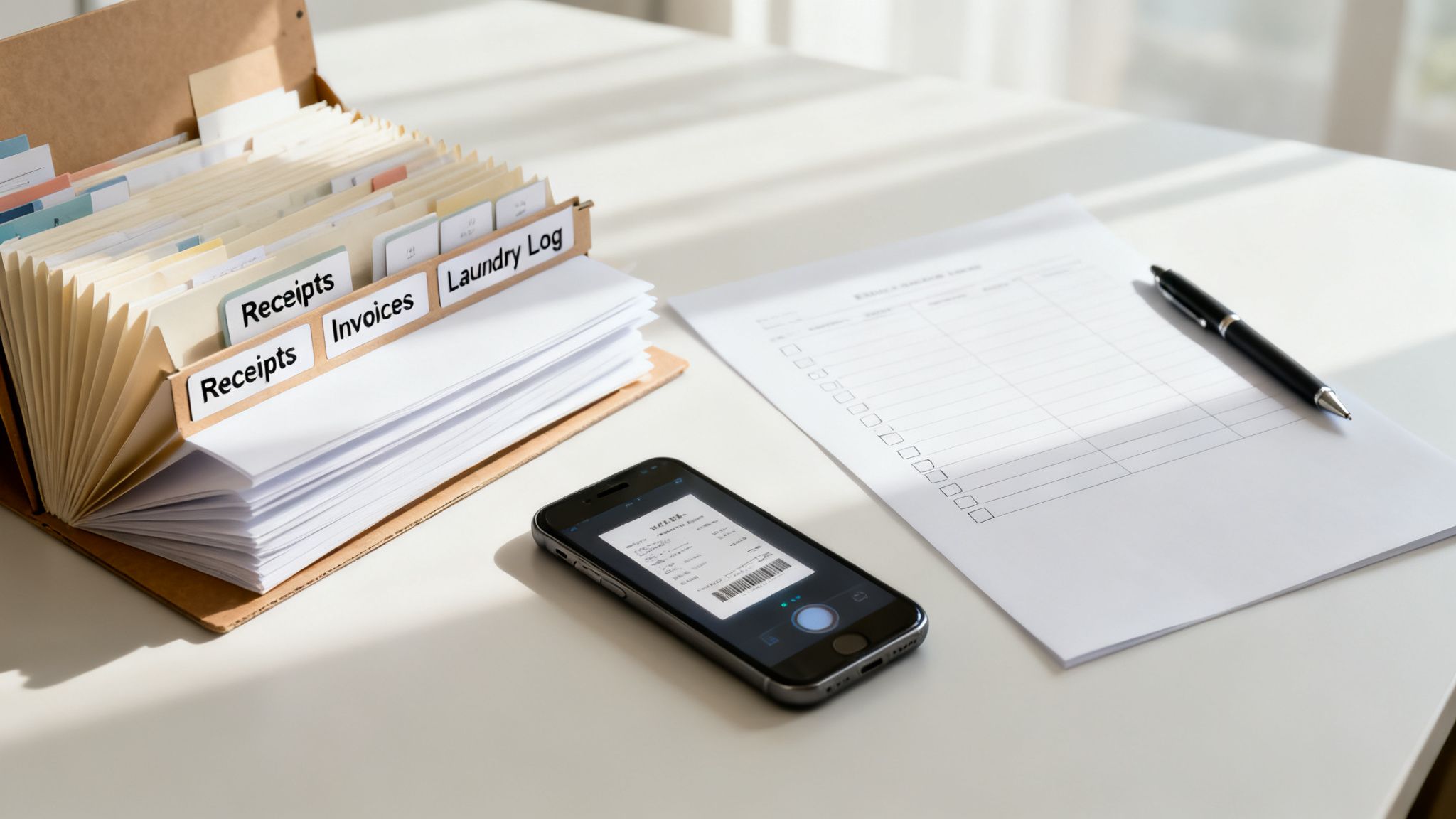
A simple system can help you stay organised. Use a digital folder or a physical envelope to keep the following:
Purchase Receipts: For compulsory uniforms, protective clothing, or registered items.
Repair Invoices: For mending zippers or tears.
Dry-Cleaning Slips: Essential if using the 'actual costs' method.
Laundry Diary: For the 'cents per load' method, a log over a four-week period is sufficient.
Bank or Card Statements: As backup evidence.
Employer’s Uniform Policy: A copy proves the uniform is compulsory.
Common Mistakes People Make with Clothing Claims
Navigating the rules for uniform expenses ATO claims can be tricky. Knowing the common pitfalls is the best way to ensure your claim is accurate, compliant, and will stand up to ATO scrutiny. Most errors arise from misunderstanding what the ATO considers a legitimate work expense versus a private one.
Claiming Conventional Clothing
This is the most frequent mistake. A dress code requiring you to wear plain black trousers and a white shirt, a business suit, or specific colours does not make these items a deductible uniform. The ATO classifies these as conventional clothes—items you could reasonably wear outside of work—making them a non-deductible personal expense.
Brisbane Example: An assistant in a Brisbane retail store is told to wear black jeans and a grey t-shirt. Even though it's a condition of their job, they cannot claim these items because they are not branded, specific, or protective.
Miscalculating Laundry Expenses
Incorrectly calculating laundry costs is another common error. This often happens in two ways:
Guessing the Amount: Claiming a round number like $150 without any basis is a red flag. You must be able to show your calculation.
Using the Wrong Method: If you dry clean expensive workwear but only claim the 'cents per load' rate, you are missing out on deductions. Conversely, claiming actual costs without receipts will result in the claim being denied.
For more on record-keeping, see our guide on what you can claim on tax without receipts in Australia.
Forgetting About Reimbursements
You cannot claim an expense for which your employer has reimbursed you. If you receive an allowance to cover uniform costs, you must declare that allowance as income on your tax return. You can then claim a deduction for the actual amount you spent, provided you have records to prove it.
Failing to Apportion for Private Use
If an item, particularly protective gear, is used for both work and personal activities, you must apportion the cost. For example, if you buy a sun-protective shirt for your landscaping job but also wear it on weekend fishing trips, you must estimate the work-related usage and only claim that percentage of the cost.
Practical Checklist for Claiming Uniform Expenses
Follow this checklist to ensure your uniform expense claims are accurate and compliant.
[ ] Verify Eligibility: Confirm your clothing is a compulsory uniform, registered non-compulsory uniform, or protective clothing.
[ ] Exclude Conventional Clothes: Do not claim for general dress codes (e.g., "black pants, white shirt").
[ ] Keep Purchase Receipts: Store all receipts for buying, renting, or repairing eligible items.
[ ] Choose a Laundry Method: Decide between the 'cents per load' or 'actual costs' method for cleaning expenses.
[ ] Maintain a Laundry Diary: If using the 'cents per load' method, keep a four-week log of your washing routine.
[ ] Collect Dry-Cleaning Receipts: If using the 'actual costs' method, keep every single receipt.
[ ] Check the $300 Rule: If your total work expenses are over $300, ensure you have receipts for everything.
[ ] Declare Any Allowances: Report any uniform allowance from your employer as income.
[ ] Apportion for Private Use: If an item is used privately, only claim the work-related portion.
Summary
Claiming uniform expenses correctly is a key part of maximising your tax return while staying compliant with ATO rules.
Here are the key takeaways:
Eligibility is Strict: You can only claim for compulsory uniforms, registered non-compulsory uniforms, and protective clothing.
Conventional Clothing is Not Deductible: A general dress code does not qualify as a uniform.
Records are Essential: Your claims must be backed by evidence, whether it's receipts for purchases or a diary for laundry costs.
Two Methods for Laundry: Choose between the simple 'cents per load' method or the more detailed 'actual costs' method based on your situation.
Honesty is Key: Declare all allowances and only claim for expenses you genuinely incurred and were not reimbursed for.
By following these guidelines, you can confidently and accurately claim your uniform expenses on your next tax return.
Frequently Asked Questions (FAQs)
Can I claim plain clothes my boss tells me to wear?
No. Even if your employer has a strict dress code (e.g., black trousers, white shirt), you cannot claim these items. The ATO considers them conventional clothes that are a private expense. For a claim to be valid, the clothing must have a company logo, be part of a registered non-compulsory uniform, or be genuinely protective.
What if my employer gives me a uniform allowance?
You must declare the full allowance amount as income on your tax return. You can then claim a deduction for the actual amount you spent on your uniform during the financial year, provided you have the records to prove the expense.
Can I claim the cost of shoes and socks?
Generally, no. Standard business shoes, sneakers, and socks are considered private expenses. The only exception is for specific protective footwear required for your job, such as steel-capped boots or non-slip safety shoes.
How do I prove my laundry claim without receipts?
When using the ATO’s ‘cents per load’ method, you don't need receipts for detergent. However, you must have a logical basis for your claim. The best way is to keep a simple diary for a representative period, such as four weeks, to track your work-only loads and mixed loads. This log serves as your evidence to show how you calculated your claim.
What happens if my total work expense claims are over $300?
If your total work-related expenses for the financial year exceed $300, you must have written evidence (like receipts) for every single expense you claim, not just the amount over the $300 threshold.
ATO Official Guidance Reference
Need Clarity on Your Situation?
The information provided in this article is general in nature and for educational purposes only. Tax laws are complex, and their application can vary significantly based on your individual circumstances, occupation, and employer policies.
To ensure you are claiming all your entitlements correctly and have the right documentation, it is always wise to seek advice tailored to your specific situation. A qualified professional can provide clarity and help you navigate the rules with confidence.
Baron Tax & Accounting
Website: https://www.baronaccounting.com
Email: info@baronaccounting.com
Phone: +61 1300 087 213
Whatsapp: 0450 468 318
Comments