
What Can You Claim on Tax Without Receipts in Australia? An ATO Guide

Ever wondered what you can claim on your Australian tax return without a shoebox full of receipts? It’s a common question, and while the Australian Taxation Office (ATO) does allow for some work-related expenses to be claimed without a perfect paper trail, this is only permitted under specific conditions and up to strict limits.
Understanding these rules is crucial for compliance. This guide explains the ATO's substantiation exceptions, helping you claim what you're entitled to while avoiding common pitfalls. Misunderstanding these rules can lead to incorrect claims, triggering an ATO audit and potentially resulting in having to repay the claimed amount, plus interest and financial penalties.
The ATO's Rules on Substantiation: Proving Your Expenses
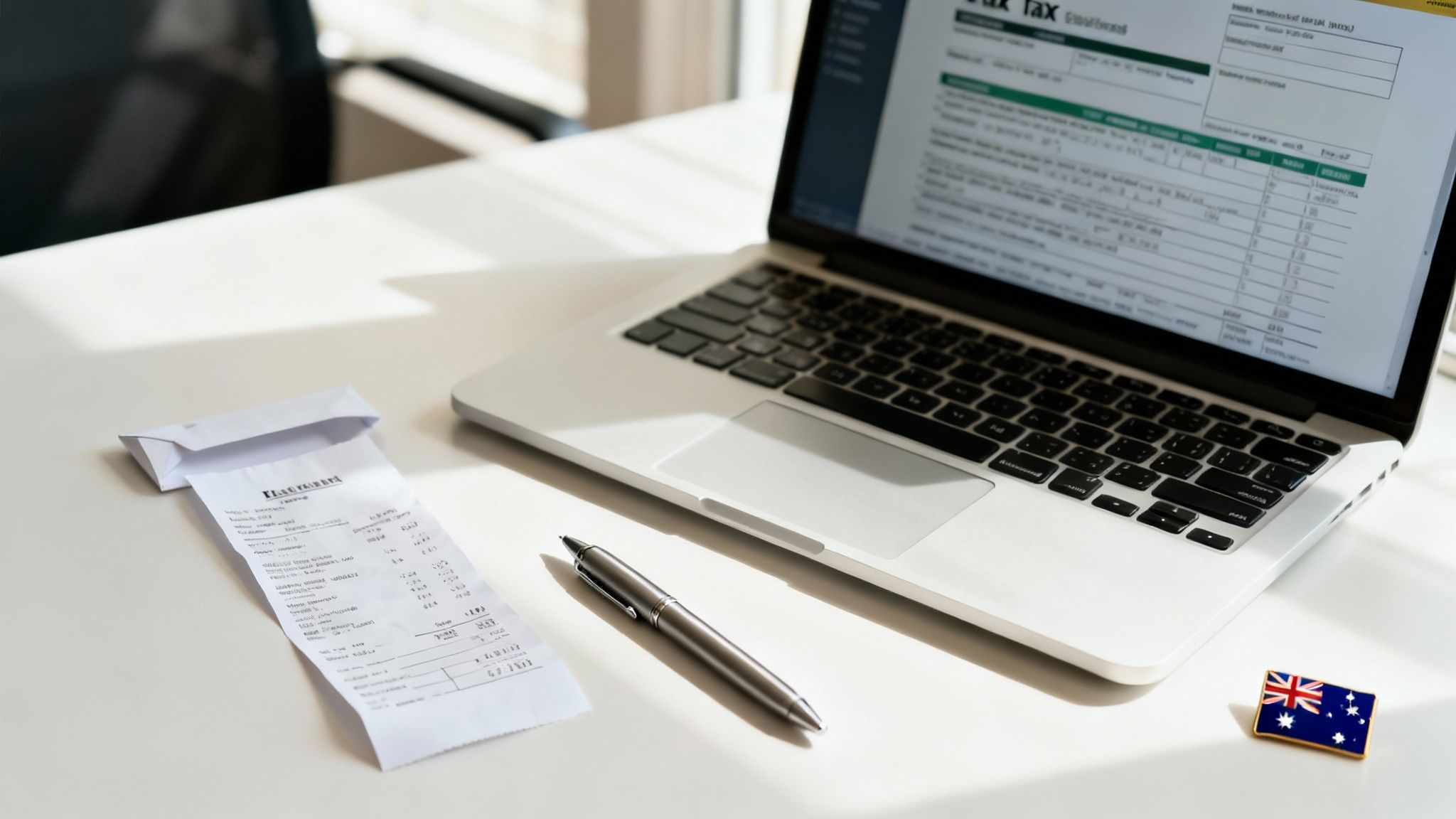
When you lodge a tax return, the core ATO principle is substantiation. This means you must be able to prove your expense claims. A receipt is the gold standard of proof, but the ATO recognises it isn't always practical to obtain or keep one for every minor purchase.
This is where "substantiation exceptions" apply. These are not loopholes; they are legally defined allowances for specific expenses. The ATO's framework is built on clear conditions and limits. It distinguishes between having no record at all and providing other forms of acceptable evidence.
Why Good Records are Essential for Compliance
Your records are your primary defence in an ATO review. The ATO uses sophisticated data-matching technology to compare your claims against industry benchmarks and data from banks, employers, and other government agencies. A claim that appears unusual or is not backed by solid evidence is a significant red flag.
This guide will clarify what you can legitimately claim without a receipt by breaking down:
The specific ATO rules and limits you must adhere to.
What alternative evidence is acceptable instead of a receipt.
Common mistakes to avoid.
Knowing these rules allows you to maximise your tax return confidently and compliantly. For a broader overview of deductions, see our comprehensive ATO guide to deductions.
The Foundation of Receipt-Free Claims
Substantiation exceptions were designed to cover small, incidental costs where the administrative burden of keeping a receipt outweighs the expense itself, such as minor parking fees or stationery. However, these exceptions are not an invitation to claim expenses you did not incur.
You must have spent the money, and the expense must be directly related to earning your income. Even without a receipt, the ATO can ask you to explain how you calculated your claim.
ATO Position: The purpose of substantiation exceptions is to be reasonable. The ATO provides these allowances for genuine, minor work-related costs—they are not a standard, automatic deduction for every taxpayer. Misinterpreting these rules can lead to your claims being denied and even financial penalties.
Key Conditions and Limits to Know
To use these exceptions, you must follow the ATO's strict rules. The most well-known are the total claim limits, such as the $300 total limit for work-related expenses and specific allowances for laundry and car expenses.
These are cumulative totals for all claims made under the exception. If your total claim exceeds a threshold, you must provide written evidence for all your claims in that category, not just the amount over the limit.
What Can You Claim on Tax Without Receipts?
The ATO prefers receipts as the primary form of evidence for work-related expenses. However, they have established specific allowances for certain expenses where a receipt may not be practical.
These are not automatic entitlements—you must have incurred the expense, and it must be directly linked to earning your income.
Work-Related Car Expenses
If you use your personal vehicle for work, you can claim expenses using the cents per kilometre method without needing receipts for fuel or running costs.
This method allows you to claim a set rate for each work-related kilometre, up to a maximum of 5,000 business kilometres per car, per year. You do not need written evidence for fuel, insurance, or registration.
However, you do need to show the ATO how you calculated the total kilometres. A diary or logbook documenting your work-related trips is required. Learn more in our guide on the cents per km method.
Laundry and Uniform Expenses
You can claim the cost of washing a compulsory work uniform or protective clothing without receipts, provided your total laundry claim is under $150.
The ATO provides a reasonable basis for this calculation:
$1 per load if washing only work clothes.
50 cents per load if it is a mixed load with other private items.
This allowance only applies to specific workwear, such as a uniform with a company logo or protective gear, not conventional office attire.
Small Work-Related Expenses (The $300 Rule)
The $300 total work-related expenses rule allows you to claim a total of up to $300 for various minor work expenses without providing individual receipts. This can cover items like stationery, professional subscriptions, or union fees.
ATO Warning: This is not a $300 standard deduction. You must have actually spent the money and be able to explain the nature of the expense if asked. The ATO actively investigates unsubstantiated claims and has sophisticated systems to detect anomalies.
ATO Claims Without Receipts: A Summary Table
This table provides a quick reference for common work-related expenses you can claim without a receipt, outlining their specific rules and limits.
Expense Category | ATO Method/Rule | Claim Limit/Condition | Required Record |
|---|---|---|---|
Work-Related Car Use | Cents per kilometre method | Up to 5,000 business km per car/year | Diary or logbook showing work-related travel and calculation basis. |
Laundry Expenses | Reasonable basis calculation | Total claim must be under $150 | A log of washes ($1/load or 50c/mixed load). |
Minor Work Expenses | Total work-related expenses rule | Total combined claim must be under $300 | Must be able to explain the expense and its connection to your work if asked. |
How to Prove Your Expenses Without a Receipt
If a receipt is lost or was never provided, you have not automatically forfeited the deduction. The ATO accepts other forms of evidence, provided it proves you paid for a legitimate work-related expense. A bank statement is a starting point but is often insufficient on its own.
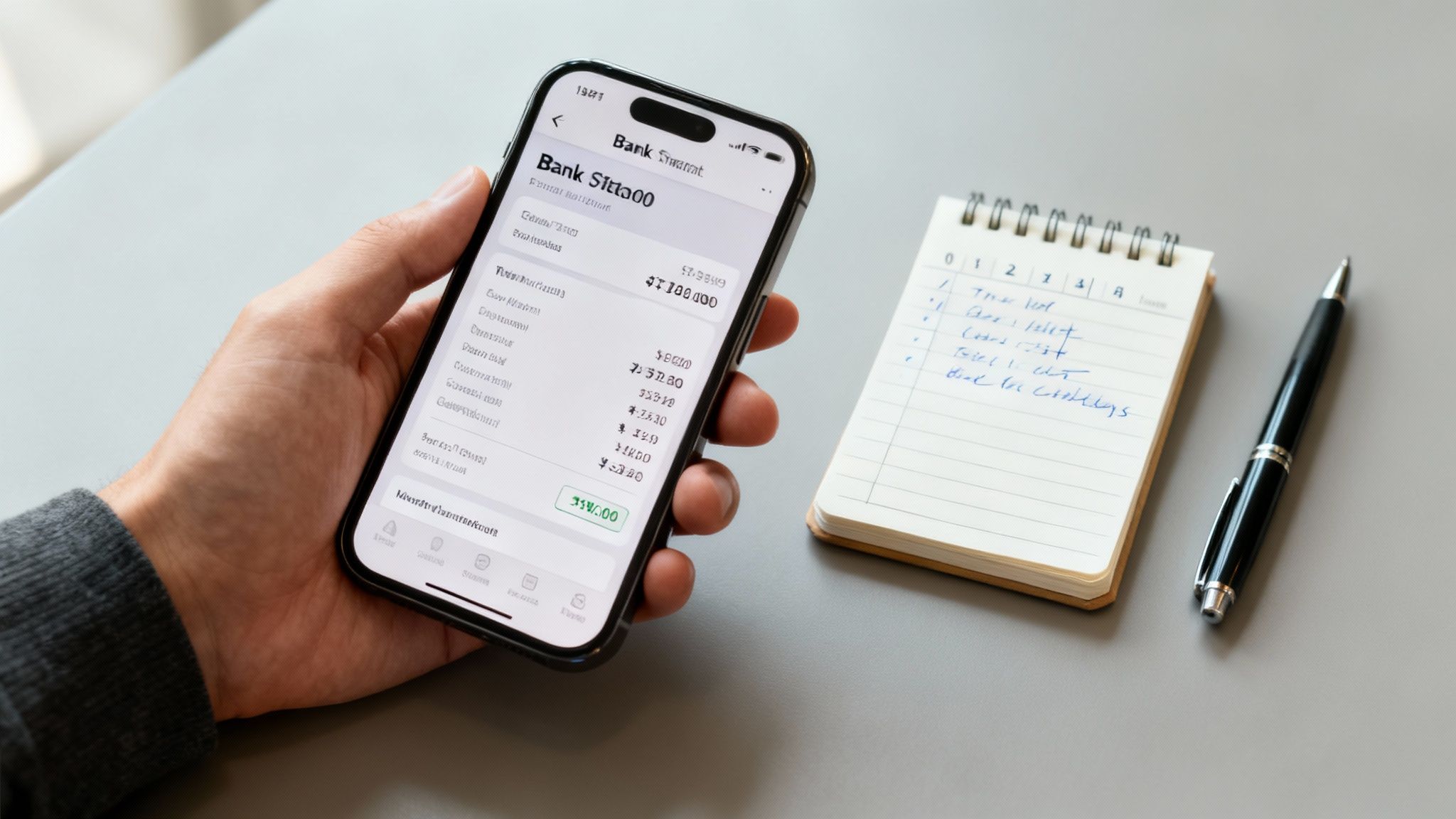
Your objective is to build a case that leaves no doubt the expense was real, necessary for your job, and paid for by you.
Creating a Strong Evidence File
Your alternative evidence must substantiate five key details required by the ATO:
The name of the supplier.
The exact amount of the expense.
The nature of the goods or services.
The date the expense was incurred.
The date the document was prepared.
For property investors, deductions are often substantiated through specific documents like an investment property depreciation schedule, which serves as a specialised form of evidence.
ATO-Accepted Alternative Evidence
The most effective method is to combine a bank or credit card statement with another detailed, contemporaneous record—a record created at or near the time of the transaction. The closer the record is to the purchase date, the more credible the ATO will consider it.
ATO Guidance: The most compelling evidence is created in the moment. A diary entry written weeks after a purchase has less weight than one made on the same day. Consistency and timeliness are crucial for substantiating a claim.
Acceptable forms of alternative evidence include:
A bank or credit card statement showing the transaction, combined with:
A diary or logbook entry detailing the item and its work-related purpose.
Written correspondence from the supplier, such as a confirmation email.
For example, to claim your mobile phone bill, a bank statement showing a payment to your telco is not enough. You must supplement it with a logbook showing the percentage of work-related use. For further details, see our guide on the mobile phone tax deduction.
Common Mistakes When Claiming Without Receipts
Navigating the rules for deductions without receipts is complex, and several common mistakes frequently attract ATO scrutiny.
A primary error is treating the $300 total work-related expenses allowance as an automatic deduction. It is not. It is an exception to the record-keeping requirement, but you must have incurred the expenses.
Another common mistake involves the cents per kilometre method. Estimating kilometres or claiming the 5,000-kilometre limit without a reasonable calculation basis is non-compliant. The ATO requires a diary or other records to justify your claim.
Vague Records and Incomplete Logbooks
Vague or incomplete records are a major red flag for the ATO and are likely to be challenged.
Bank Statements Alone: A bank statement proves a transaction occurred but does not describe the goods or services purchased. A payment to a retailer like "Officeworks" could be for personal items or business stationery. The ATO requires more specific proof.
Insufficient Logbook Entries: For car or home office claims, generic entries like "work travel" or "worked from home" are inadequate. The ATO requires dates, specific destinations or tasks, and a clear, documented purpose for the expense.
ATO Compliance Standard: A poorly maintained logbook is as high-risk as having no records. The ATO requires sufficient detail to verify that a claim is directly related to earning assessable income. Ambiguity can lead to claims being denied.
Failure to meet these standards significantly increases your risk of an audit. If you are concerned about a review, it is wise to seek professional tax audit help.
FAQ: Your Top Questions on Tax Claims Without Receipts
Here are answers to frequently asked questions about claiming tax deductions without receipts, based on official ATO guidelines.
Is the $300 work expense claim an automatic deduction?
No. The $300 rule is a common misconception. It is not a standard deduction or "freebie." It is a substantiation exception, meaning you can claim up to $300 in total for legitimate work-related expenses without holding individual receipts. You must have actually spent the money and be prepared to explain the expenses to the ATO if asked.
What if I lose a receipt for an expensive item?
Losing a receipt for a significant purchase does not automatically disqualify the deduction, but you must provide robust alternative evidence. Start with a bank or credit card statement showing the transaction. Supplement this with a contemporaneous record, such as a detailed diary note, that specifies the date, amount, supplier, a clear description of the item, and its work-related purpose.
How can I prove cash expenses without a receipt?
Substantiating cash expenses is challenging but possible with disciplined record-keeping. Since there is no bank transaction, your primary evidence is a detailed record created at the time of the expense. The ATO requires a diary or logbook entry showing the date, amount, supplier, and a specific description of the goods or services and their connection to your work. Without this, defending a cash claim during an ATO review is extremely difficult.
Are bank statements sufficient proof for the ATO?
On their own, bank statements are generally not sufficient proof. A statement proves a transaction occurred but typically fails to detail what was purchased. For example, a transaction from a supermarket does not prove you bought work-related items. You must link the bank transaction to other evidence, like a diary entry or photo, to prove it was a legitimate work expense.
Summary
Claiming tax deductions without receipts is permissible under Australian tax law, but only if you adhere strictly to the ATO’s rules. The burden of proof always rests with you, the taxpayer.
Key Takeaways
Stick to Approved Methods: Use ATO-approved methods like the cents per kilometre rate for car expenses.
Respect the Limits: Adhere to caps, such as the $300 limit for miscellaneous work expenses and the $150 threshold for laundry.
Provide Solid Proof: Even without a receipt, you need credible evidence. Detailed diary notes, logbooks, and bank statements are essential to build a defensible claim.
Core Principle: You must be able to prove you spent your own money on legitimate costs directly related to earning your income.
Use this guide as a checklist to ensure every claim you make is accurate, compliant, and defensible.
Need Help Navigating Your Tax Claims?
Interpreting the ATO's rules on substantiation can be complex. If you are unsure about what you can claim without receipts or need assistance preparing a compliant tax return, professional guidance is invaluable.
Our experienced accountants provide clear, authoritative advice to help you meet your tax obligations while legally maximising your return.
Contact Baron Tax and Accounting today for a consultation.
Website: baronaccounting.com
Email: info@baronaccounting.com
Phone: +61 1300 087 213

Comments