
Uber and DiDi Driver Tax in Australia for 2026-27: GST, ABN and What You Can Actually Claim

Most people who sign up to drive for Uber or DiDi treat it like any other bit of side income — keep a loose record, sort it out at tax time, declare whatever the app says they earned. Rideshare driving doesn't actually work that way, and the gap between what people assume and what the ATO requires is where almost every mistake in this guide starts.
Here's the short version. If you carry paying passengers for Uber, DiDi or a similar platform, you need an ABN and you need to be registered for GST from your very first fare — regardless of how little you earn in a year. That single requirement catches out more new drivers than anything else on this list, because it doesn't follow the normal small business GST threshold at all.
Baron Tax & Accounting is a registered tax agent based in Rochedale South, Brisbane, and we handle the GST registration, BAS lodgment and tax returns for rideshare and delivery drivers across Australia. This guide sets out what the ATO actually expects from Uber and DiDi drivers for the 2026-27 year, what you can claim, and where the rules differ from the ones that apply to Uber Eats or DoorDash.
What's in this guide

Why rideshare income doesn't get the benefit of the doubt
Employee income has tax withheld before it reaches your bank account. Rideshare income doesn't — the full fare lands with you, minus the platform's cut, and it's on you to work out what's owed. The ATO treats this as business income from the very first trip, not as a hobby or casual pocket money, which means every fare has to be declared, not just the ones you remember.
What changes the calculation for a lot of drivers is that the ATO isn't relying on your word for it. Under the sharing economy reporting regime, Uber, DiDi and similar platforms have been required to report driver payment data to the ATO twice a year — by 31 January and 31 July — since 1 July 2023. In practice, that means the ATO often has your numbers before you've lodged, so a return that doesn't match what the platform reported tends to get flagged rather than quietly accepted.
That's not a reason to panic about past returns — if you've under-reported in an earlier year, the ATO's own guidance is that you can amend it rather than wait to be caught. But for the current year, it's worth treating your rideshare income the way you'd treat wages from a job: assume it's all visible, because for the most part, it already is.
Getting your ABN and TFN sorted before you start driving
You can't register for GST without an ABN, and the ATO expects rideshare drivers to have both an ABN and a GST registration in place before they accept their first paid ride, not sometime in the weeks after. When you apply, the business description that fits is ride-sourcing — generally entered under a taxi driver or taxi cab service category — rather than a generic sole trader description, since that's what determines how your GST registration is treated.
If you already hold an ABN for other work — a different side business, or past contracting — you don't need a new one. You do still need to add GST registration to it if you haven't already, and the ATO gives you 21 days from the date you start ride-sourcing to do that. If you're already GST-registered for something else entirely, that same registration covers your rideshare income too; there's no need to register twice.
Once you're set up, give your ABN to the platform directly. Uber and DiDi both use it to issue tax invoices on your behalf for the fares you drive, and without it on file, the paperwork trail gets messier than it needs to be.
GST registration — the rule that catches new drivers out
This is the part that genuinely surprises most new drivers: the usual $75,000 turnover threshold that lets most small sole traders avoid GST altogether does not apply to ride-sourcing. The ATO is explicit about it — you have to register for GST regardless of how much you earn, even if your total rideshare income for the year comes to a few thousand dollars.
The reasoning goes back to how ride-sourcing is classified. The ATO treats it the same way as taxi travel, and taxi travel has never had a turnover-based exemption from GST — a position the Federal Court upheld in the original Uber case nearly a decade ago, and the rules haven't moved since. It doesn't matter if you drive ten hours a week or two; the obligation starts with your first paid trip.
Skip this step and the exposure isn't limited to back-paying the GST you should have collected. The ATO can register you for GST itself, backdate that registration, charge interest on the GST you didn't remit, assess the income tax owed on top of it, and apply penalties — in a recent six-week compliance push, more than 3,000 drivers registered after being contacted, which gives some sense of how actively this gets followed up.
How GST is actually worked out on your fares
A lot of drivers get this part of the maths wrong without realising it: GST is one-eleventh of the full fare the passenger pays — not one-eleventh of what actually lands in your account after Uber or DiDi takes its commission.
Take a $55 fare as an example. The GST component is $55 ÷ 11, or $5, and that's what you're liable to remit regardless of what the platform deducts afterwards. If the platform then takes an $11 service fee that includes GST, you can generally claim a GST credit of $1 — one-eleventh of that fee — which offsets what you owe. Run that across a week of fares totalling, say, $2,554, and the GST payable comes to roughly $232, before any GST credits on the platform's commission and your other business expenses are applied.
Exactly how this appears on your BAS depends on which figures your platform provides — some show the full fare, others show it net of commission — so it's worth checking your specific statement against what you're reporting rather than assuming every platform presents it the same way.

Quarterly BAS lodgment and where Q1 2026-27 sits in the calendar
Once you're GST-registered, you report and pay through a Business Activity Statement, generally quarterly unless you've chosen monthly reporting. For the 2026-27 year, the September quarter — covering July, August and September — is due on 28 October 2026, with the remaining quarters falling at the end of February, April and July.
That's worth saying twice, because it gets confused with the 31 October deadline for individual tax returns, and they're not the same thing. One is about your GST obligation on fares you've already collected; the other is about your income tax return for the previous financial year. A rideshare driver can easily be dealing with both deadlines inside the same fortnight.
Rather than working through the figures from scratch every quarter, most of the drivers we work with prefer to have their BAS prepared and lodged by a registered agent from the start — it also means the later agent lodgment deadlines, rather than the earlier self-lodgment dates, generally apply to you as well.
Car expenses: cents per kilometre or logbook
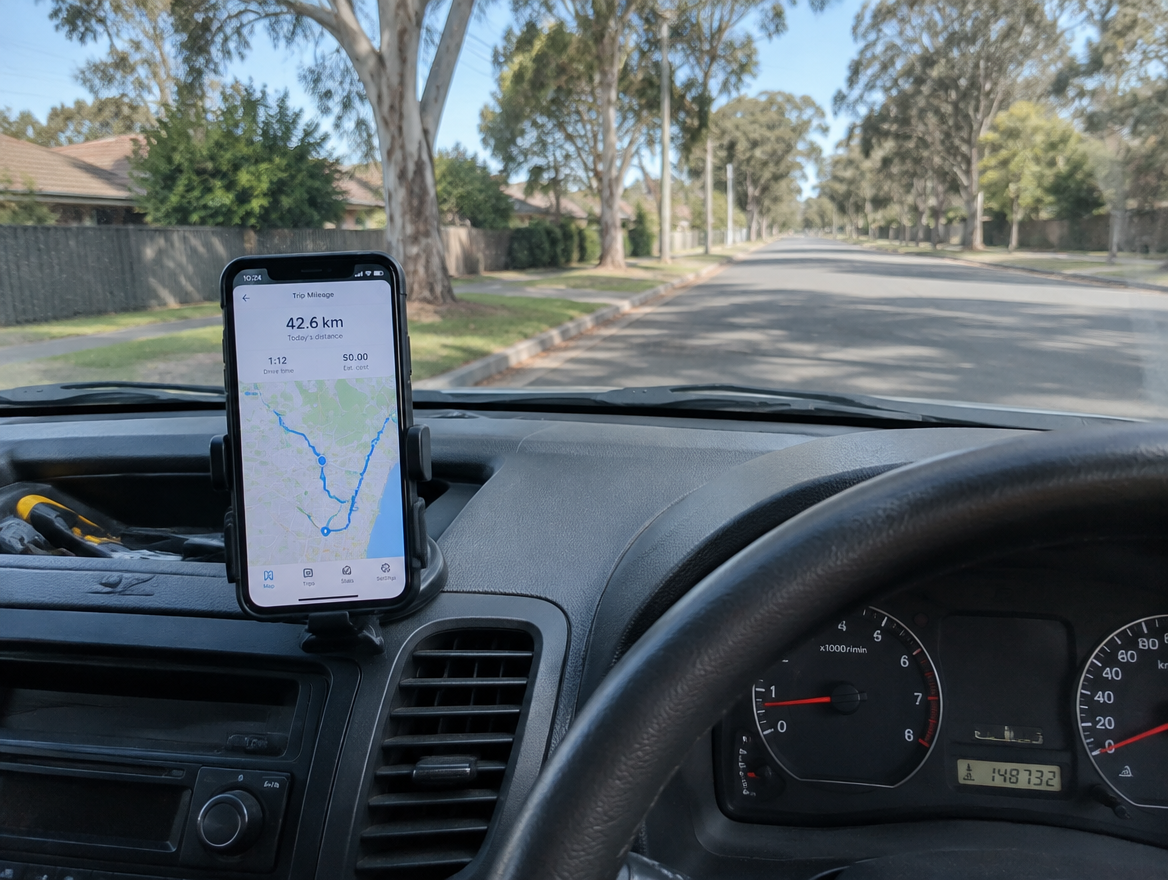
Your car is almost certainly your biggest deduction, and you've got two ways to claim it. The cents per kilometre method is the simpler of the two: for 2026-27 the rate is 91 cents per kilometre, capped at 5,000 business kilometres a year, which works out to a maximum claim of $4,550 regardless of how many kilometres you actually drove for work.
The logbook method takes more record-keeping — a 12-week logbook establishing your business-use percentage, then applying that percentage to your actual running costs, including fuel, servicing, insurance, registration and depreciation — but for most rideshare drivers, who are often putting on well over 5,000 business kilometres a year, it produces a noticeably larger deduction. If you're driving rideshare more than a few hours a week, it's worth running the logbook for at least one quarter to see which method actually comes out ahead before committing to cents per kilometre by default.
One detail that's easy to miss either way: the logbook method is also the only one that lets you claim GST credits on car-related purchases like fuel and servicing, since the cents per kilometre rate is deemed to already include everything. If GST credits matter to your cash flow, that's a real factor in choosing between the two methods, not just a record-keeping preference.
The deductions drivers forget about beyond the car
Phone and data plans used for the Uber or DiDi app — and for navigation — are deductible to the extent they're used for driving, which in practice means keeping a rough log of work versus personal use rather than claiming the whole bill. Platform commission and booking fees are deductible in full, and so is the GST component buried inside them, which is where a lot of drivers leave money on the table simply because it doesn't show up as a separate line item.
Beyond that: car cleaning (inside and out, since a clean car is genuinely part of the job), bottled water and mints provided to passengers, parking and tolls incurred while working, and any rideshare-specific insurance you've taken out on top of your standard comprehensive cover. Ordinary comprehensive car insurance commonly excludes commercial ride-sourcing use, so a separate rideshare policy is often both a platform requirement and a legitimate deduction in its own right.
What doesn't make the list: fines — speeding, parking — and the portion of any expense that relates to personal driving rather than paid trips. Mixing the two up is one of the more common reasons a deduction gets queried.
PAYG instalments: when the ATO starts asking for tax upfront
There's a point where the ATO stops waiting for your annual return and starts collecting tax as you go. Once your rideshare income, combined with any other income, reaches a level where you're expected to owe tax at year-end, it can move you onto PAYG instalments — quarterly prepayments towards that eventual tax bill, rather than one lump sum at tax time. This usually kicks in after your first tax return showing rideshare income has been processed, not from day one.
It's not a penalty, and the instalments count as credit against your actual tax bill when you lodge — but it does mean budgeting for a quarterly payment on top of your GST obligations, which catches some drivers off guard if they haven't planned their cash flow around it.
Why rideshare drivers don't get the same pay floor delivery riders just got
If you've seen headlines about gig workers getting a guaranteed minimum pay rate, it's worth being precise about who that actually covers. The Fair Work Commission's new minimum standards order, which applies from 17 August 2026, is specifically for on-demand delivery of food, drinks, alcohol and groceries arranged through an app — think Uber Eats, DoorDash and similar. It does not extend to rideshare or passenger transport work.
So driving passengers for Uber or DiDi doesn't currently carry the same guaranteed hourly floor that delivery riders have just gained. That's a genuinely different regulatory space from the tax obligations covered in this guide, and it's one area where rideshare and delivery driving — despite running through similar apps — are treated quite differently.
Handling it yourself versus having a registered agent run it
Nothing in the ATO's rules stops you from registering for GST and lodging your own BAS — plenty of drivers do. Where it tends to go wrong is less about the paperwork and more about the two things that are genuinely easy to get backwards: calculating GST on the full fare instead of the net amount, and not realising the $75,000 threshold simply doesn't apply.
If you'd rather not carry that risk yourself, this is exactly the kind of recurring compliance work we take off drivers' hands. You send through your platform statements and expense records each quarter, our registered agents check the GST and deduction figures against what's actually claimable, and we lodge the BAS and your tax return on your behalf — with the later agent lodgment deadlines generally applying once we're looking after it.

A short checklist before your first shift
Apply for an ABN (or confirm your existing one), using a ride-sourcing or taxi business description
Register for GST from the date you start — don't wait to see how much you earn first
Give your ABN to Uber and/or DiDi so they can issue tax invoices correctly
Decide between cents per kilometre and logbook before you've driven too far into the quarter to backdate a logbook
Set aside roughly one-eleventh of each fare for GST, separate from what you treat as income
Keep platform statements, fuel receipts and any rideshare-specific insurance documents together, by quarter
Frequently asked questions
Do I need an ABN to drive for Uber or DiDi?
Yes. An ABN is required before you can register for GST, and the ATO expects both to be in place before your first paid trip, not sometime after you've started earning.
Do I have to register for GST even if I only drive a few hours a week?
Yes — the usual $75,000 GST turnover threshold doesn't apply to ride-sourcing. You're required to register regardless of how much you earn, even if your total rideshare income for the year is modest.
Is GST calculated on the full fare or on what I actually receive after the platform's fee?
On the full fare. GST is one-eleventh of what the passenger pays, not one-eleventh of the amount left after Uber or DiDi deducts its commission.
What happens if I don't register for GST or don't declare my rideshare income?
The ATO can register you for GST itself, backdate the registration, charge interest on unpaid GST, assess the income tax owed, and apply penalties. Platforms already report driver income to the ATO twice a year, so under-reporting is generally easier to detect than drivers assume.
Should I use the cents per kilometre method or keep a logbook?
Cents per kilometre is simpler but caps your claim at 5,000 kilometres a year ($4,550 for 2026-27). Most rideshare drivers who work regular hours drive well beyond that, so a logbook — despite the extra record-keeping — usually produces a larger deduction.
Do Uber and DiDi drivers get a guaranteed minimum pay rate like delivery riders now do?
No. The Fair Work Commission's minimum standards order that took effect in August 2026 applies specifically to on-demand food and grocery delivery work, not to rideshare or passenger transport driving.
Can I claim GST credits on the commission Uber or DiDi charges me?
Generally yes, if the platform's fee includes GST — it's a credit that's easy to overlook because it doesn't arrive as a separate invoice the way a typical business expense would.

If you're already driving for Uber or DiDi and want this handled properly rather than worked out as you go, Baron Tax & Accounting looks after GST registration, quarterly BAS lodgment and annual tax returns for rideshare and delivery drivers across Australia. Here's how it works with us: you send through your platform statements and expense records each quarter, a registered agent checks the GST and deduction figures, and we lodge on your behalf — including the online tax return lodgement for your personal return at the end of the year.
Start your online tax return with us, or see our
ABN and GST registration service if you haven't registered yet.
Contact Baron Tax & Accounting
If you have questions about GST registration, BAS lodgment or your tax return as a rideshare driver, we're happy to help.
Address: 758 Underwood Road, Rochedale South QLD 4123
Phone: +61 7 3706 3147 or 1300 087 213
Email: info@baronaccounting.com
Hours: Monday–Friday 09:30–17:00
This article provides general information only and does not constitute personal tax or financial advice. It does not take into account your objectives, financial situation or needs. Tax rules change and apply differently to each person's circumstances. Before acting, please seek advice from a registered tax agent. Baron Tax & Accounting accepts no liability for any loss arising from reliance on this article. Source references: ATO (ato.gov.au) and other Australian government agencies, current as at the date of publication.


Comments