
Repair or Renovation? A Guide for Australian Rental Income and ATO Rules
- 바른회계법인

- Feb 5
- 13 min read
As a property investor in Australia, navigating your expenses can be one of the most complex areas of your tax return. Is that new fence a repair or a renovation? Getting the classification right is critical because the answer directly impacts how and when you can claim a deduction with the Australian Taxation Office (ATO), which in turn affects your cash flow and long-term tax position.
A repair is generally claimed as an immediate, 100% tax deduction in the year you pay for it. A renovation, on the other hand, is considered a capital improvement, and its cost is claimed over many years. It's a distinction that can significantly alter your tax outcome. This article is based on the Current Financial Year at the time of writing.
At Baron Tax & Accounting, we frequently assist property owners with this exact issue. A common scenario we encounter in Brisbane involves investors who misclassify major capital improvements as simple repairs, which can lead to compliance reviews from the tax office. For example, a client purchasing an older property and undertaking significant work to make it tenant-ready may not realise that these initial repairs are typically treated as capital costs by the ATO.
Getting this right from the start allows you to legally maximise deductions while remaining compliant. This knowledge is beneficial not only for your annual tax return but also for managing your tax obligations when you eventually sell the property.
Key Concepts at a Glance
When you’re trying to answer the question "repair? renovation? rental income ato", you need to understand a few core ideas:
Repairs: This involves fixing something that is broken or worn out to return it to its original working condition. Examples include patching a hole in a wall, replacing a cracked windowpane, or fixing a leaking tap. The goal is to restore, not upgrade.
Renovations (Improvements): This work goes beyond a simple fix. It enhances the property’s value, function, or character in a significant way. This includes projects like remodelling a kitchen, adding a deck, or removing a wall to create an open-plan living area.
Immediate Deduction: The cost of a genuine repair can be claimed in full in the same financial year you paid for it. This provides a direct benefit to your cash flow.
Capital Works: Renovations fall under capital works. You cannot claim the cost immediately. Instead, the ATO allows you to deduct a portion of the cost (usually 2.5% per year) over a period of up to 40 years.
Decoding Your Rental Property Expenses for the ATO
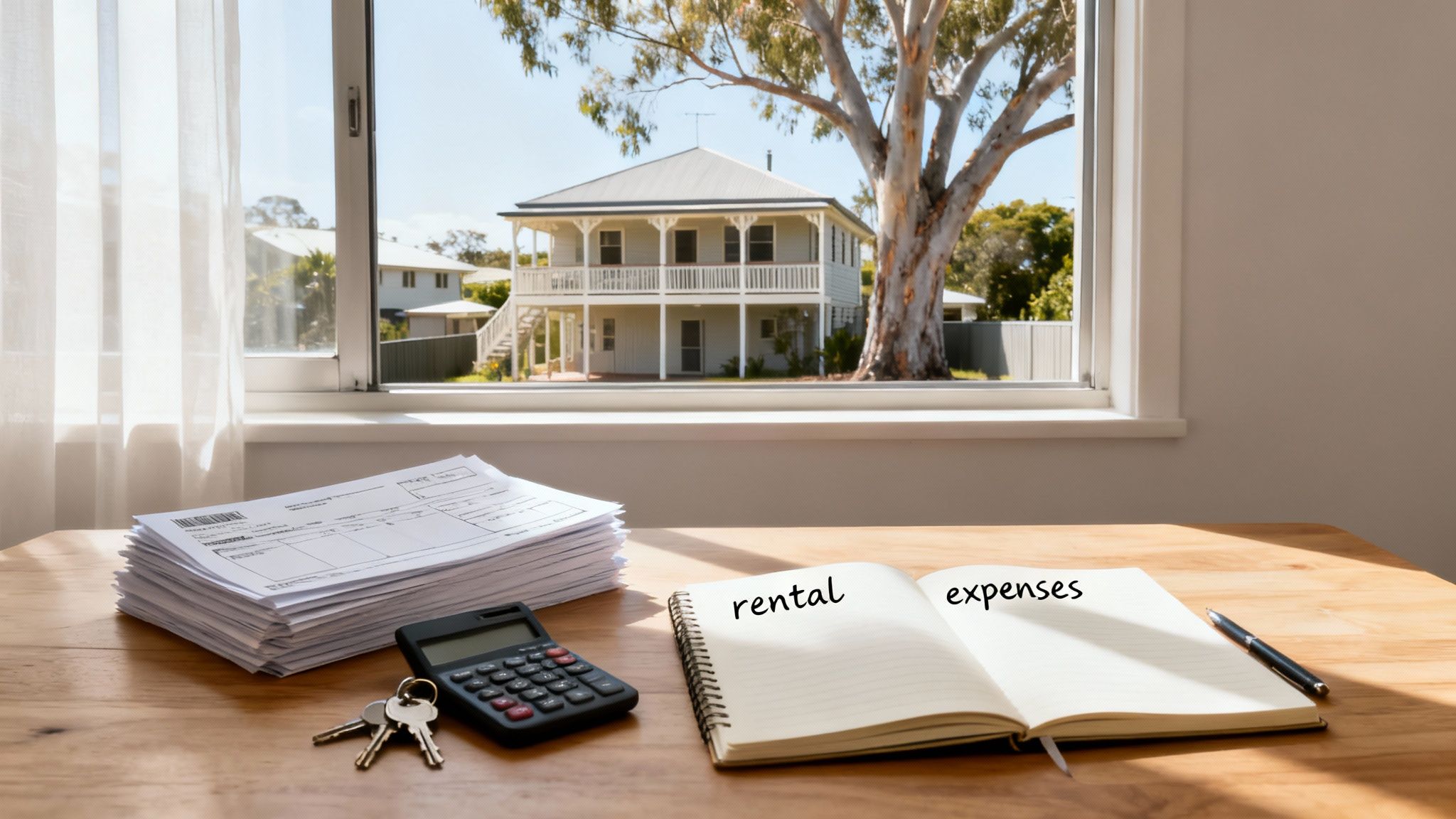
Understanding the Australian Taxation Office (ATO) rules is fundamental for any landlord. The line between a repair and a renovation isn't just about semantics; it fundamentally changes your tax return. In fact, misclassifying these expenses is one of the most common issues the ATO identifies when reviewing investor tax returns.
This guide will break down the critical difference between a repair you can claim right away and a capital works renovation that you claim over time.
The Repair Test: What Qualifies?
A repair is all about restoration. It’s fixing something that's broken, damaged, or has deteriorated through normal wear and tear while the property was used to generate rental income. The key is that the work returns the item to its previous condition without substantial improvement.
Here are classic examples of repairs:
Fixing a leaking tap or a burst water pipe.
Replacing a few cracked roof tiles.
Patching a hole in a plaster wall.
Repairing a broken hinge on a kitchen cupboard door.
For an expense to qualify as a deductible repair, the damage must have occurred while your property was earning rental income. The significant advantage for investors is that the cost of a genuine repair is 100% deductible in the financial year it is paid, directly reducing your taxable income.
The Renovation Test: Identifying a Capital Improvement
A renovation is treated differently. The ATO classifies this as a capital improvement, and it goes far beyond a simple fix. This is any work that materially improves the property, adds a new feature, or changes its character for the better. These costs are not an immediate write-off.
Instead, the ATO requires you to claim these expenses over many years as either capital works or depreciating assets.
According to ATO guidelines, an improvement is something that makes an asset better, more valuable, or more desirable. It can involve adding something new or upgrading an existing part of the property with superior materials or functionality.
Broader market trends can also influence this. For instance, in a strong market like Brisbane where dwelling values have risen, investors might renovate to boost rental yields. That strategic decision to upgrade a kitchen has direct tax implications, shifting what might have been minor repair costs into the capital works category.
The Special Case of Initial Repairs
This is a common trap for new investors. An initial repair refers to work you do to fix defects, damage, or deterioration that already existed when you purchased the property.
Even if the job seems like a standard repair—such as fixing a broken fence or repainting peeling walls—the ATO sees it differently. Their logic is that the purchase price you paid already reflected the property's condition. Therefore, the cost of fixing these pre-existing issues is considered part of acquiring the asset, not a day-to-day maintenance expense. These costs are added to the property's cost base for Capital Gains Tax purposes.
Understanding the Core Difference Between Repairs and Renovations
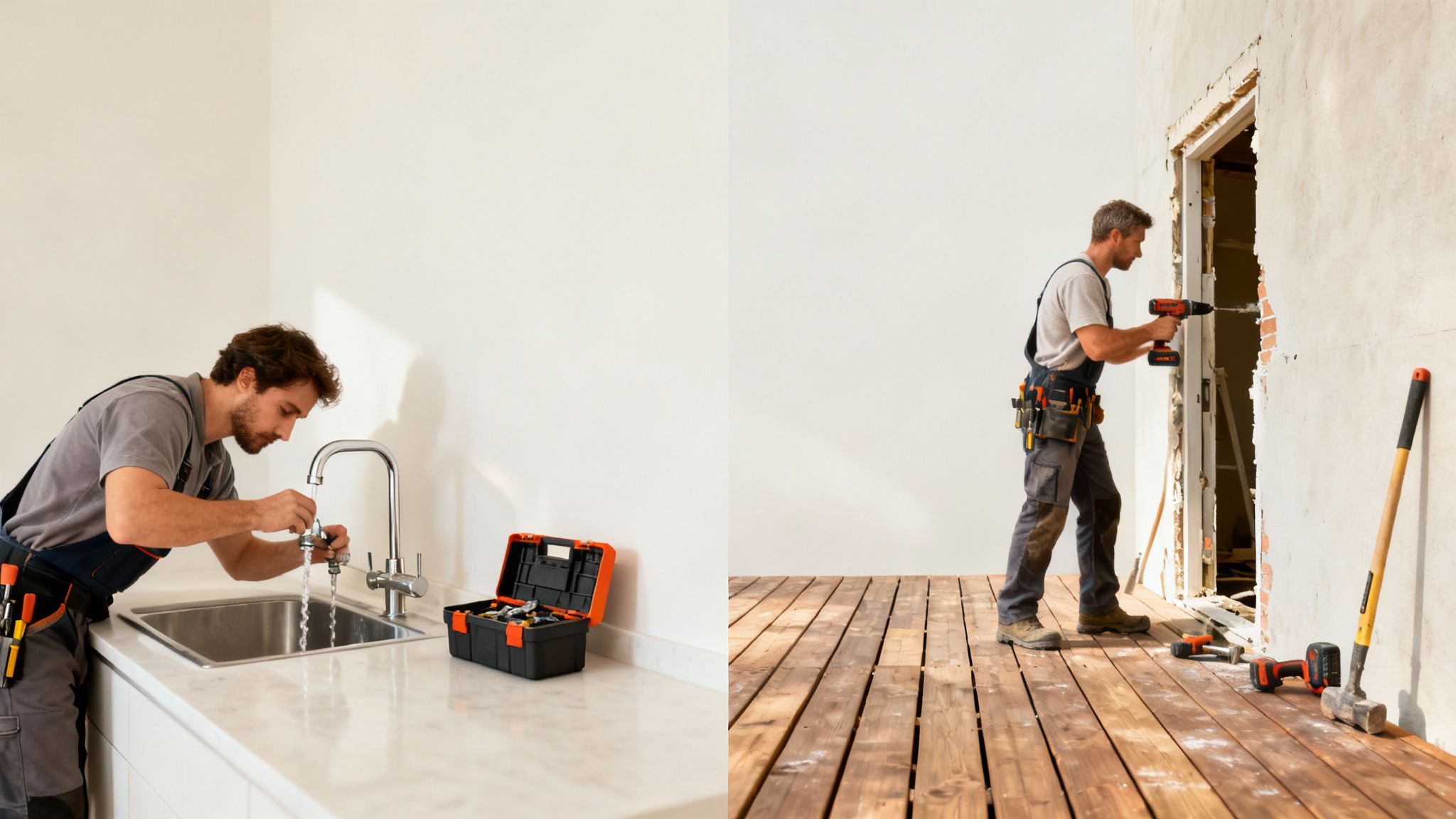
When it comes to your tax obligations as a landlord, the ATO draws a very clear line between a 'repair' and a 'renovation'. Think of it this way: a repair is work you do to fix something that’s broken or worn out, bringing it back to how it was. A renovation, on the other hand, is an improvement that fundamentally changes the property's character, function, or value.
A simple analogy helps here. Imagine your rental property is a car. Fixing a flat tyre is a clear-cut repair; you’re just getting the car back to its original, roadworthy state. But if you swap out the standard engine for a high-performance one, that's a renovation—or what the ATO calls a capital improvement. The ATO views your property expenses through this exact same lens.
ATO Treatment: Repair vs Renovation At a Glance
To make this crystal clear, the table below summarises the key differences in how the ATO treats these expenses.
Attribute | Repair (Maintenance) | Renovation (Capital Improvement) |
|---|---|---|
Purpose | To restore an asset to its previous working condition. | To enhance, alter, or significantly upgrade an asset. |
Tax Treatment | Claimed as a 100% immediate deduction. | Capitalised and claimed over time. |
Timing of Claim | In the financial year the expense is incurred. | Over many years (e.g., 2.5% per year for 40 years). |
ATO Classification | Operating Expense. | Capital Works (Div 43) or Depreciating Asset (Div 40). |
Common Example | Replacing a single broken window pane. | Installing new double-glazed windows throughout. |
Impact on Asset | Maintains existing value and function. | Increases value and improves function. |
Having a solid grasp of these rules is fundamental for any property investor. It ensures you claim your deductions correctly, stay compliant with the ATO, and make smarter financial decisions about maintaining and improving your asset.
Claiming Repairs The Right Way
Claiming an immediate deduction for a repair is one of the quickest ways to improve your rental property's cash flow. The process itself is straightforward but demands good record-keeping.
Confirm It’s Genuinely a Repair: First, double-check that the work fits the ATO’s definition. Did it restore something to its original state without making it substantially better? Fixing a broken hot water system is a clear repair. Upgrading to a much larger, more efficient solar model steps into improvement territory.
Get a Detailed Invoice: Your tradie’s invoice is your key piece of evidence. It needs to clearly detail the work done, the date, the cost, and the ABN of the supplier. An invoice that just says "building work" is a red flag for the ATO.
Show Proof of Payment: You need to prove you actually paid the bill. A bank statement showing the transfer or a formal receipt is perfect.
Claim in the Correct Year: You claim the deduction in the financial year you paid the bill, not necessarily when the work was done.
Decoding Renovation Claims: Division 40 vs. Division 43
Renovations are different. You almost never claim the cost as a single lump sum. The ATO requires you to split the expenses into two main categories: Capital Works (Division 43) and Depreciating Assets (Division 40). A quantity surveyor can prepare a report that correctly allocates these costs.
Capital Works (Division 43)
This category covers the "bones" of your property—the structural and permanently fixed parts.
What this covers: Building extensions, adding a deck or pergola, major kitchen and bathroom overhauls (structural components), new walls, roofs, and fences.
How you claim it: These costs are claimed at a rate of 2.5% per year over 40 years from the date the work was completed.
Depreciating Assets (Division 40)
This category is for removable or mechanical items, often called "plant and equipment," which have a limited effective life.
What this covers: Ovens, cooktops, dishwashers, air conditioners, carpets, blinds, and hot water systems.
How you claim it: Each item is depreciated over its specific effective life, a timeframe set by the ATO. For example, a new carpet might have an effective life of 10 years, so you would claim its value decline over that period.
This distinction is why a detailed bathroom renovation cost breakdown is so useful. It helps separate structural plumbing work (Division 43) from a new vanity and tapware (Division 40 assets). For a broader overview, see our guide on what rental property deductions you can claim in Australia.
A Practical Brisbane Renovation Example
Let's say you own a rental in Sunnybank and spend $50,000 on a new kitchen. Here’s a typical breakdown for tax purposes:
Expense Category | Description | ATO Treatment | Annual Deduction (Example) |
|---|---|---|---|
Capital Works (Div 43) | Removing a wall, new structural cabinetry, tiling, plumbing installation. Total Cost: $30,000 | Claimed at 2.5% per year over 40 years. | $750 |
Depreciating Assets (Div 40) | New oven, cooktop, dishwasher, rangehood. Total Cost: $10,000 | Depreciated over their individual effective lives (e.g., 8-12 years). | ~$1,000 (average) |
Immediately Deductible Repair | Repainting a section of wall that was water-damaged before the reno. Total Cost: $500 | Claimed at 100% in the current financial year. | $500 |
Non-Deductible Labour | The value of your own time spent project managing. | You can't claim a deduction for your own time. | $0 |
This shows how one project can generate three different types of deductions, claimed over different timelines. Correctly segmenting these costs is key to maximising your claims within ATO rules.
Navigating Common Grey Areas and ATO Rulings
It’s not always black and white. Sometimes, an expense doesn’t neatly fit into the "repair" or "renovation" box. This is where many property investors can make costly tax mistakes. Getting a handle on how the ATO views these situations is key.
With national vacancy rates remaining low, landlords are active in maintaining and upgrading their properties. Understanding the current Australian property and rental trends shows just how important it is to get these classifications right.
Introducing the Entirety Test
The most important concept for these grey areas is the ATO's 'entirety test'. This principle helps determine if you've repaired a part of an asset or replaced the asset in its entirety.
Think of it this way: an asset is a distinct, separate item. If you replace a smaller, subordinate part of that asset to get it working again, it is usually a repair. But if you replace the whole thing, you’ve made a capital improvement.
A hot water system is a classic example. The entire unit is considered a single asset. If a faulty heating element breaks, replacing just that element is a repair. If the whole system fails and you install a brand-new unit, you've replaced the asset in its entirety, which is a capital expense.
The Entirety Test in Action: Case Studies
Let’s apply this logic to common scenarios.
Scenario 1: The Fence
Repair: A storm blows down a 5-metre section of your 50-metre boundary fence. You hire someone to replace just the broken palings and posts in that section, matching the rest of the fence. This is a repair. You've restored a portion of a larger asset.
Renovation: Your entire 50-metre fence is old and leaning. You decide to replace the whole thing with a new Colorbond fence. This is a capital improvement because you've replaced the asset in its entirety.
Scenario 2: The Roof
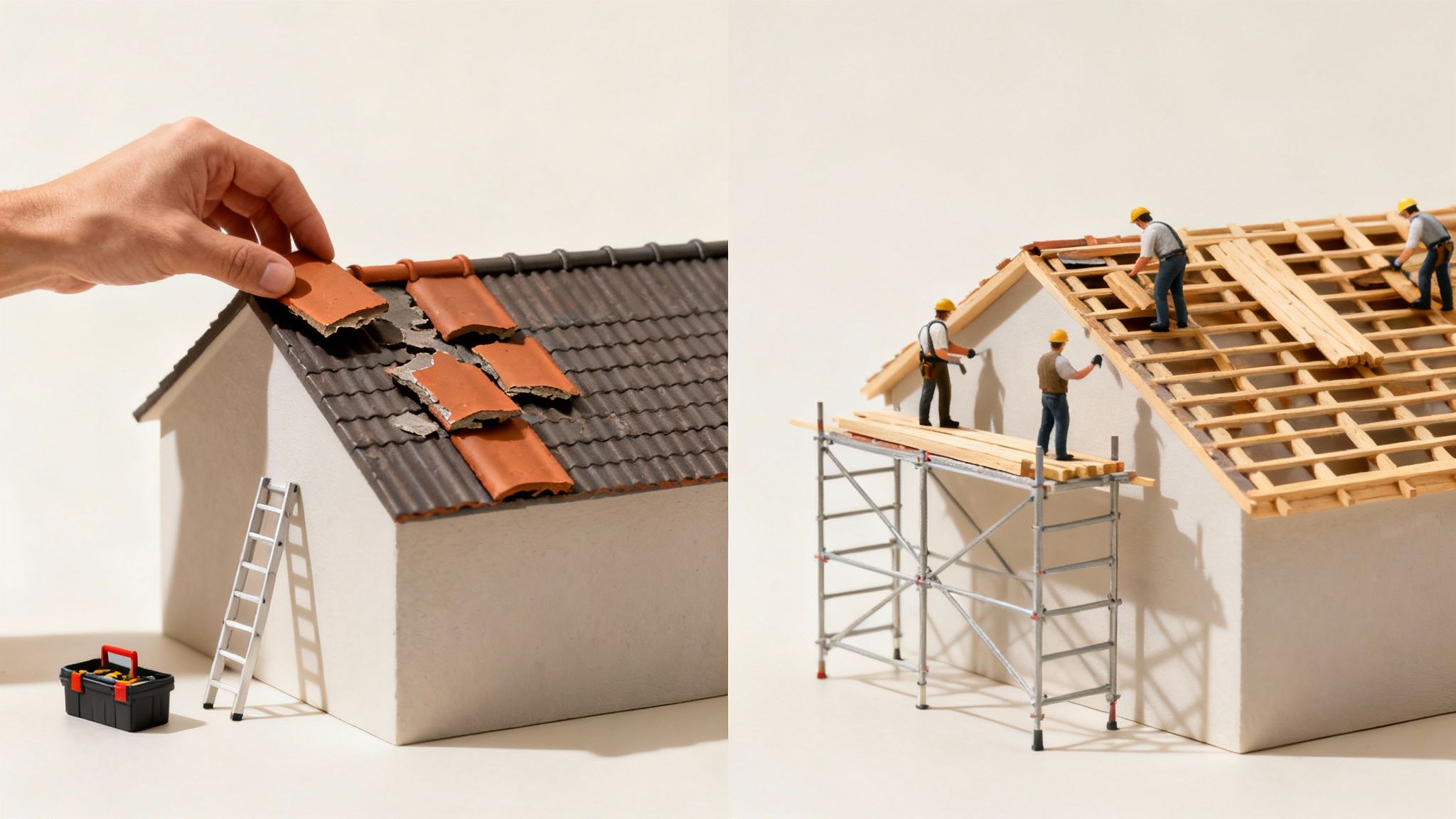
Repair: A hailstorm cracks 20 roof tiles. You get a roofer to replace only those 20 damaged tiles. This is a clear-cut repair. You've fixed a defect in a part of a larger asset.
Renovation: The entire roof is over 30 years old. You decide to replace all the tiles, battens, and sarking. This is a capital improvement, as you have replaced the entire roof, a major structural component.
The Improvement vs. Repair Distinction
Another key factor is whether the work provides a significant upgrade. The materials used can often be the deciding factor.
The ATO is clear: using modern materials that are a reasonable equivalent to the old ones can still be considered a repair. However, if new materials give the asset a substantial upgrade in function, quality, or performance, the work looks more like a capital improvement.
For example, swapping old timber window frames for standard aluminium ones is generally seen as a repair. But if you replace them with high-performance, double-glazed acoustic windows, that’s likely a capital improvement because it provides a significant functional upgrade. Understanding these concepts is crucial for managing your property's finances, especially if you're using strategies like negative gearing and how deductions work.
This flowchart simplifies the decision-making process for classifying your expenses.
graph TD
    A[Start: An expense is incurred] --> B{Did the damage exist when you bought the property?};
    B -- Yes --> C[Initial Repair: Treat as a capital cost];
    B -- No --> D{Did you replace the entire asset? (Entirety Test)};
    D -- Yes --> E[Capital Improvement: Depreciate over time];
    D -- No --> F{Did you significantly upgrade or improve the asset?};
    F -- Yes --> E;
    F -- No --> G[Repair: Claim an immediate 100% deduction];
    C --> H[End];
    E --> H;
    G --> H;
By applying the entirety test and asking whether the work is a genuine functional improvement, you can confidently navigate most situations.
How Renovations Impact Your Capital Gains Tax on Sale
The decisions you make today about an expense have consequences when you sell your investment property. It’s a classic cash-flow-now versus tax-savings-later scenario. While an immediate deduction for a repair boosts your bank account this year, a renovation delivers its tax payoff when you sell by reducing your Capital Gains Tax (CGT).
Capital improvements, like a major kitchen overhaul, aren’t just sunk costs. The ATO lets you add these expenses to the property's cost base.
What Is the Cost Base and Why Does It Matter?
The cost base is the total amount your property has cost you. It starts with the purchase price, plus upfront costs like stamp duty and legal fees. Crucially, it also includes money spent on capital improvements.
A higher cost base is beneficial for CGT because the formula is simple:
Capital Gain = Sale Price - Cost Base
Every dollar spent on a capital improvement increases your cost base, which shrinks your taxable capital gain. This is why keeping meticulous records for every renovation is non-negotiable. You can learn more in our guide covering capital gains and rental properties.
A Practical Comparison for Brisbane Investors
Imagine two investors, Alex and Ben. They each buy an identical investment property in a Brisbane suburb for $600,000. Ten years later, they both sell for $900,000.
Investor Alex Focuses on Repairs
Over the decade, Alex only does immediately deductible repairs, spending a total of $20,000. He claimed these costs against his rental income each year. His cost base remains simple.
Sale Price: $900,000
Cost Base: $600,000
Capital Gain: $300,000
Investor Ben Undertakes a Major Renovation
Ben also spends $20,000 on minor repairs. But in year five, he invests $80,000 in a significant renovation. This $80,000 is a capital improvement, added to his cost base.
Sale Price: $900,000
Original Cost Base: $600,000
Capital Improvements: +$80,000
Final Cost Base: $680,000
Capital Gain: $220,000
The result? An $80,000 difference in their taxable capital gains. Ben's strategic renovation directly slashed his final CGT liability, proving the long-term financial power of correctly classifying capital works.
Your Essential Record-Keeping Checklist

When dealing with the ATO, the burden of proof is always on you. Your records are non-negotiable for backing up every claim, whether for a minor tap repair or a major renovation. This checklist covers the essentials needed to protect your claims.
Tax Invoices and Receipts: Ensure they are itemised, dated, and show the supplier’s ABN.
Bank or Credit Card Statements: These are your proof of payment.
Tenant Leases and Agreements: This proves the property was genuinely available for rent.
Loan Documents: Essential for correctly calculating interest deductions.
Contracts with Tradespeople: For larger jobs, these outline the scope of work, helping distinguish a repair from a capital improvement.
Before-and-After Photos: Visual evidence is powerful for showing the original state of an asset or the scale of an improvement.
By law, you must keep these records for at least five years from the date you lodge your tax return. A simple digital filing system can save significant stress.
Summary
Repairs vs. Renovations: A repair restores an asset to its original condition and is 100% deductible immediately. A renovation is a capital improvement that enhances the asset's value and is claimed over many years.
The Entirety Test: The ATO uses this to determine if you've fixed a part of an asset (repair) or replaced the whole thing (capital improvement).
Initial Repairs: Work done to fix pre-existing defects when you buy a property is a capital cost, not an immediate deduction.
Capital Gains Tax (CGT): Renovation costs are added to your property's cost base, reducing your taxable capital gain when you sell.
Record Keeping: Meticulous records, including itemised invoices and proof of payment, are essential to substantiate your claims with the ATO.
Frequently Asked Questions
Can I claim travel costs to inspect my rental property?
Yes, you can claim travel expenses incurred to inspect, maintain, or collect rent from your property, but only if the trip's sole purpose is related to the property. If you mix the trip with a holiday, you can only claim the portion of costs directly tied to the property management activities, supported by a travel diary.
Is my own labour on a repair tax deductible?
No. The ATO does not allow deductions for the value of your own time or labour. You can only claim the actual costs of materials you purchased for a repair you completed yourself.
What about improvements made before renting the property for the first time?
These are considered 'initial repairs' by the ATO. Any work done to fix defects that existed when you bought the property is a capital expense. These costs are added to your property's cost base, which reduces your Capital Gains Tax when you sell.
How should I manage records for both repairs and renovations?
Keep your expenses clearly separated. A simple system of digital or physical folders for each property, with sub-folders for 'Repairs' and 'Capital Improvements', is effective. For every expense, ensure you have a detailed invoice describing the work done. You might consider using Rental Property Inventory Software for Landlords to maintain an organised digital trail.
ATO Official Guidance Reference
Need clarity on your situation?
The information provided in this article is general in nature and is intended for educational purposes only. Tax laws are complex, and the correct treatment of expenses can vary significantly based on your individual circumstances, the specific nature of the work performed, and the timing of the expenditure.
To ensure you are compliant and are correctly maximising your deductions, it is always advisable to seek personalised advice from a qualified tax professional. An accountant can review your specific situation and provide guidance tailored to your investment property portfolio.
Baron Tax & Accounting
Website: https://www.baronaccounting.com
Email: info@baronaccounting.com
Phone: +61 1300 087 213
Whatsapp: 0450 468 318
Comments