
How Does BAS Lodgment Actually Work in Australia? What Every Sole Trader Should Know

If you're GST-registered as a sole trader, contractor or gig economy earner, you'll be lodging a Business Activity Statement (BAS) every quarter (or month) for as long as you're registered. A lot of people assume this means learning to navigate an ATO portal themselves — but understanding what a BAS actually involves matters more than knowing which button to click, because the numbers you report have to be right regardless of who's typing them in.
This guide walks through what a BAS reports, who has to lodge one, what's actually on the form, and — honestly — why most of the sole traders and gig workers we work with have stopped doing this themselves. If you're looking for our specific Q1 2026–27 deadline (28 October), see our separate guide linked below.
Quick answer: a BAS reports GST, PAYG withholding, PAYG instalments and (for some businesses) FBT instalments, luxury car tax, wine equalisation tax and fuel tax credits, on a monthly, quarterly or annual cycle. You only lodge one if you're registered for GST or have another activity statement obligation. Getting the figures right — GST-inclusive vs exclusive amounts, correct apportionment, eligible credits — is where most DIY mistakes happen, which is why it's one of the more commonly outsourced pieces of compliance work for small businesses.

What This Guide Covers
What a BAS Actually Reports
A Business Activity Statement is the form the ATO uses to collect several different tax obligations in one lodgment, rather than requiring separate reports for each. Per the ATO's overview of business activity statements, a BAS can cover GST, PAYG (Pay As You Go) withholding, PAYG instalments, and — for larger or specific businesses — fringe benefits tax instalments, luxury car tax, wine equalisation tax and fuel tax credits.
For the vast majority of sole traders and gig economy earners, a BAS is really about two things: GST (how much you collected on sales, and how much you can claim back on business purchases) and, if you have employees, PAYG withholding on their wages. The other categories mostly apply to larger or more specialised businesses.
Who Has to Lodge One
You only have a BAS obligation once you're registered for GST (or have a PAYG withholding or instalment obligation). For most sole traders, that means the standard $75,000 GST turnover threshold applies — with one notable exception for ride-sourcing drivers, who must register from their first dollar of income regardless of turnover. We cover the registration thresholds in detail in our guide to GST registration thresholds and compliance, and the current quarterly due dates — including this quarter's — in our Q1 2026–27 BAS deadline guide.
Once you're registered, the obligation doesn't pause just because a particular quarter was quiet — even a BAS with nil GST activity generally still needs to be lodged (as a nil return) unless the ATO has specifically told you otherwise.
What's Actually on the Form
Most small businesses with GST turnover under $10 million use what's called Simpler BAS reporting, which cuts the GST section down to three figures: total sales, GST collected on sales, and GST paid on purchases. The full BAS (used by larger businesses, or those that opt in) adds extra detail — export sales, GST-free sales, and a split between capital and non-capital purchases.
If you have employees, there's a separate section for PAYG withholding — the tax you've withheld from their wages and need to remit to the ATO. And if you pay PAYG instalments toward your own expected income tax bill, those show up as their own line as well.
It sounds simple laid out like this. In practice, the work is in getting the underlying numbers right — separating GST-inclusive figures correctly, knowing which expenses actually carry a claimable GST credit, and apportioning anything used for both business and private purposes (a vehicle, a phone plan, a home office). That's the part that trips people up, not the form itself.
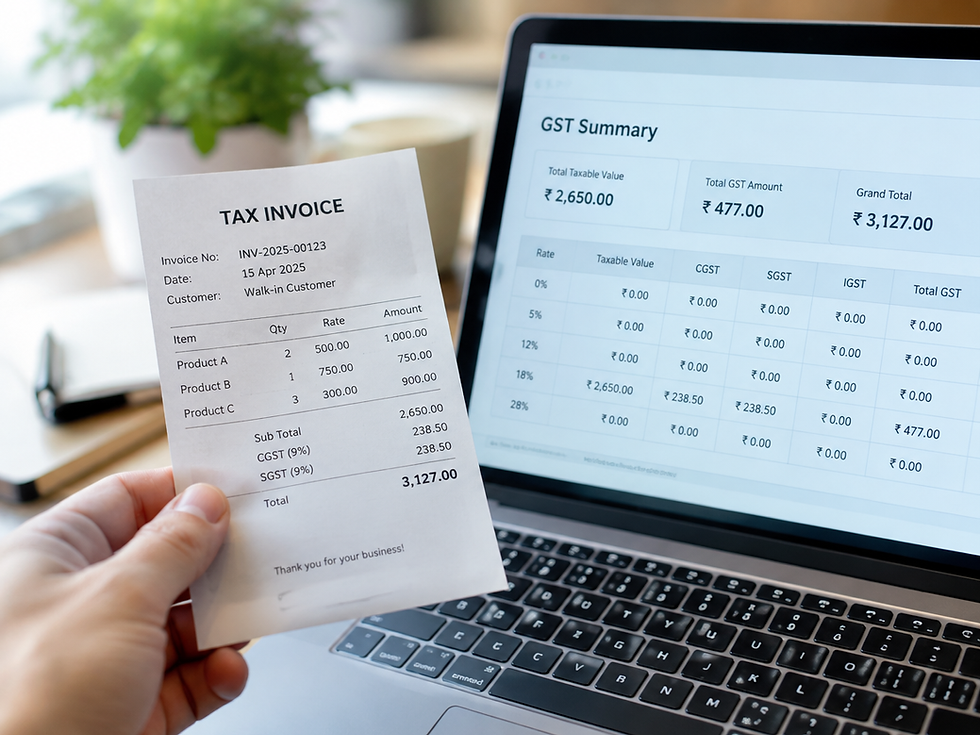
A worked example makes this concrete. Say a sole trader graphic designer has $22,000 in GST-inclusive sales for the quarter and $4,400 in GST-inclusive business expenses (software subscriptions, a laptop upgrade, a portion of home office costs). On Simpler BAS, G1 (total sales) would be $22,000, 1A (GST on sales) would be $2,000 (one-eleventh of $22,000), and 1B (GST on purchases) would be $400 (one-eleventh of $4,400) — leaving net GST payable of $1,600. Real numbers are rarely this tidy, particularly once apportionment for mixed-use expenses comes into it, but the underlying structure is the same for every Simpler BAS lodgment.
PAYG instalments work differently again — rather than GST on sales and purchases, this is a prepayment toward your own expected income tax bill for the year, calculated either as a set amount the ATO nominates or as a percentage of your instalment income. If you're not sure whether you have a PAYG instalment obligation, it will show up as a specific line on your activity statement rather than something you opt into separately.
How Often You Lodge
Most small businesses report quarterly — four BAS lodgments a year. Monthly reporting is compulsory once your GST turnover reaches $20 million and optional below that. Annual reporting is available in limited circumstances, mainly for voluntarily GST-registered businesses under $75,000 turnover. Quarterly due dates fall on the 28th of the month following the end of each quarter (with a built-in extra month for the October–December quarter), and monthly BAS is due on the 21st of the following month.
Quarterly is the default for a reason: it's frequent enough that GST doesn't build up into a bill you're not prepared for, without becoming a monthly chore. Some businesses voluntarily choose monthly reporting anyway — usually because they want tighter visibility over cash flow, or because they're regularly in a GST-refund position and would rather receive that refund sooner than wait out a full quarter. Annual reporting, by contrast, is really only relevant if you're voluntarily registered well under the $75,000 threshold and don't have much GST activity to track in the first place — most actively trading sole traders won't be eligible once their turnover justifies compulsory registration.
For gig economy earners specifically, the reporting frequency question often gets tangled up with having multiple income streams — rideshare fares one week, delivery income the next, on top of a part-time job. None of that changes which cycle you're on, but it does mean more platforms' worth of statements to reconcile each period, which is exactly the kind of thing that becomes easier to keep on top of monthly rather than letting three months of records pile up before a quarterly deadline.
GST Credits: What You Can (and Can't) Claim
You can generally claim a GST credit on a business purchase if GST was included in the price, the purchase was for a business (not private) purpose, and you hold a valid tax invoice for purchases over $82.50. Common eligible categories for sole traders and gig workers include software and subscriptions, business insurance, a business-use portion of phone and internet, fuel and vehicle running costs (apportioned for private use), and platform or marketplace fees.
Common ineligible or partly-ineligible categories: purely private expenses (even if paid from a business account), entertainment in most cases, and the private-use portion of anything with mixed business and personal use — a car used for both rideshare driving and the school run, for instance, only attracts a GST credit on the business-use percentage, not the whole running cost.
This is where a lot of the real work in a BAS actually sits — not in the arithmetic, but in correctly classifying which expenses qualify and at what percentage. Getting it wrong in either direction is a problem: overclaiming risks an ATO adjustment (and possibly penalties) down the track, while underclaiming just means paying more GST than you needed to.
Where DIY BAS Lodgment Goes Wrong
The BAS form itself isn't complicated — three or four figures on Simpler BAS. What actually causes errors, in our experience, is almost always one of these:
• Reporting GST-inclusive income as if it were GST-exclusive (or vice versa), which throws out every downstream figure.
• Claiming GST credits on expenses that aren't actually eligible, or missing credits on ones that are.
• Getting the business-vs-private apportionment wrong on a vehicle, phone, or home office — especially common for gig economy earners running one car or one phone across multiple income sources.
• Mixing up which quarter a transaction belongs to, particularly around quarter-end.
• Not realising a nil BAS still needs to be lodged, and missing the deadline as a result.
None of these show up as an error message on the form — the BAS will happily accept whatever numbers you type in. The risk is finding out later, either through an ATO review or a nasty surprise at tax time, that the numbers were wrong all along.
What Records You Need Before Your BAS Is Due
Whether you're lodging it yourself or handing it to someone else, the records that actually determine how accurate your BAS is are the same either way:
• Sales records or invoices for the quarter, showing GST-inclusive amounts.
• Tax invoices for any business purchase over $82.50 you're claiming a GST credit on.
• A logbook or reasonable basis for apportioning any vehicle, phone or home office expense between business and private use.
• Platform statements if you earn through rideshare, delivery or short-term rental platforms — these often show gross earnings before platform fees, which needs to be reconciled correctly.
• Records of the GST treatment of anything unusual for the quarter — an asset purchase, an overseas transaction, or a one-off sale.
The ATO generally requires these records to be kept for five years, whether or not you're the one entering the figures onto the BAS.

Why Most Sole Traders Have Us Handle It
Given how easy it is to get the underlying numbers wrong — and how little the ATO's systems do to catch it before you've already lodged — most of the sole traders, contractors and gig economy earners we work with have moved to having their BAS handled for them entirely, rather than preparing it themselves each quarter. Baron Tax & Accounting looks after GST registration and ongoing BAS lodgment for clients across Australia — the figures are checked properly before anything goes near the ATO, and you're not the one who has to remember which expenses carry a GST credit or how to apportion your car.
If you'd rather hand this off than manage it every quarter, get in touch — you can also check our ABN / GST registration service if you're not yet registered, or our fees to see what ongoing BAS support costs.
In practice, that usually looks like a short check-in each quarter rather than a big production: you send through your sales and expense records (or we pull them directly from your bookkeeping software), we work out what's GST-eligible and what isn't, apply the correct apportionment, and lodge before the deadline — with any issues flagged before they've had a chance to compound over several quarters, rather than discovered all at once at tax time.

What Late Lodgment Costs You
If a BAS is lodged late, the ATO can apply a Failure to Lodge penalty of one penalty unit ($364 as at 1 July 2026) for every 28 days it's overdue, up to a maximum of five units ($1,820), plus General Interest Charge (currently 11.51% p.a. for the October–December 2026 quarter) on any unpaid amount — and since 1 July 2025, that interest charge is no longer tax deductible. We break these figures down in detail, along with the full 2026–27 quarterly due-date calendar, in our Q1 BAS deadline guide.
Frequently Asked Questions
What is a Business Activity Statement (BAS)?
A BAS is the form GST-registered businesses use to report GST, PAYG withholding, PAYG instalments and related obligations to the ATO, on a monthly, quarterly or annual cycle depending on your reporting frequency.
Do I need to lodge a BAS if I have no GST-registered income this quarter?
Generally yes — if you're GST-registered, a nil BAS still needs to be lodged for a quiet quarter unless the ATO has told you otherwise. The obligation comes from being registered, not from having activity to report.
What's the difference between Simpler BAS and full BAS?
Simpler BAS, available to businesses with GST turnover under $10 million, only requires three GST figures: total sales, GST on sales and GST on purchases. Full BAS adds GST-free sales, export sales and a capital-versus-non-capital purchase split.
Can I lodge my own BAS?
Yes — GST-registered individuals can lodge through myGov or the ATO's Online Services for Business. Whether it's worth doing yourself depends on how confident you are in your GST calculations and apportionment; many sole traders and gig workers find it simpler to have a registered agent handle it instead.
What happens if my BAS numbers are wrong?
An incorrect BAS doesn't get flagged automatically — the ATO's lodgment systems accept whatever figures you submit. Errors usually surface later, either through an ATO review or when reconciling your annual figures, which is why getting the numbers right the first time matters more than the mechanics of lodging.
How much does it cost to have a BAS agent lodge for you?
Costs vary by business complexity — see our fees page for current pricing, or get in touch for a specific quote.
Do I need a tax invoice to claim a GST credit?
For purchases over $82.50 (GST-inclusive), yes — you need a valid tax invoice to claim the GST credit. Below that threshold, less formal records are generally acceptable.
How long do I need to keep BAS-related records?
Generally five years from the date you lodge the relevant BAS, whether the records are digital or paper.
Does a quiet or zero-income quarter still need a BAS lodged?
Usually yes, as a nil BAS — the obligation to lodge comes from being GST-registered, not from having GST activity in that specific quarter.
What's the difference between GST and PAYG withholding on a BAS?
GST relates to the tax collected on your sales and paid on your purchases. PAYG withholding is separate — it's the tax withheld from employees' wages (if you have any) that you remit to the ATO on their behalf, not tax on your own business income.
Disclaimer
This article provides general information only and does not constitute personal tax or financial advice. It does not take into account your objectives, financial situation or needs. Tax rules change and apply differently to each person's circumstances. Before acting, please seek advice from a registered tax agent. Baron Tax & Accounting accepts no liability for any loss arising from reliance on this article. Source references: ATO (ato.gov.au) and other Australian government agencies, current as at the date of publication.


Comments