
How to Check Super Balance: A Comprehensive Guide for Australians

Checking your superannuation balance is a critical financial task, and the most efficient way to do it is by linking the Australian Taxation Office (ATO) to your myGov account. This free government service acts as a centralised dashboard, pulling together a secure, complete view of all your super funds in one place—including any lost or unclaimed super you might have forgotten about.
Why does this matter? Your super is often one of your largest assets, second only to the family home. Ignoring it can lead to significant financial loss through unnecessary fees on multiple accounts or missed employer contributions. For instance, failing to provide your Tax File Number (TFN) to your super fund can result in your contributions being taxed at a much higher rate, a compliance risk that can cost you thousands over your working life. Regularly monitoring your super is the first step in taking control of your financial future and ensuring you are on track for a comfortable retirement.
Here at Baron Tax & Accounting in Brisbane, we frequently see clients who are unaware they have multiple superannuation accounts from previous jobs, each eroding their savings with separate administrative fees. A common example is a professional who worked part-time during their university studies; they often have small, forgotten super funds that, if consolidated, could significantly enhance their long-term investment growth by minimising fees and maximising compound interest.
Why Checking Your Super Balance Is a Financial Priority

Treating your super as a "set and forget" investment is one of the biggest financial mistakes you can make. It’s not just something to worry about when retirement is around the corner; it's a vital part of your financial health right now. Regularly checking in on your super balance means you're taking active control of what is, for most Aussies, one of their biggest assets outside the family home.
When you're actively monitoring your super, you can quickly spot if your employer is making the correct Superannuation Guarantee contributions on time. It also gives you a clear picture of how your investments are performing and helps you stop paying unnecessary fees on those old, duplicate accounts.
The Scale of Australian Super
The sheer size of Australia's superannuation system shows just how critical it is to stay on top of your own slice of the pie. As of the 2025-26 financial year, total superannuation assets in the country have grown to a staggering figure, with annual contributions in the hundreds of billions.
With millions of accounts scattered across hundreds of funds, it's no surprise that some get lost in the shuffle, leading to billions of dollars in unclaimed super. You can dig into more of this data over at the Australian Prudential Regulation Authority (APRA), the primary government regulator.
Key Compliance Risks
Ignoring your super doesn't just cost you in fees; it can lead to some nasty compliance headaches. For instance, if your Tax File Number (TFN) isn't correctly linked to your super account, you could be slapped with a much higher tax rate on your contributions.
It’s a simple piece of admin that can save you a fortune over your working life. Knowing your balance is the first step, but understanding why it's so important to plan for retirement is what keeps you motivated to stay engaged and make smart decisions with your money.
Using MyGov And The ATO To See Your Entire Super Picture
If you want the full, unfiltered truth about your super, the MyGov portal is your best bet. By linking it to the Australian Taxation Office (ATO), you get a complete bird's-eye view of every super account you’ve ever had. It's the most reliable way to track down all your funds in one place.
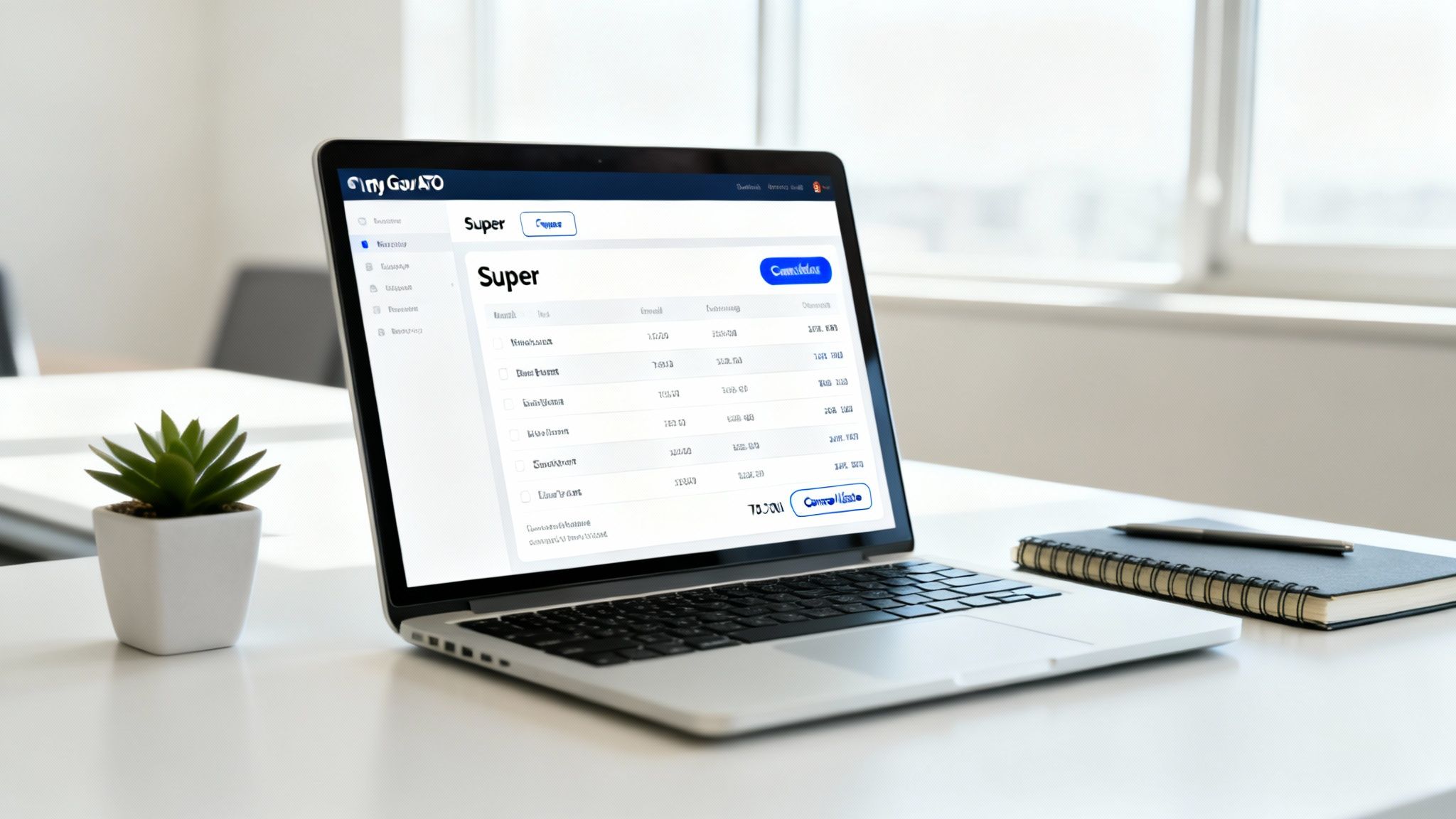
Think of it as your superannuation command centre. It shows every account held under your name, and crucially, it will uncover any 'lost' super that’s been sitting with the ATO—money you might have completely forgotten about from a casual job years ago.
Step-by-Step: How to Check Your Super on MyGov
Getting everything set up is pretty straightforward. You'll just need a MyGov account, and then you link it to the ATO's online services. It’s a one-time process that gives you permanent access to your retirement savings.
Once you’re linked, finding your super info is simple:
Log in to your MyGov account.
Click on the Australian Taxation Office link from your list of services.
From there, just head over to the Super tab.
This dashboard will show you a clean list of all your super accounts. You can see the latest balance reported for each fund, check if your employer has been making contributions, and even see what insurance policies (like life or TPD cover) you’re paying for.
The best thing about the MyGov platform isn't just seeing the numbers; it's being able to act on them. The portal lets you consolidate multiple super accounts into one preferred fund with just a few clicks, all managed securely through the ATO.
Why This Method Is The Gold Standard
Using the ATO via MyGov is easily the top-tier method because everything is tied to your Tax File Number (TFN). Sure, your fund's app might give you a slick daily performance chart for that one account, but only the ATO can show you that forgotten fund from a uni job a decade ago. It stops old accounts from falling through the cracks.
The dashboard gives you a clear snapshot of your total super balance and then breaks it down by each individual fund. This makes it incredibly easy to spot if you’re paying fees on multiple accounts and kickstart the consolidation process.
This centralisation is huge for managing your finances properly. By rolling all your super into one account, you can cut down on paying multiple sets of admin fees and insurance premiums, which means more of your hard-earned money stays invested for your future.
For anyone who has worked overseas, it's also worth understanding the rules around accessing super early, like a Departing Australia Superannuation Payment (DASP). If you're looking into other refunds you might be entitled to, you can find out more about claiming your TRS refund in Australia.
Other Ways to Check Your Super
While jumping onto myGov gives you the complete bird's-eye view of your superannuation, it’s definitely not the only way to get the information you need. Sometimes, you need specific details fast, and the best place for that is by going straight to the source—your super fund.
This direct approach often gives you a different level of detail and can be much quicker for a simple balance check.
Your Super Fund's Website or App
Logging directly into your super fund's website or dedicated mobile app is hands-down the fastest way to see the day-to-day action in your account. It’s where you’ll find the granular details you need to actively manage your investment.
Going direct usually lets you:
See your current balance, often updated with the latest investment performance.
Dig into your investment options to see exactly how your money is split between different assets like Australian shares, international property, or cash.
Update your nominated beneficiaries, which is crucial for making sure your super goes to the right people if anything were to happen to you.
Find digital copies of everything the fund has sent you, from annual statements to insurance policies.
This gives you a powerful set of tools to not just check your super balance but actually tweak your strategy based on your financial goals.
Don't Forget the Old-School Methods
If you're not keen on navigating online portals or just prefer a more hands-off approach, the traditional methods still work perfectly well. By law, your super fund must send you an annual member statement. This document, which might land in your physical letterbox or your email inbox, gives you a full summary of what’s happened in your account over the last financial year.
Your annual statement is a really important document. It breaks down every single contribution (from you and your employer), investment earnings or losses, all the fees you've been charged, and the cost of any insurance premiums. Think of it as a complete health check for your super.
And finally, there's always the phone. A quick call to your super fund's customer service line is often the simplest way to get an answer. Just have your member number handy to verify your identity, and you can get a balance update or ask specific questions. It’s a straightforward way to get what you need without logging into anything.
How to Interpret Your Superannuation Statement
Knowing your super balance is a great start, but the real power comes from understanding what all those numbers on your statement actually mean. Think of it less like a bank balance and more like a detailed health report for one of your biggest long-term assets. Learning to read it properly is how you spot issues, track performance, and make smarter decisions for your future.
A typical super statement boils down to three key things: money coming in, how your investments are performing, and money going out. Getting your head around these parts is essential if you want to seriously track your progress toward a comfortable retirement.
Contributions: The Inflow to Your Account
The first thing you’ll usually see is a breakdown of all the contributions that have landed in your account over the period. It’s not just a single lump sum; the statement separates it out so you can see exactly where the money has come from.
Here’s what to look for:
Employer Contributions: These are the mandatory Superannuation Guarantee (SG) payments from your boss. It’s always a good idea to cross-reference this figure with your payslips to make sure everything adds up and is being paid on time.
Personal Contributions: This line shows any extra cash you’ve voluntarily put into your super from your after-tax pay.
Salary Sacrifice Contributions: If you have a salary sacrifice arrangement, these pre-tax contributions will be listed separately. It’s important to understand how these work, especially when it comes to reportable superannuation contributions and how they can affect your taxable income.
Investment Earnings and Deductions
This is the section that shows you how hard your money has been working. You’ll see a figure for investment earnings (or losses), which reflects the performance of the investment option you’ve chosen. A positive number here is what really helps your nest egg grow beyond just the contributions you and your employer make.
But it's not all about growth; you also need to keep a close eye on the deductions. Pay attention to these three:
Administration Fees: This is the cost of simply keeping your account running.
Investment Fees: These are the charges for managing the investment portfolio your money is in.
Insurance Premiums: If you have life, TPD, or income protection insurance through your super, this is what you’re paying for it.
High fees can be a silent killer for your retirement savings, slowly eating away at your balance over the years. Comparing the fees you’re paying against other funds is one of the smartest financial moves you can make.
The long-term impact of getting these contributions and earnings right is massive. Projections from the Australian Treasury show a huge shift on the horizon for retirees. While 65% of retirees had balances under $250,000 in 2020, that figure is projected to drop to just 30% by 2060, showing just how much more significant our super accounts are becoming. You can dig into more of these fascinating insights in Treasury's report on superannuation balances at retirement.
Solving Common Superannuation Problems

Sometimes, a routine check of your super balance uncovers something that doesn’t look quite right. Don’t panic—most of these problems are surprisingly common and, thankfully, often straightforward to fix once you know the steps. Tackling them early is the key to keeping your retirement savings on track.
One of the most serious issues you might face is discovering your employer hasn't paid your Superannuation Guarantee (SG) contributions, or they've paid them late. The law is crystal clear on this: employers must pay super for eligible staff on time and into the correct fund.
If you think you're missing super payments, the ATO has a clear process. The first step is to calmly chat with your employer. It could be a simple administrative slip-up. If that conversation doesn't clear things up, you can formally report them to the ATO using their secure online tool.
Finding Lost Super and Fixing TFN Issues
Another frequent headache is dealing with 'lost super'. These are accounts that have gone quiet, usually because you've changed your name, address, or switched jobs. After a while, these inactive, low-balance accounts might get transferred to the ATO for safekeeping.
Luckily, finding and reclaiming this money is simple:
Jump onto myGov: Head to the ATO section and click on the 'Super' tab.
See all your accounts: The platform will show you any super the ATO is holding in your name.
Start the claim: With just a few clicks, you can kick off the process to roll this lost super directly into your main, active account.
It’s also crucial to make sure your Tax File Number (TFN) is correctly linked to every super account you have. If your fund doesn't have your TFN, they can't accept any personal (after-tax) contributions from you. Worse, you could end up paying a lot more tax on your employer's contributions—potentially the top marginal rate instead of the usual concessional 15%.
Your TFN is the key that links all your financial information correctly. An unlinked TFN is a major compliance risk that not only costs you more in tax but can also make it much harder for your fund to identify and process contributions meant for you.
You can usually check and update your TFN in minutes through your fund’s online portal or by giving them a quick call. Taking a moment to fix this ensures your account stays active and compliant, protecting your savings from unnecessary taxes.
FAQ: Your Superannuation Questions Answered
Managing your super can feel like a minefield of questions. Getting clear, straightforward answers is the key to feeling confident about your financial future. Let's tackle some of the most common queries that pop up when people start taking a closer look at their super.
How often should I check my super balance?
It is good practice to check your superannuation balance at least twice a year. A convenient time to do this is when you receive your annual statement from your fund, as it provides a comprehensive summary of the year's activity. You should also check your balance whenever you change jobs to ensure your new employer’s Superannuation Guarantee (SG) contributions are being paid into the correct fund.
What should I do if my employer has not paid my super?
If you believe your employer has not paid your superannuation, first verify the missing payments against your payslips and super fund statements. The next step is to discuss the matter with your employer, as it could be an administrative error. If this does not resolve the issue, you can report it to the ATO. They provide a secure online tool to lodge an unpaid super enquiry and will investigate the matter for you. For detailed instructions, refer to the ATO's official page on "Unpaid super from your employer".
What is the fastest way to find all my super accounts?
The quickest and most authoritative method to view all your superannuation accounts is by using your myGov account linked to the ATO. This platform serves as a central repository for all super-related information tied to your Tax File Number (TFN). Once logged in, the 'Super' section will display every account held in your name, including any "lost super" that the ATO is holding on your behalf. This is significantly more efficient than attempting to contact each potential fund individually.
Can I check my super balance without a myGov account?
Yes, you can check your balance directly with your super fund without using myGov. The primary methods are:
Fund Website or App: Log in to your fund’s secure online portal or mobile application for real-time balance information.
Member Statement: Review your latest annual or semi-annual statement sent to you via mail or email.
Phone Call: Contact your fund’s customer service line. You will need your member number and personal details for identity verification.
Note that these methods will only provide information for that specific account.
Summary
Effectively managing your superannuation is an essential, ongoing process for securing your financial future.
Centralised View: The most comprehensive way to see all your super accounts, including lost super, is through your myGov account linked to the ATO.
Regular Checks: Review your balance at least twice a year and every time you change jobs to ensure contributions are correct and on time.
Consolidation is Key: Combining multiple super accounts into one can significantly reduce administrative fees and insurance premiums, allowing more of your money to grow.
Understand Your Statement: Learn to read your annual statement to track contributions, investment performance, and fees, enabling you to make informed decisions.
Resolve Issues Promptly: Act quickly to address problems like unpaid super or an unlinked TFN to avoid financial penalties and protect your savings.
The material provided in this article is for informational purposes only and is general in nature. It does not constitute financial or legal advice and should not be relied upon as such. Superannuation and taxation laws are complex and subject to change. For guidance tailored to your specific financial circumstances, it is recommended that you consult with a qualified financial advisor or a registered tax agent.
Baron Tax & Accounting
Website: https://www.baronaccounting.com
Email: info@baronaccounting.com
Phone: +61 1300 087 213
Whatsapp. 0450468318


Comments